




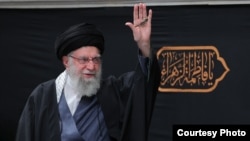
Iranian state media confirmed early on March 1 that Supreme Leader Ayatollah Ali Khamenei had been killed amid US and Israeli air strikes a day earlier, hours after US President Donald Trump reported the death on his social media platform.
A presenter on state TV said that "with the martyrdom of the supreme leader, his path and mission neither will be lost nor will be forgotten [but] will be pursued with greater vigor and zeal."
State media reported that a council made up of President Masud Pezeshkian -- considered by some to be a relative moderate -- hard-line judiciary head Gholamhossein Mohseni-Ejei, and Mohammad Mokhber, a Khamenei adviser and former acting president of Iran, would temporarily assume leadership duties in the face of Khamenei's death.
Following the announcement of the death of the 86-year-old hard-line leader, state media said that 40 days of public mourning would begin in the country and that offices and businesses would be closed for seven days.
The media reports insisted that the authoritarian Khamenei -- who had spent much of his final days out of public view and was rarely seen in public during his decades in power -- was killed in his office and not while hiding in a bunker as some reports said.
State TV did not mention the US and Israeli air strikes when making the announcement at 5 a.m. local time.
Iranian media earlier had not confirmed the leader's death but had reported that Khamenei's daughter, grandchild, son-in-law, and daughter-in-law had been killed in attacks.
Trump Announcement
"Khamenei, one of the most evil people in History, is dead," Trump wrote in a post on Truth Social on February 28 before the ayatollah's death was confirmed by Iranian officials.



"This is not only Justice for the people of Iran, but for all Great Americans, and those people from many Countries throughout the World, that have been killed or mutilated by Khamenei and his gang of bloodthirsty THUGS."
"He was unable to avoid our Intelligence and Highly Sophisticated Tracking Systems and, working closely with Israel, there was not a thing he, or the other leaders that have been killed along with him, could do," Trump added.
Trump later told CBS News that he believed it would be easier to reach a settlement over Iran's nuclear program following Khamenei's death. "Much easier now than it was a day ago, obviously," he said.
Trump had threatened military strikes if Tehran pressed ahead with its nuclear and ballistic-missile programs.
Dictator's Powers
Khamenei's death represents a major blow to the country’s embattled leaders.
Earlier, Iranian officials denied reports of the supreme leader's death. Foreign Ministry spokesman Esmail Baghaei said Khamenei, along with Pezeshkian, was safe and "firmly" in command.
The anti-West Khamenei had held near-dictatorial powers over Iran since becoming the supreme leader in 1989 after the death of the founder of the Islamic republic, Ayatollah Ruhollah Khomeini.
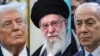
Before Trump's comments, Israeli Prime Minister Benjamin Netanyahu said there were "signs" indicating that Khamenei had been killed in the attacks.
"This morning, we destroyed the compound of the tyrant Khamenei," Netanyahu said in a video statement.

"There are many signs that this tyrant is no longer. This morning, we eliminated senior officials in the ayatollahs' regime, Revolutionary Guards commanders, senior figures in the nuclear program -- and we will continue. In the next few days, we will hit thousands more targets of the terror regime," Netanyahu added.
Iran's Islamic Revolutionary Guards Corps (IRGC) vowed to take revenge against those responsible for his death, pointing to the United States and Israel.
Time Spent In Hiding
Khamenei had mostly been in hiding since the 12-day war against Israel in June, although he spent much of his rule under heavy security, rarely making public appearances.
He had survived several crises during his rule, including student protests in 1999, mass demonstrations over disputed elections in 2009, and further mass protests in 2019 that were followed by a brutal crackdown on demonstrations by the authorities.
In 2022-23 Iran was hit by the Woman, Life, Freedom protests -- which were sparked by the death in custody of a 22-year-old Iranian Kurdish woman who had been arrested for allegedly violating the strict dress code for women.
Next Iranian Leaders?
Even before the death, there had been much speculation on a possible successor to Khamenei, given his advanced age. Some observers say the hard-line IRGC could gain even more power and influence with his departure.
On February 28, Trump was asked by US television news whether the United States believes other members of Iran's leadership were dead following the air strikes.
"A lot of it is."
"The people that make all the decisions, most of them are gone," Trump added, according to NBC.
Iranian state media later confirmed that top Khamenei adviser Ali Shamkhani and IRGC commander Mohammad Pakpor had been killed in the attacks.
Trump said US officials "have a very good idea" of who will fill the positions of power in Tehran but was not more specific.

