




PRISTINA -- Police fired tear gas at protesters outside Kosovo's parliament on the evening of October 5 as a dispute over proposed restrictions on a Hague-based war crimes court became entangled with a last-minute political standoff over electing the country's next president.
Some protesters threw fireworks and glass bottles toward the parliament and the police as demonstrators demanded lawmakers complete passage of legislation that would sharply restrict the jurisdiction of the Kosovo Specialist Chambers.
Six officers were injured and 11 civilians sought medical attention during the protests. Three protesters were taken to a police station for further judicial processing.
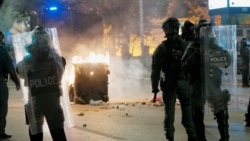
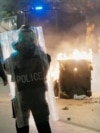

Parliament approved the bill in a first reading earlier on October 5, with all 91 participating lawmakers voting in favor. But a second reading and final vote remained uncertain after the opposition Democratic Party of Kosovo (PDK) tied its support for electing a president to passage of the legislation, while Prime Minister Albin Kurti's ruling Vetevendosje party insisted the president should be elected first.
Kurti and PDK leader Bedri Hamza met on October 5 in an attempt to break the impasse, but no agreement was announced. At around 7 p.m., Vetevendosje lawmakers were seen leaving parliament.
The standoff comes just hours before an October 6 constitutional deadline to elect a president. Failure to do so would trigger parliament's dissolution and fresh parliamentary elections.
Several hundred supporters of the Kosovo Liberation Army (KLA) -- including veterans of the former guerrilla force -- had gathered outside parliament earlier in the day and said they would not leave until the legislation was fully approved.
The PDK proposed the changes following last month's war crimes convictions of four former KLA leaders, including former President Hashim Thaci.

Kurti backed the initiative despite describing the proposed changes as rushed and saying there had been little time to analyze them. He said the appeals process remained the route to challenging the convictions and called for a coordinated national strategy.
The second opposition party, the Democratic League of Kosovo (LDK), which has 18 seats in the 120-seat parliament, said it could not support the initiative. Lawmaker Jehona Lushaku-Sadriu warned that parliamentary approval would not guarantee implementation and that the changes might have no legal effect.
Ramush Haradinaj of the opposition Alliance for the Future of Kosovo (AAK) called for a second reading later the same day. The bill must undergo detailed committee scrutiny before a second reading, although parliamentary rules allow procedural deadlines to be waived under certain conditions.
The proposals would cap prison sentences at 15 years, allow appeals to Kosovo's Supreme Court, require sentences to be served in Kosovo, and make those convicted eligible for presidential pardons.
The bill would also limit the court's jurisdiction to offenses mentioned in a 2011 Parliamentary Assembly of the Council of Europe report, which addressed allegations including postwar organ trafficking. It would also narrow the period covered by the court from January 1998–December 2000 to July 1, 1999–December 2000, excluding the wartime period.
Legal experts warn, however, that parliamentary approval alone would not establish whether the changes could take effect.
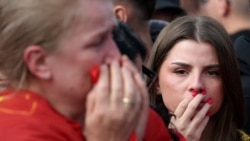
The PDK submitted the bill on September 21, five days after the court sentenced former President Hashim Thaci and former parliamentary speaker Jakup Krasniqi to 25 years in prison each, former parliamentary speaker Kadri Veseli to 18 years, and Rexhep Selimi to 13 years.
All four were convicted of war crimes and acquitted of crimes against humanity. Their defense teams have announced plans to appeal.
PDK leader Bedri Hamza says the initiative aims to strengthen oversight and accountability rather than dismantle the court. Kosovo's government cleared the bill to proceed on October 2.
The dispute over the legislation has complicated an already difficult effort to secure the votes needed to elect a president.
Hamza has said the PDK, which holds 22 seats, is prepared to provide the necessary votes for the presidential process once parliament completes approval of the court legislation. Vetevendosje, by contrast, wants the presidential vote to take place first.
Kurti had met separately with Hamza and LDK leader Lumir Abdixhiku over the weekend in an effort to find a way forward before holding another meeting with Hamza on October 5.

A presidential candidate needs 80 votes in the first two rounds or 61 in a third. At least 80 lawmakers must participate for the election to proceed.
Kurti's Vetevendosje holds 53 seats, while his government was elected with 62 votes. PDK participation could provide the numbers needed to hold the presidential vote.
A first-reading vote would not complete the legislative process; committee scrutiny and a second reading would still follow. Parliament can waive procedural deadlines under certain conditions.
Ehat Miftaraj, director of the Kosovo Law Institute, told RFE/RL in reporting published on September 30 that lawmakers may propose amendments but must respect Kosovo's international commitments.
These include a commitment to consult the European Union on legislative changes affecting the court's mandate or related proceedings and to allow its work to continue until relevant investigations and proceedings are completed.
Visiting Pristina on October 1, European Commission President Ursula von der Leyen said decisions on legislative changes were for Kosovo to make but judicial independence must be guaranteed. She said the court's mandate must be fully respected and stressed the verdict concerned individual responsibility, not Kosovo's resistance.
The US State Department had not responded by publication to RFE/RL's request for comment.
Miftaraj said amendments concerning the court could face review by the Specialist Chamber of the Constitutional Court in The Hague.
The Specialist Chambers told RFE/RL for the September 30 report that they had not been consulted. They declined to comment on political initiatives, saying they remained focused on ensuring fair, impartial, and secure trials.