




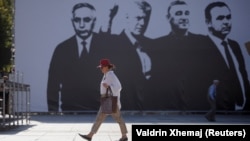
PRISTINA -- An international tribunal is due to deliver a verdict in the war crimes trial of former Kosovo Liberation Army (KLA) commander and later Kosovo President Hashim Thaci in a case that could shape how the country's 1990s war of independence from Serbia is remembered.
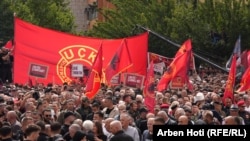
Thaci and three other former senior KLA leaders, Kadri Veseli, Rexhep Selimi, and Jakup Krasniqi, face charges of war crimes and crimes against humanity -- allegations they deny. There have been protests in Pristina in support of the defendants, and the trial has met with widespread criticism in Kosovo, including from political leaders.
"If they, let's suppose, in quotation marks, are found guilty or something, then I am also accused, I am also convicted, and the entire Albanian people are convicted," Nusret Kadriu, a KLA veteran, told RFE/RL's Kosovo Service, referring to Kosovo's ethnic Albanian majority.
Fear And Disappointment
Kadriu runs a car wash in Likoc, where the KLA had its headquarters during the war. Now 45, he had just started working as a young music teacher when he decided to join the KLA.
Despite his concerns, he said he was convinced there could only be an innocent verdict, a view widely shared by ethnic Albanians who spoke to RFE/RL ahead of the verdict.
"Whoever we sit with...when two or three of us get together, and we have a little time, we drink a tea or a coffee, we talk about this matter, and everyone is worried," said Kadri Thaci, a cousin of Hashim Thaci.
In Pristina and other cities, big screens have been erected on main squares with a countdown to the judgement, due at 10 a.m. local time on September 16. Large banners have been put up in support of the suspects.
In Kosovo's ethnic Serb community, expectations are muted. Some told RFE/RL's Kosovo Service that they had once believed the court would bring greater recognition and justice for Serb civilian victims, but not anymore.
Jasmina Zivkovic has been trying to find out what happened to her father for the past 27 years. He is among 1,600 people still missing from the Kosovo war. But her father's disappearance occurred in late September 1999 -- after the period covered by the current indictment (March 1998 to early September 1999).
"Unfortunately…many victims have been excluded from this process" for these reasons, she said.
Zivkovic added that she had lost hope that this week's verdict would bring any change for her and that the trial had focused more on political issues than on the victims.
A Brutal War
The KLA emerged in the mid-1990s, after years of peaceful resistance by Kosovo Albanians to the regime of Slobodan Milosevic.
From small guerrilla groups, it grew into a force fighting against ethnic Serb and Yugoslav troops. Hundreds of thousands of ethnic Albanians were driven from their homes in the conflict, raising the specter of a repeat of the ethnic cleansing practiced in Bosnia-Herzegovina. Some 13,000 people were killed or went missing.

In March 1999, NATO launched air strikes against Yugoslav targets, leading to the withdrawal of Yugoslav and ethnic Serb forces.
A number of Serbs have been convicted for crimes committed in Kosovo at the International Criminal Tribunal for the Former Yugoslavia (ICTY), which also dealt with cases from the 1990s wars in Bosnia and Croatia.
The current trial has been heard at the Kosovo Specialist Chambers in The Hague, a temporary international tribunal set up in 2015 to hear cases related to the 1998-99 conflict under Kosovo law.
Timothy Waters, an international law professor at Indiana University, told RFE/RL he expected responses to the verdict to fall largely along ethnic lines.
"It's fully consistent with everything we know about all the other trials that have occurred in the former Yugoslavia, in the region. They all get read like an ethnic census. You can tell what side people belong to by their reaction to court processes in Croatia, in Serbia, in Bosnia," he said.
The recent funeral of Ratko Mladic in Belgrade, convicted of war crimes in Bosnia including the 1995 Srebrenica massacre, was a perfect illustration of this, Waters said. Thousands of people turned out to say farewell as Mladic was buried with military honors even though he was found responsible for the killing of more than 8,000 Bosniak men and boys.
"That tells you a lot more than anything that's happening in the court," said Waters.
A Joint Criminal Enterprise?
Thaci and the three other defendants have been in pretrial detention since 2020, with the first hearings beginning in 2023.
Prosecutors have described the KLA as a structured organization in which the four defendants held senior leadership roles. Prosecutors alleged that more than 50 KLA detention centers were used to unlawfully detain, abuse, and kill perceived opponents, including Albanians, Serbs, Roma, and others.
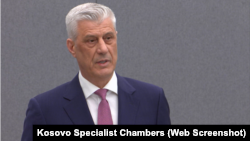
They're seeking 45-year prison sentences for each of the accused.
"The defense is arguing that actually this whole situation was very loosely organized, (that) there was no hierarchy in this movement," Mark Ellis, executive director of the International Bar Association, told RFE/RL.
In other words, the argument runs, Thaci and the others cannot be held responsible for acts committed by other KLA members -- there was not what is known as a joint criminal enterprise.
"The panel is going to have to assess separately each defendant, and whether there was this kind of superior-subordinate relationship that existed, and that the defendant had effective control. That's really critical to this," he said.
"And then to determine whether the defendants knew or had a reason to know that the crimes were being committed and didn't do anything to stop them," he added.
These legal arguments fit uneasily with an ongoing political crisis in Kosovo, which has seen deadlock between rival parties and repeated elections.
Against this backdrop, the ongoing public support for Thaci -- which again brought thousands of people to the streets of Pristina on September 12 -- has even led to calls by some opposition parties for him to be reelected president if he's acquitted.
Speaking on September 14, a day after being reelected prime minister, Albin Kurti said "for us, everything is clear: the people of Kosovo, our resistance, and our war were just and liberating, against an occupier that committed war crimes, crimes against humanity, and genocide."
Speaking to RFE/RL, young people in Kosovo who were not alive at the time of the war often had less strident views on the trial -- but broadly backed the defendants.
"We haven't really had any deep conversations," 22-year-old Pristina student Arjon Lika said. "We would say, ‘Hopefully they will release them, hopefully they will release our heroes.' (But) we haven't really gone very deeply into this topic."
In any case, September 16 will not necessarily mark the end of the proceedings, as the judgement will only be a first-instance ruling -- and parties then have the right to appeal.
Thaci is also facing a separate trial on charges of obstruction of justice.