



The governments of five European countries released a statement on February 14 saying they are confident the Russian opposition politician Aleksei Navalny was poisoned with a lethal toxin not found naturally in Russia -- a poisoning that led to his death in a Russian prison two years ago.
The United Kingdom, Sweden, France, Germany, and the Netherlands made their conclusion based on analyses of samples from Navalny that confirm the presence of epibatidine -- a toxin derived from poison dart frogs in South America -- that is known to cause paralysis and respiratory arrest.
Speaking to RFE/RL on the sidelines of the Munich Security Conference, Dutch Prime Minister Dick Schoof said "there is a high possibility that Russia killed Navalny by poison."
"It's a serious offense," he added. "I hope that it will [show] the world that Russia is playing a dirty game."
In the joint statement, the five capitals note that "Russia claimed that Navalny died of natural causes. But given the toxicity of epibatidine and reported symptoms, poisoning was highly likely the cause of his death. Navalny died while held in prison, meaning Russia had the means, motive, and opportunity to administer this poison to him."
US Secretary of State Marco Rubio, who is on a one-day trip to Slovakia, said the United States has "no reason to question" the report.
Speaking at a press conference with Slovak Prime Minister Robert Fico on February 15, Rubio said the five-country report was "serious" and "troubling."

It also adds that "these latest findings once again underline the need to hold Russia accountable for its repeated violations of the Chemical Weapons Convention and, in this instance, the Biological and Toxin Weapons Convention."
Aleksandr Polupan, an anesthesiologist-resuscitator, told Current Time that it was clear before the verdict of the five European countries that "Navalny had been murdered and that he did not die a natural death."
"All that we know about [Navalny's] abdominal pain, vomiting, and seizures, I don't see any contradictions in [how the poison works]," Polupan said. "Given that independent laboratories confirmed [the presence] of the same molecule, I'd say there's no need to guess much further."
For other experts, however, doubts remain. Ismail Efendiev, a member of the European Association of Poison Control Centers and Clinical Toxicologists, told Current Time that the use of an exotic toxin could not be ruled out "because the symptoms are similar with the effects of Novichok, but we need to identify these cases in a laboratory."
Navalny's Widow Responds
In response to the statement, Navalny's widow, Yulia Navalnaya, tweeted that "I was certain from the first day that my husband had been poisoned, but now there is proof: [Russian President Vladimir] Putin killed Aleksei with a chemical weapon. I am grateful to the European states for the meticulous work they carried out [for] over two years and for uncovering the truth. Vladimir Putin is a murderer. He must be held accountable for all his crimes."
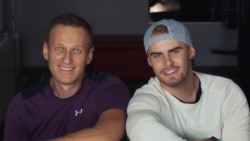

RFE/RL reached out to Navalnaya's press team for further comment but the request was declined.
Navalnaya has always rejected the official Russian autopsy report that stated that hypertension and other diseases caused a heartbeat disorder that led to Navalny's demise and was instrumental in getting biological samples smuggled out from Russia to other European countries.
Roman Dobrokhotov, founder and editor in chief of The Insider, an independent Russian media outlet specializing in investigative journalism, said he believes the Kremlin was "confident that no bio samples will ever be smuggled abroad to be examined. And should samples get abroad, [the Kremlin's] hope was that there will not be a laboratory competent enough to identify this poison."
"We were lucky indeed to find laboratories and experienced scientists so the substance can be found," Dobrokhotov said.

Navalny was a longtime anti-corruption fighter and Russia's most prominent opposition politician for over a decade. At the time of his death in a prison north of the Arctic Circle, Navalny was serving a 19-year sentence on an extremism conviction that he and his supporters say was politically motivated and revenge for his anti-Kremlin activism.
He had been behind bars since January 2021, when he was arrested upon returning to Russia after recovering in Germany from a poisoning with a form of the nerve-agent Novichok that he said was a state-sponsored assassination attempt carried out by Russian security agents and approved by Putin.
RFE/RL's Russian Service unearthed a Russian scientific paper from 2013 that describes a method for creating synthesized epibatidine. Three of the paper's five authors worked at the State Scientific Research Institute of Organic Chemistry and Technology, which was involved in developing Novichok in the 1970s.
The United States and European Union imposed sanctions on the institute in the wake of Navalny's poisoning in 2020. Ukraine and Canada followed suit in 2023, citing the institute supplies of technology to the Russian military.
Asked to comment on the finding about Navalny's death, Ukrainian President Volodymyr Zelenskyy said he "cannot think about Vladimir Putin and his toxic ambitions.... I have no time for this."
"[Russia attacks] us with 100 drones and missiles. What is the difference between poison and missiles? I don’t see the difference," Zelenskyy said on the sidelines of the Munich Security Conference.