




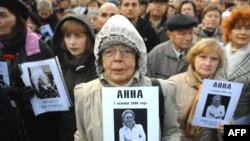
Two decades after the murder of Anna Politkovskaya, a tenacious investigative reporter who exposed the brutality of Russia's war in Chechnya and documented how President Vladimir Putin curtailed democracy in Russia, her daughter, Vera, says little has changed in the country's political climate.
People told her, “You’re exaggerating. You see everything through a dark lens,” she told RFE/RL's Russian Service in an interview ahead of the 20th anniversary of Politkovskaya's brutal killing on October 7, 2006. "And now it’s the same thing, except that the divide has deepened so much. Everything has become so stark, even compared with what she predicted more than 20 years ago".
Politkovskaya, who worked for the independent newspaper Novaya Gazeta, was gunned down in her Moscow apartment. The shooting occurred on President Vladimir Putin's birthday, prompting speculation that it was meant as a "gift" to the president.

Former Russian police officer Sergei Khadzhikurbanov -- who denied the charges -- was sentenced to 20 years in prison for his role in organizing the assassination but received a pardon from Putin in 2023 after taking part in Moscow's ongoing full-scale invasion of Ukraine.
Two natives of Russia's North Caucasus region of Chechnya, Rustam Makhmudov and Lom-Ali Gaitukayev, were subsequently handed life sentences after a jury found Makhmudov guilty of shooting Politkovskaya, while Gaitukayev was convicted of organizing the assassination. Gaitukayev later died in prison.
Another defendant in the case, former Moscow police officer Denis Pavlyuchenkov, was sentenced to 11 years in prison after he confessed to organizing the surveillance of Politkovskaya before she was murdered.
Six Novaya Gazeta journalists and contributors -- Igor Domnikov (2000), Yury Shchekochikhin (2003), Politkovskaya (2006), Anastasia Baburova (2009), Stanislav Markelov (2009), and Natalya Estimirova (2009) -- have been killed in attacks that the newspaper and human rights activists say were retribution for their work.

Since Politkovskaya's death, Russian authorities have gradually expanded the legal toolbox used to punish dissent, censor independent media, shutter civil society groups, and silence opposition lawmakers.
This includes measures such as the "foreign agent" law, which punishes individuals and groups that receive foreign funding, and the "undesirables" law, which bans foreign organizations deemed a threat to national security and criminalizes people who work for, associate with, or donate money to such organizations.
Such moves are exactly what her mother's reporting was aimed at exposing, said Vera Politkovskaya, who now lives abroad at an undisclosed location.
"Essentially, the main theme of my mother's work was telling the stories of ordinary people," she said. "And how that everyday person was run over by the political and military system...That's what my mom witnessed and talked about back then. She saw, so to speak, further ahead than many other people did. And people didn't believe her."

Anna Politkovskaya was born in New York in 1958, the daughter of a Soviet diplomat from Ukraine.
She was won numerous Russian and international awards, including an Amnesty International Global Award for Human Rights Journalism in 2001, a PEN Freedom to Write award in 2002, and an Olaf Palme Prize in 2004.
In 2007, she became the first person ever to receive a posthumous UNESCO/Guillermo Cano World Press Freedom Prize.

