





Photojournalist Anatolii Stepanov was working in Druzhkivka, a town in eastern Ukraine, on June 22 when a first-person view (FPV) drone buzzed directly overhead and slammed into an apartment. The residence was engulfed in flames.
“A guy living next door went out onto his balcony and just watched the apartment burn,” Stepanov told RFE/RL. “I asked whether he was leaving. He responded by saying: ‘Where would I go? What would I do there?’”
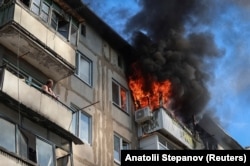
The apartment drone strike is one of several incidents captured by Stepanov in recent days that highlight increasingly impossible conditions for residents of Druzhkivka. The town lies some 15 kilometers from the front lines, near the city of Kostyantynivka which Russia is currently attempting to surround.
In March this year, Ukrainian President Ukrainian President Volodymyr Zelenskyy made a short video address standing in the center of Druzhkivka. The daylight selfie video was viewed as risky at the time. Today, it might be unthinkable.
"Here, civilians are exposed every day to the risk of death," Stepanov said.
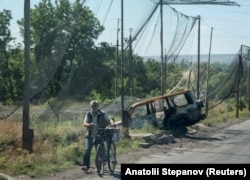
On the same day the photographer witnessed the FPV drone apartment strike, he passed a car that had run off the road and had most of its windows broken. Inside, lay the bodies of a man and woman.
“These people were driving down the street in the morning [of June 22] when a drone struck the passenger side of the vehicle. It was a husband and wife. They died on the spot,” Stepanov said. “They had white ribbons tied to the car. Some people think this will protect them from attack, but it didn’t save them.”
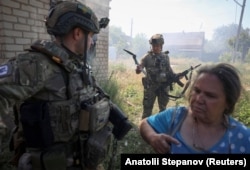
Stepanov, a freelance photographer who was on assignment in Druzhkivka with Reuters, was embedded with the White Angels. The Ukrainian police unit is tasked with evacuating civilians from frontline areas, including children, who are subject to mandatory evacuations in some extreme-risk areas near the fighting.
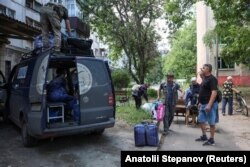
The evacuation missions do not always go to plan, Stepanov said. When the police team reached one elderly couple on June 22, the pair claimed it was a mistake, the photojournalist recalled. “Someone had requested evacuation on their behalf but they wanted to stay, so they stayed.”
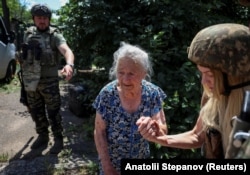
According to veteran aid worker Yevhen Tkachov, those who remain in frontline towns amid creeping Russian encroachment can be widely categorized as either people harboring pro-Kremlin sentiments who are awaiting the arrival of Russian forces, or those simply unwilling to part with homes they have spent their lives building up.
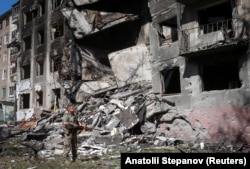
In settlements near the front, there is no respite from attacks even during the short summer nights, Stepanov said. In Kramatorsk, some 15 kilometers from Druzhkivka, the photographer described how, "at night you get woken up because something exploded near your window. You hear drones flying overhead even after dark."
Despite this, Stepanov said, some semblance of normality can still be seen in Kramatorsk, where "people are still in the streets, people even trade in the market and buy things in shops."
One resident of Druzhkivka who was evacuated on June 22 told Stepanov that the threat of FPV quadcopters as well as the far more destructive Shahed drones had made it too frightening to continue living in the town. But the woman insisted she planned to return.
"I don't want to stay in a foreign land," she said, adding, "the war will end and I will come home."

