




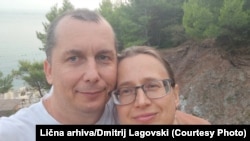
Six months after Russia launched the full-scale invasion of Ukraine, where Dmitry Lagovsky and his wife were born, they left their life in the Moscow suburbs and moved to Serbia with their two children. Fighting was not an option, he said, so they chose flight.
"Our friends are there, my wife's parents," Lagovsky told RFE/RL's Balkan Service in a recent interview. "It would be a disaster if I went to war against Ukraine."
But that's exactly what he fears will happen if he is sent back to Russia, and the nightmare now threatens to become reality: On December 3, the Court of Appeal in Belgrade upheld a High Court ruling that paves the way for his extradition.
The case will be forwarded to the Justice Ministry, whose decision is final and cannot be appealed, Lagovsky's lawyer, Marko Stambuk, told RFE/RL. He suggested past precedent was not encouraging.
"In practice, it very rarely happens that the minister of justice refuses to extradite a person for whom the courts have determined that the prerequisites for that have been met," Stambuk said.

A lawyer himself in Russia, Lagovsky, 49, did not speak Serbian when his family made the move. He took a job as a bus driver in the Belgrade public transportation system.
Lagovsky faced no criminal proceedings in Russia before leaving the country in August 2022. The extradition request is based on a case that was initiated later, in which Russian authorities say he is suspected of fraud.
'I Am Not A Criminal'
He said the case stemmed from a 2021 deal in which, as a lawyer, he drew up a contract on the purchase and sale of land between two companies.
"One company sold another piece of land, but I was neither an employee nor an owner in any of them. I was a lawyer and as a lawyer I drew up a contract between those two companies," Lagovsky said.
"I am not a criminal and I have never been one," he said.
In April 2025, Lagovsky was summoned to report to the High Court in Belgrade, where he was given a document stating he was wanted by Russia. The court ordered him detained for 21 days, and he was released at the end of that period.

If he is extradited, Lagovsky should be tried in Russia, but he fears the state will send him to the front instead. "I have the rank of captain in the army. I think they want to send me to Ukraine," he said.
Two days after the appeals court decision, Lagovsky informed Serbia's Internal Affairs Ministry of his intention to apply for asylum. Under Serbian and international law, the government is obliged "to adequately investigate whether he is really in such danger before possible extradition," Stambuk said.
No Reply
RFE/RL contacted the Justice Ministry by e-mail to ask whether the minister would take all the circumstances of the case into account when making a decision. No reply has been received.
Estimates of the number of Russians who have left the country since the start of the full-scale invasion of Ukraine range up to 1 million and higher. Some have returned, but hundreds of thousands remain abroad.
More than 53,000 of the roughly 100,000 foreigners legally residing in Serbia are Russians, according to the government. Serbia is not a European Union member, and Russians do not need visas to travel there.
Several Russians who have opposed the war against Ukraine or say they fled as a result of the invasion have been denied entry or permanent residency in Serbia, with the state providing little by way of explanation in some cases.
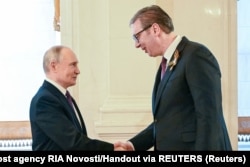
Serbian President Aleksandar Vucic has maintained good relations with Russian President Vladimir Putin, and Belgrade has resisted EU pressure to join Western sanctions to punish the Kremlin for the war.