




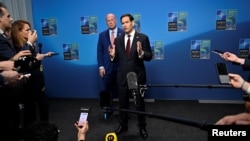
US Secretary of State Marco Rubio said there has been "slight progress" in Pakistan-mediated talks to end the Iran war, while warning against what he described as Tehran's attempt to establish a tolling system in the Strait of Hormuz, which he said no country should accept.
Speaking to reporters on May 22 in Helsingborg, Sweden, where he was attending the second day of a NATO foreign ministers' meeting, Rubio said discussions mediated by Pakistan had shown limited but positive movement.
"There has been some slight progress," he said. "I don't want to exaggerate it, but there's been a little bit of movement, and that's good."

His comments came as Pakistan’s powerful army chief, Asim Munir, traveled to Tehran, according to media reports in Pakistan and Iran. The Iranian state-run IRNA news agency and Pakistan's Dawn newspaper both reported that Munir was expected to hold talks with senior Iranian officials.
Munir’s trip -- his second to Tehran since a cease-fire between the United States and Iran went into effect on April 8 -- has raised hopes that the United States and Iran are close to agreeing a draft peace agreement.
'Tolling System'
Rubio also criticized Iran's reported move to introduce a tolling system for the strategically vital Strait of Hormuz.
"Iran is trying to create a tolling system. They're trying to convince Oman, by the way, to join them in this tolling system in an international waterway," he said. "There is not a country in the world that should accept that."

Earlier, Rubio told reporters that a diplomatic agreement would be “unfeasible” if Tehran continued pursuing the implementation of a tolling system in the Strait of Hormuz, which accounted for some 20 percent of global oil and gas supplies before the war.
US President Donald Trump also rejected any type of toll on Hormuz traffic. "We want it open. We want it free. We don't want tolls," he told reporters at the White House on May 21. "It's an international waterway."
The Council of the European Union, calling Iran’s actions against vessels transiting through the Strait of Hormuz a violation of international law, has decided to impose restrictions on individuals and entities involved in these “actions and policies” by the Iranian authorities.
“Such actions infringe upon established rights of both transit and innocent passage through international straits,” the council said in a press release on May 22.
In an X post on the same day, the EU Council said that from now on the bloc "will be able to sanction individuals and entities threatening freedom of navigation in the Middle East.”

