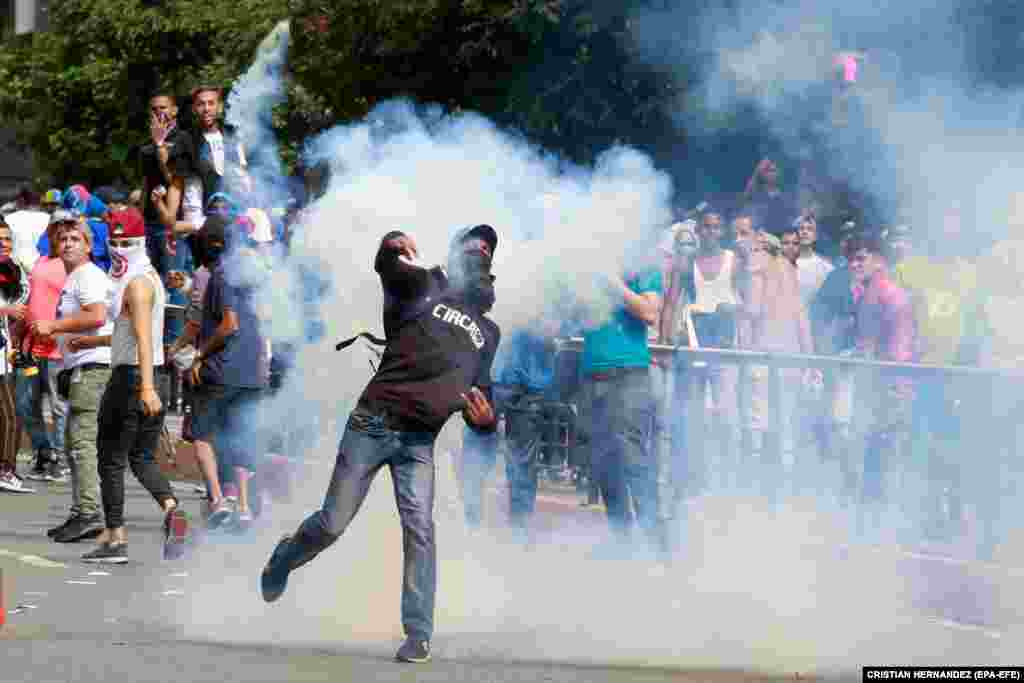
WATCH: Venezuelan Police Fire Tear Gas At Antigovernment Protesters
U.S. President Donald Trump has said he recognizes Venezuelan opposition leader Juan Guaido as interim president, leading the South American country to break off diplomatic relations with bitter rival Washington.
Guaido, the president of the opposition-led National Assembly, earlier on January 23 declared himself acting president in Caracas, as tens of thousands of people marched across the country against socialist President Nicolas Maduro.
Canada, Brazil, Argentina, and Colombia were among regional countries offering support for Guaido, while European Union Council President Donald Tusk tweeted that "I hope all of Europe will united in support of democratic forces in Venezuela."
"Unlike Maduro, the parliamentary assembly, including Juan Guaido have a democratic mandate from Venezuelan citizens," Tusk wrote.
French President Emmanuel Macron also voiced support for the anti-Maduro protesters.
"Following the illegitimate election of Nicolas Maduro in May 2018, Europe supports the restoration of democracy," Macron wrote on Twitter in both French and Spanish.
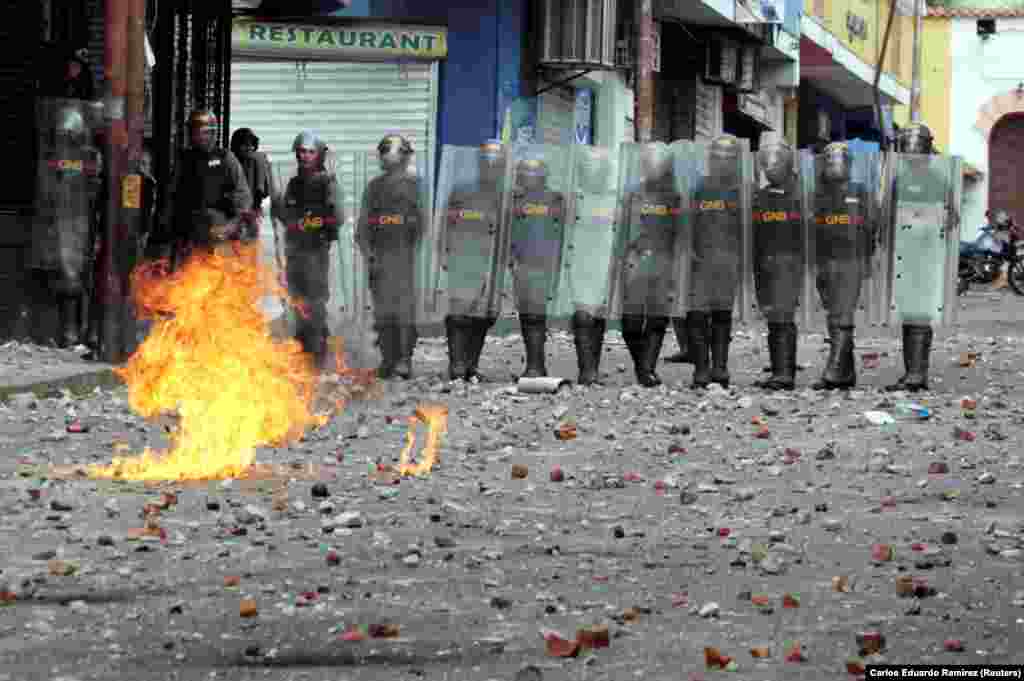
Venezuela In Crisis As Opposition Leader Declares Himself Acting President
1/15A police officer fires rubber bullets during a protest against the government of Venezuelan President Nicolas Maduro in Caracas on January 23. Maduro was sworn in early in January following his reelection in a poll considered fraudulent by much of the international community.
Venezuelan opposition leader Juan Guaido declared himself interim president on January 23 as tens of thousands of people demonstrated against socialist President Nicolas Maduro. Some of the nationwide protests have turned violent, reportedly leaving at least four people dead. With Venezuela in the midst of economic collapse, Maduro was reelected last year in a vote labeled illegitimate at home and abroad.
Show moreShow less
2/15Members of the national police force clash with protesters during an antigovernment demonstration in Caracas on January 23.
Venezuelan opposition leader Juan Guaido declared himself interim president on January 23 as tens of thousands of people demonstrated against socialist President Nicolas Maduro. Some of the nationwide protests have turned violent, reportedly leaving at least four people dead. With Venezuela in the midst of economic collapse, Maduro was reelected last year in a vote labeled illegitimate at home and abroad.
Show moreShow less
3/15Juan Guaido, the head of Venezuela's National Assembly, declares himself the country's acting president during the mass protests on January 23. U.S. President Donald Trump said he recognized Guaido as interim president, prompting Maduro's government to break off diplomatic ties with Washington.
Venezuelan opposition leader Juan Guaido declared himself interim president on January 23 as tens of thousands of people demonstrated against socialist President Nicolas Maduro. Some of the nationwide protests have turned violent, reportedly leaving at least four people dead. With Venezuela in the midst of economic collapse, Maduro was reelected last year in a vote labeled illegitimate at home and abroad.
Show moreShow less
4/15Antigovernment protesters hold up their hands as Guaido took an oath swearing himself in as acting president.
Venezuelan opposition leader Juan Guaido declared himself interim president on January 23 as tens of thousands of people demonstrated against socialist President Nicolas Maduro. Some of the nationwide protests have turned violent, reportedly leaving at least four people dead. With Venezuela in the midst of economic collapse, Maduro was reelected last year in a vote labeled illegitimate at home and abroad.
Show moreShow less
5/15Protesters face off with police in Caracas. At least four people were reported to have died in overnight clashes before the nationwide protests.
Venezuelan opposition leader Juan Guaido declared himself interim president on January 23 as tens of thousands of people demonstrated against socialist President Nicolas Maduro. Some of the nationwide protests have turned violent, reportedly leaving at least four people dead. With Venezuela in the midst of economic collapse, Maduro was reelected last year in a vote labeled illegitimate at home and abroad.
Show moreShow less
6/15Paramedics rescue a wounded member of the national guard during clashes with opposition demonstrators. The January 23 protests took place on the anniversary of the 1958 uprising that overthrew Venezuela's military dictatorship.
Venezuelan opposition leader Juan Guaido declared himself interim president on January 23 as tens of thousands of people demonstrated against socialist President Nicolas Maduro. Some of the nationwide protests have turned violent, reportedly leaving at least four people dead. With Venezuela in the midst of economic collapse, Maduro was reelected last year in a vote labeled illegitimate at home and abroad.
Show moreShow less
7/15Security forces hold their position during protests in Tachira, western Venezuela.
Venezuelan opposition leader Juan Guaido declared himself interim president on January 23 as tens of thousands of people demonstrated against socialist President Nicolas Maduro. Some of the nationwide protests have turned violent, reportedly leaving at least four people dead. With Venezuela in the midst of economic collapse, Maduro was reelected last year in a vote labeled illegitimate at home and abroad.
Show moreShow less
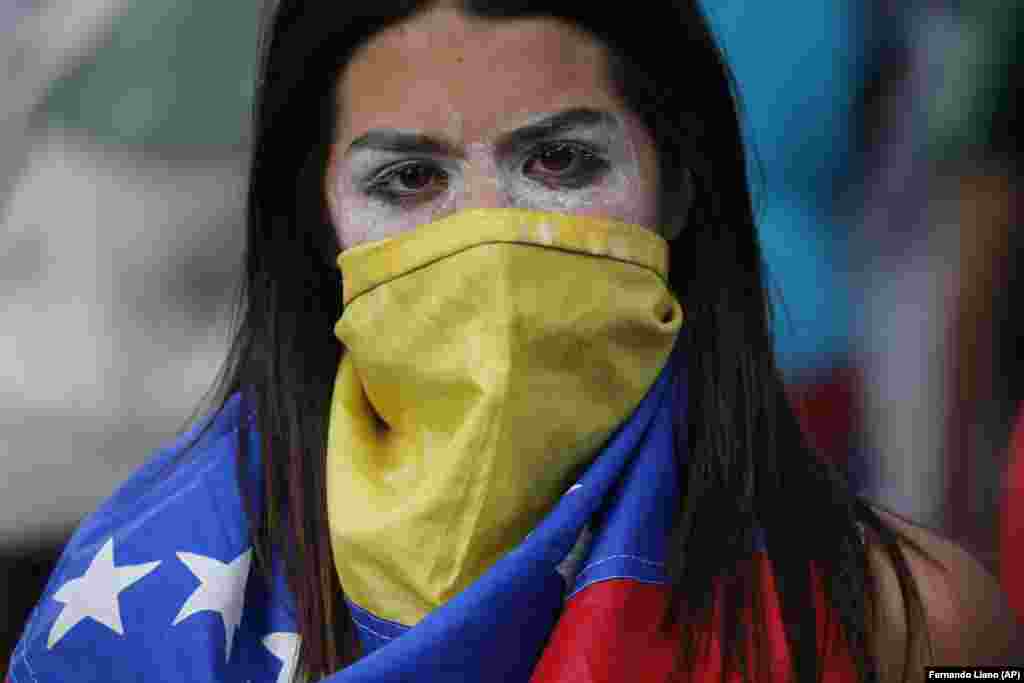
8/15An antigovernment uses toothpaste around her eyes to help lessen the effects of tear gas.
Venezuelan opposition leader Juan Guaido declared himself interim president on January 23 as tens of thousands of people demonstrated against socialist President Nicolas Maduro. Some of the nationwide protests have turned violent, reportedly leaving at least four people dead. With Venezuela in the midst of economic collapse, Maduro was reelected last year in a vote labeled illegitimate at home and abroad.
Show moreShow less
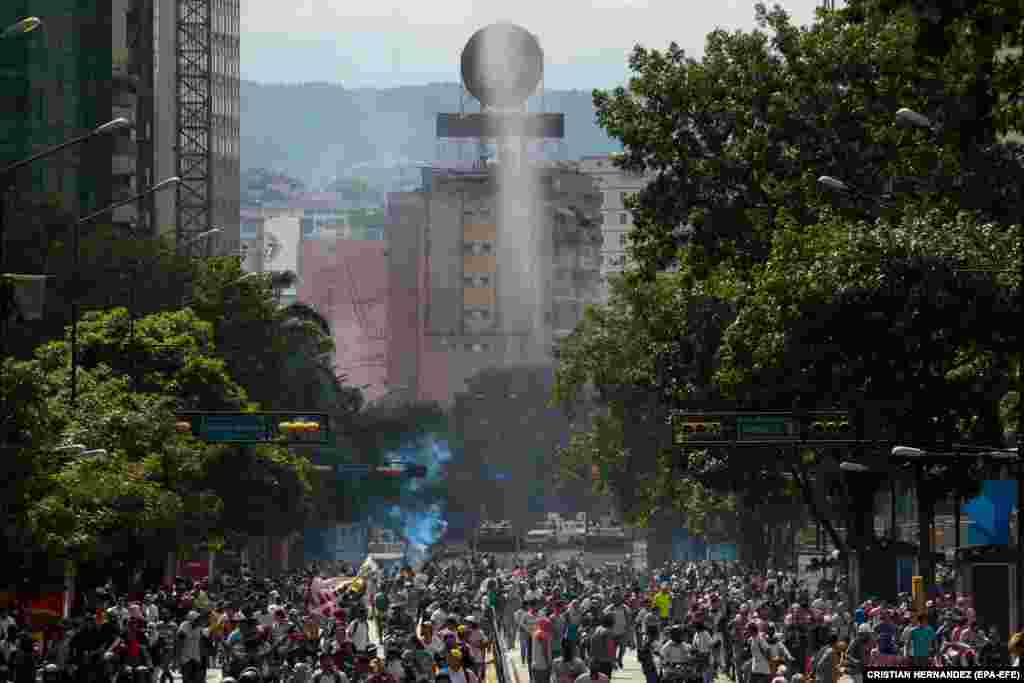
9/15Demonstrators take to the streets of Caracas after members of the opposition called for people to ignore the legitimacy of Maduro's second term. Along with charges of election fraud, Maduro has been criticized for his handling of Venezuela's collapsing economy and for alleged human rights abuses.
Venezuelan opposition leader Juan Guaido declared himself interim president on January 23 as tens of thousands of people demonstrated against socialist President Nicolas Maduro. Some of the nationwide protests have turned violent, reportedly leaving at least four people dead. With Venezuela in the midst of economic collapse, Maduro was reelected last year in a vote labeled illegitimate at home and abroad.
Show moreShow less
10/15An officer takes his position as thousands demonstrate in Caracas.
Venezuelan opposition leader Juan Guaido declared himself interim president on January 23 as tens of thousands of people demonstrated against socialist President Nicolas Maduro. Some of the nationwide protests have turned violent, reportedly leaving at least four people dead. With Venezuela in the midst of economic collapse, Maduro was reelected last year in a vote labeled illegitimate at home and abroad.
Show moreShow less
11/15A supporter of President Nicolas Maduro's government wears a button depicting Argentine-born revolutionary leader Che Guevara while taking part in a counterprotest.
Venezuelan opposition leader Juan Guaido declared himself interim president on January 23 as tens of thousands of people demonstrated against socialist President Nicolas Maduro. Some of the nationwide protests have turned violent, reportedly leaving at least four people dead. With Venezuela in the midst of economic collapse, Maduro was reelected last year in a vote labeled illegitimate at home and abroad.
Show moreShow less
12/15Opposition demonstrators chant slogans in Caracas.
Venezuelan opposition leader Juan Guaido declared himself interim president on January 23 as tens of thousands of people demonstrated against socialist President Nicolas Maduro. Some of the nationwide protests have turned violent, reportedly leaving at least four people dead. With Venezuela in the midst of economic collapse, Maduro was reelected last year in a vote labeled illegitimate at home and abroad.
Show moreShow less
13/15A confrontation in Caracas
Venezuelan opposition leader Juan Guaido declared himself interim president on January 23 as tens of thousands of people demonstrated against socialist President Nicolas Maduro. Some of the nationwide protests have turned violent, reportedly leaving at least four people dead. With Venezuela in the midst of economic collapse, Maduro was reelected last year in a vote labeled illegitimate at home and abroad.
Show moreShow less
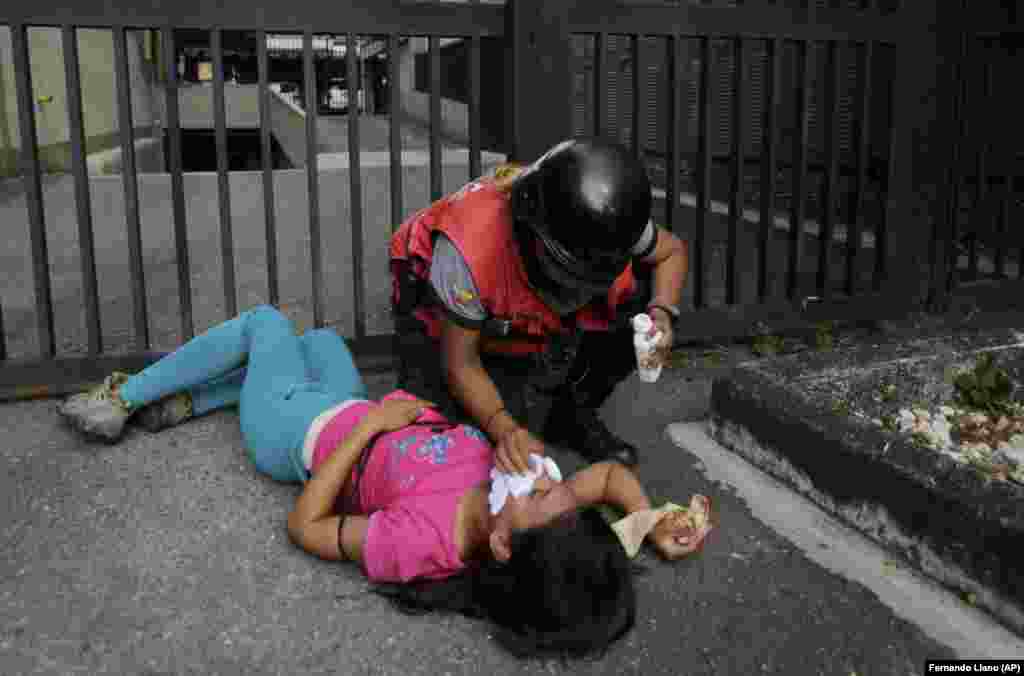
14/15A paramedic helps a protester suffering from the effects of tear gas.
Venezuelan opposition leader Juan Guaido declared himself interim president on January 23 as tens of thousands of people demonstrated against socialist President Nicolas Maduro. Some of the nationwide protests have turned violent, reportedly leaving at least four people dead. With Venezuela in the midst of economic collapse, Maduro was reelected last year in a vote labeled illegitimate at home and abroad.
Show moreShow less
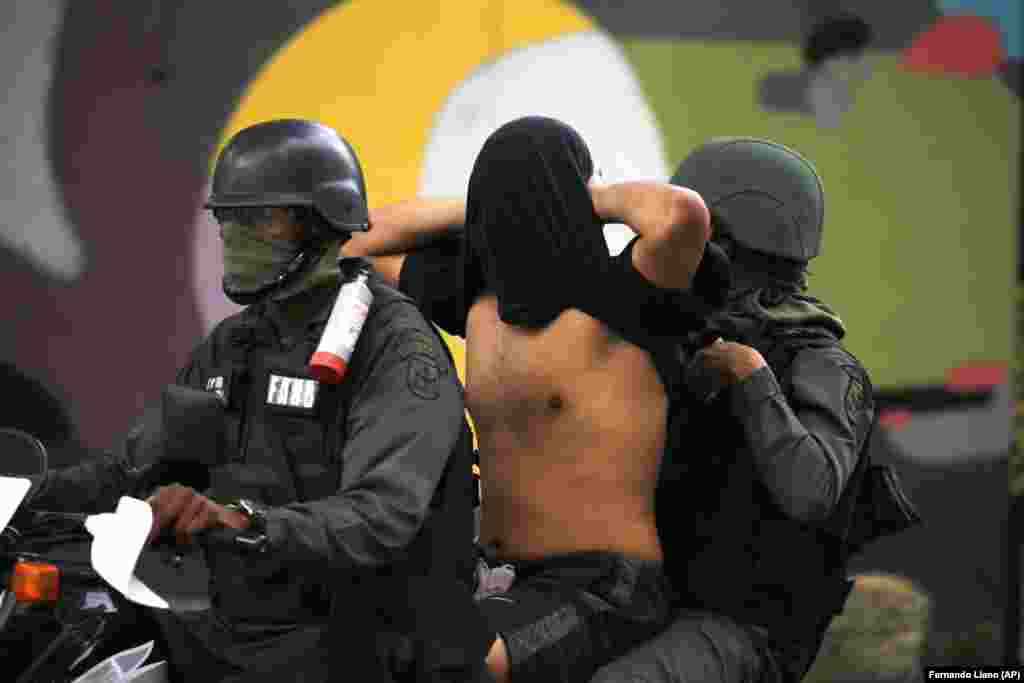
15/15Troops detain an antiovernment protester.
Venezuelan opposition leader Juan Guaido declared himself interim president on January 23 as tens of thousands of people demonstrated against socialist President Nicolas Maduro. Some of the nationwide protests have turned violent, reportedly leaving at least four people dead. With Venezuela in the midst of economic collapse, Maduro was reelected last year in a vote labeled illegitimate at home and abroad.
Show moreShow less
Previous slide
Next slide
Meanwhile, Russia has dismissed Gaiudo's announcement and criticized the U.S. position on the crisis.
Kremlin spokesman Dmitry Peskov said Gauido's announcement was an "attempt to usurp power" that violated international law. He also said the Kremlin was concerned about statements "from foreign nations," ''which do not rule out foreign intervention."
Vyacheslav Volodin, the speaker of Russia's lower house of parliament was quoted by Interfax news agency as saying that the move was "illegal," while the Foreign Ministry in Moscow said U.S. actions in Venezuela reveal the West's true attitude toward international law.
"The developments in Venezuela show very well how progressive Western society really treats international law, sovereignty, and noninterference into internal affairs of other states," spokeswoman Maria Zakharova said.
Russia has had close relations with Venezuela under Maduro and recently sent two nuclear-capable strategic bombers to the country to participate in military maneuvers in an unusual display of Russian military force in South America. Venezuela has also purchased millions of dollars in military equipment from Russia in recent years.
WATCH: Opposition supporters clashed with the police in Venezuela's capital, Caracas, after parliament speaker Juan Guaido declared himself acting president in a January 23 rally.
Venezuela's defense minister, Vladimir Padrino Lopez, in a Twitter statement indicated that the country's armed forces would not recognize Guaido, or any other "self-proclaimed" person, as president.
"Soldiers of the Motherland do not recognize the president imposed on us under the influence of foreign interests and self-proclaimed unlawfully. The Armed Forces are defending the Constitution and are guarantors of national sovereignty," he wrote, raising fears of further violence.
Images from the protests in the capital showed some demonstrators facing off against National Guard security forces, tear gas being dispersed, and vehicles on fire. A rally the night before reportedly left four people dead.
Some counterdemonstrations were also being held in support of Maduro, who was reelected last year in a vote labeled as illegitimate at home and abroad.
He was sworn in for a second term two weeks ago but has been met by international condemnation.
In response to Trump's recognition of the opposition leader, Maduro gave all U.S. diplomatic staff in the country 72 hours to leave and said he was breaking diplomatic ties with Washington.
However, U.S. Secretary of State Mike Pompeo said Maduro no longer had the authority to break diplomatic relations and that Washington would continue to conduct business with Guaido's interim government.
Maduro, who took office in 2013 after the death of Hugo Chavez, has been criticized for alleged human rights abuses and for his handling of Venezuela's economy.
An estimated 3 million people have fled the country amid shortages of items like medicine and food.
With reporting by the BBC, AP, Reuters, Interfax, and AFP
RFE/RL journalists report the news in 24 languages in 18 countries where a free press is banned by the government or not fully established. We provide what many people cannot get locally: uncensored news, responsible discussion, and open debate.