




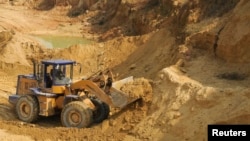
WASHINGTON -- When US President Donald Trump and Chinese leader Xi Jinping met in Washington last month, they failed to make headway on one of the most contentious issues in the bilateral relationship: Beijing’s sweeping critical minerals export restrictions that have roiled Pentagon and commercial supply chains alike.
Trump and Xi agreed to extend a trade truce -- set to expire on November 10 -- by two months. But the extension doesn’t address Washington’s core concerns about inadequate minerals exports from China.
During testimony in July before the Senate Finance Committee, US Trade Representative Jamieson Greer said that China’s mineral exports are “not as much as we would want. It’s not at the pace we would want.”

China dominates global production and refining of critical minerals and rare earth permanent magnets, which retain their magnetic properties indefinitely without the need for external power. Rare earth permanent magnets are essential for the functionality of everything from electrical vehicle motors and wind turbines to fighter jets and missile guidance systems.
The International Energy Agency (IEA), an autonomous intergovernmental organization based in Paris, estimates that China is the top refiner for 19 out of 20 key strategic minerals, with an average market share of 70 percent.
China has an even tighter grip on permanent magnets with a 94 percent global market share, according to the IEA.
Beijing has weaponized its critical minerals dominance to counter US sanctions on its semiconductor sector and the Trump administration’s tariffs. It has calibrated the export controls to inflict maximum pressure on Pentagon supply chains while avoiding large-scale disruption to consumer industries, which would risk escalation with Washington that China’s ruling Communist Party (CCP) does not want.
Overall, China exported 512 metric tons of rare-earth permanent magnets to the US in August, down 21 percent from July and 13 percent from a year earlier, according to Chinese customs data.
Heading into the summit, Xi sought to leverage China’s strategic metals dominance to secure a lasting trade truce with the United States, says Tomasz Nadrowski, portfolio manager at the New York-based Amvest Terraden Critical Minerals Fund.
“China has this spigot that it can turn on and off -- which determines the flow of critical minerals to the US and other countries,” he told RFE/RL in an interview.
“Extending the trade truce two years would have given this tool additional value,” further locking in US dependency on China’s critical mineral supply chains.
The Trump administration was concerned that with a two-year truce, “everyone [both commercial and defense manufacturers] would relax and think, 'We don’t need to build any new capacity,” he says.
“The US cannot afford to accept strategic chokepoint dependencies for inputs that are essential to our defense industrial base and foundational industries like automotive,” Mahnaz Khan, vice president of policy for critical supply chains at the Silverado Policy Accelerator in Washington, said in an interview.
The two-month truce agreed to by Trump and Xi “buys the United States time, but it doesn’t eliminate the underlying vulnerability,” she said
Partnering With Central Asia
As it works to reduce critical minerals dependence on China, the Trump administration has cast a wide net. In an August fact sheet, the White House said it has signed or approved more than 160 mineral deals since January 2025, totaling about $40 billion.
While the administration prioritizes domestic minerals production, in some cases, overseas projects are more feasible. This holds true for tungsten, which the United States has not produced at home since 2015. Tungsten is a crucial input for military-grade steel, aerospace components, munitions, and ground vehicle armor. Given its high density, the metal is used for stabilization and control in missiles and aircraft.
Tungsten’s importance for defense led the Trump administration to throw its support behind a $1.1 billion project in Kazakhstan. Under an agreement signed in November 2025 between US-based Cove Capital (now known as the Cove Kaz Capital Group) and the state-run Kazakh mining company Tau-Ken Samruk, the two parties will jointly develop one of the world’s largest tungsten resources.
“Kazakhstan made a conscious political choice to make an award to a US company, though rumor has it that China was also bidding for the same project,” Akbota Karibayeva Meyer, a research fellow at the Caspian Policy Center in Washington, told RFE/RL. The decision exemplifies Kazakhstan’s multi-vector foreign policy, which aims to preserve strategic autonomy by balancing ties with major powers, she explains.

Drilling, feasibility studies, and site preparation began after the agreement’s formal closing. Yet full commercial production is several years away.
“Are these projects in Kazakhstan viable? Sure, they’re viable. The economics are very hard to pencil out without a subsidy, though,” Ian Lange, a professor at the Colorado School of Mines and deputy director of its Critical Materials Innovation Hub, said in an interview.
“Ideally, I might want to do something [in terms of a mining investment] that limits the government’s expenditure and provides for some competition,” he says.
The Trump administration is also working with Uzbekistan to source critical minerals.
In February, the US commodities firm Traxys signed a $1 billion deal with the Uzbek government focused on the exploration and extraction of tungsten, molybdenum, and copper. This agreement aligns with a separate critical minerals pact reached between the US International Development Finance Corporation (DFC) and Uzbekistan.
Elsewhere in Central Asia, the potential for cooperation with the US exists. Kyrgyzstan and Tajikistan both have major reserves of antimony, a critical mineral used as a flame retardant, an alloying agent for lead, and a compound in semiconductors.
During a September visit to Bishkek, US Special Envoy for South and Central Asia Sergio Gor and US Senator Steve Daines, chairman of the Senate Central Asia Caucus, discussed mining cooperation with Kyrgyz officials.
During their trip, they also met with the presidents of Kazakhstan, Uzbekistan and Tajikstan.
While the US continues to make progress sourcing critical minerals from Central Asia, “it is important to recognize the limiting factor of geography,” Karibayeva Meyer says.
Given its proximity to Central Asia, “it is much easier for China to be involved in the region.”
Short And Long-Term Challenges
In the short term, the US faces a key hurdle in its critical minerals diversification push: from January 1, 2027, the Pentagon will prohibit the use of certain metals sourced from the “foreign adversary countries” of China, Russia, North Korea, and Iran.
The ban, outlined in Executive Order 14415, sharply narrows the possibility of receiving waivers for the use of rare-earth magnets, tungsten, tantalum, and molybdenum from those four nations. Defense firms can no longer be granted a waiver based on cost or convenience reasons. To receive one, they must show that compliant materials are completely unavailable despite exhaustive efforts to source them.
The Aerospace Industries Association (AIA), a Washington-based trade association, said in a recent report that some of its member companies expect to achieve compliance for certain applications by January 1. Others may need until 2028 or later, given the paucity of compliant aerospace-grade material for several covered materials.
AIA recommends that the Trump administration align compliance requirements with supply chain readiness and preserve flexible waiver authorities.
Lange of the Colorado School of Mines says that the administration may offer defense firms some additional leeway.
In the longer term, analysts say that the United States must focus greater effort on critical minerals processing. Decades of outsourcing production to China have resulted in high regulatory costs, a shortage of specialized metallurgical expertise and a dearth of commercial-scale downstream facilities.
“I do see processing as the top, most enduring impediment to large-scale diversification away from China,” Cory Combs, head of critical mineral and supply chain research at the consultancy Trivium China, told RFE/RL.
“Mining is generally much less technologically complex. Processing is where the most critical know-how bottlenecks lie. China's own experience, with decades spent building its processing capabilities, reflects the challenge,” he says.
He further notes that the US lacks strong demand signals in the parts of the production chain between processed minerals and end uses, which limits the scale of offtake agreements necessary to properly fund processing expansions.

Given long project lead times, permitting bottlenecks and capital constraints, analysts expect that Washington will need more than a decade to develop a midstream critical minerals supply chain not dependent on China.
In the meantime, Beijing will aim to exploit that continued dependency to deter the US from imposing further curbs on its development of advanced technologies integral to semiconductors and artificial intelligence.
So far, it has been successful.
Earlier this year, the Trump administration delayed adding more than 100 Chinese firms to the Commerce Department Entity List -- a trade and export blacklist -- because of concern over how Beijing might further throttle rare earth shipments.
China’s continuing dominance of critical minerals could also constrain Washington’s ability to intervene in a Taiwan Strait crisis.
A Heritage Foundation report published in January warns that if China fully weaponizes its export restrictions at the onset of a war, the US could deplete existing stockpiles of minerals needed to produce new advanced munitions in under 90 days.