


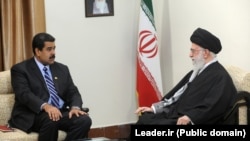
Just days after deposing Venezuelan leader Nicolas Maduro, President Donald Trump has threatened to carry out military action against other US foes.
Maduro’s capture in a US raid on January 3 has shaken Tehran, a close ally of the Venezuelan strongman.
Washington is unlikely to carry out a similar operation in Iran. But the brazen Venezuela attack has sent a clear signal to Tehran that the United States is willing to use force to remove its enemies, experts say.
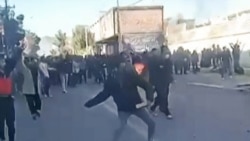
Trump recently warned Iran that Washington was “locked and loaded” and ready to intervene if Tehran killed “peaceful protesters” during ongoing antiestablishment protests. Iranian security forces have so far killed at least 19 protesters in a brutal state crackdown.
'Khamenei Himself Could Be Targeted'
Experts say the United States replicating its Venezuela operation in Iran and deposing Supreme Leader Ayatollah Ali Khamenei -- who has been in power since 1989 -- is unlikely.
Habib Hosseinifard, a Germany-based political analyst, said Venezuela lies in the United States' strategic “backyard,” whereas Iran is located thousands of kilometers away in the Middle East. The Islamic republic also has greater military capabilities and a more entrenched political system, he said.


Still, other experts say the US capture of Maduro has sent a worrying message to Tehran.
Damon Golriz of The Hague University of Applied Sciences said Maduro’s removal signals that the United States is moving beyond pressuring governments to targeting individual leaders.
“Unlike before, this time Khamenei himself could be targeted,” Golriz told RFE/RL’s Radio Farda.
Indeed, during the 12-day war with Israel in June, Israel actively sought to assassinate Khamenei but, as Israeli Defense Minister Israel Katz put it, operationally it was "not realistic" to target him because he had gone "very deep underground."
“Staying close to the leader has now become more costly than distancing oneself from him,” Mohammad Ghaedi, a lecturer at George Washington University, told Radio Farda. “The taboo of the leader being untouchable has been broken.”
Lessons From Venezuela?
Maduro’s removal from power has fueled debate inside Iran over what lessons the country can take from Venezuela.
Conservative media outlets insist that “Iran is not Venezuela,” emphasizing the country’s military capabilities and its allies in the region.
Nour News, which is close to senior Khamenei adviser Ali Shamkhani, described Venezuela as a “low-cost target” whereas Iran would represent a “high-risk scenario.”

Hard-line outlets echoed that message. The Javan newspaper, affiliated with the powerful Islamic Revolutionary Guards Corps, argued that comparing Iran to Venezuela is “a waste of time.” The conservative Jahan website added that the United States has already “tried and failed” to replicate military action in Venezuela in Iran.
Moderate voices, however, see cautionary parallels. Iran and Venezuela are both authoritarian countries where the authorities have used violence to crush dissent. Both countries are sanctioned by the United States and in the grips of economic collapse, despite their vast mineral wealth.
Tehran-based journalist Amir-Hossein Mosalla said that Maduro “ignored his people’s protests,” refused to enact reforms, and “met the fate of all dictators.”
Ali Sharifi-Zarchi, an academic at Tehran’s Sharif University of Technology, added that Maduro is “yet another dictator consigned to the dustbin of history after keeping his people in poverty despite sitting on massive oil reserves.”