




Welcome to Wider Europe, RFE/RL's newsletter focusing on the key issues concerning the European Union, NATO, and other institutions and their relationships with the Western Balkans and Europe's Eastern neighborhoods.
I'm RFE/RL Europe Editor Rikard Jozwiak, and this week I'm drilling down on two issues: The EU-US plan to make Ukraine richer and the deal done in Davos on Greenland.

Briefing #1: All You Need To Know About The EU-US Prosperity Framework For Ukraine
What You Need To Know: The European Union and the United States have sketched out a "prosperity framework" for Ukraine designed to provide Kyiv with financial assurances along with security guarantees to stabilize Ukraine after the war with Russia ends. The 18-page document, seen by RFE/RL, says that while $800 billion could be mobilized for Ukraine through 2040, the immediate aim is to meet the country's need for some $500 billion in reconstruction over the next decade.
The EU, the United States and international financial institutions -- including the International Monetary Fund and the World Bank -- would participate in the initial phase, providing $317 billion for reconstruction, $57 billion for private housing, and some $126 billion for the construction of both public and private buildings. Compensation to victims would be dealt with separately through a mechanism targeting Russia's frozen assets in the West.
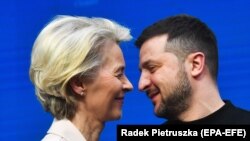
Speaking last week as the framework was being discussed at an informal meeting of members of the European Council, European Commission President Ursula von der Leyen said that it "looks at how we can boost the prosperity of Ukraine at the moment we achieve a peaceful cease-fire." "We are talking about a single document representing the collective vision of the Ukrainians, Americans, and Europe for Ukraine's post-war future," she said. The $800 billion figure comes from the war-torn country's "ambition to identify further investment opportunities that will enable its economy to grow and thrive, double its GDP, raise its productivity, and significantly improve Ukrainians' quality of life," according to the document.
Deep Background: Much of the plan depends on the war ending soon. But there are other conditions. Rapid progress toward EU accession is highlighted as a must. It is noted that the GDPs of Central and Eastern European economies that joined the club in 2004 and 2007 nearly tripled since then and that this trick can be repeated with Kyiv. While Ukraine hopes to join the club before the end of the decade, Hungary has blocked the start of accession talks for nearly two years over what Budapest sees as Ukrainian discrimination of the Hungarian-speaking minority in the country -- a spat that has now prompted leader Viktor Orban to recently state that no Hungarian parliament "in 100 years" will be ready to green-light Ukrainian EU membership.
But this is not the only condition set out in the paper. "Restoring Ukraine's access to sovereign debt markets is a critical unlock," it says, adding that this would involve "enabling banks to refocus on lending to small and medium enterprises (SMEs) and thereby stimulating job creation and the overall economy." It also mentions the need for the country to "re-establish its standing with the global investor community," which includes expanded digital infrastructure and strengthening the independence of the judiciary and property rights in the country. But where this $800 billion come from?
Drilling Down:
- There are some concrete pledges of cash. The European Commission has proposed earmarking $116 billion for Ukraine in the next multi-annual EU budget, which should start in 2028 and run through 2034.
- But all EU member states need to agree on this in long-winded negotiations over the next 18 months, and it's not clear if this number will remain given many EU capitals are keen to reduce EU budget expenditures in general.
- There is no figure yet for Washington's expected contribution. The paper notes simply that "the United States will endeavor to raise significant additional capital (public and private, grants, equity and debt) to be invested transparently and effectively in Ukraine."
- The authors also say that the return of 2.1 million migrants within the first two years of the end of the war would lead to a productivity leap of 5 percent and a potential rise in GDP per capita growth.
- The document also notes that additional public capital is expected to come from "concessional loans from international financial institutions, other grants, and philanthropies" and that Ukraine "may consider the sale of mineral rights as another means to introduce private capital into Ukraine, as envisioned by the US-Ukraine Reconstruction Investment Fund."
- However, the framework as it stands now gives no specific numbers. The appendix states while Ukraine's "minerals sector offers substantial investment opportunities," it cautions that "challenges persist, including longer lead times for lithium projects, the need to align with global standards, and the requirement for updated technological and geological data to support new greenfield initiatives."
- Apart from the country's mineral sectors, Brussels and Washington are eyeing a number of additional fields of investment. One is the over 3,000 state-owned enterprises that could be privatized -- the paper notes such a move is "necessary to open up key sectors of the economy to private investment, remove inefficiencies, and allow for innovation and investments."
- The reconstruction of over 25,000 kilometers of roads is also mentioned, as is an upgrade of the Chornomorsk port southwest of Odesa.
- In the energy sector, six new nuclear reactors in Khmelnitsky and Rivne could be constructed. The text also mentions that "the United States, and potentially US companies, will aim to partner with Ukraine through co-investment to restore, grow, modernize, and operate Ukraine's gas infrastructure, which includes its pipeline and storage facilities."
Briefing #2: What’s In The 'Davos Deal' Made To Ease Transatlantic Tensions Over Greenland?
What You Need To Know: There may be a solution to the recent tension over Greenland. US President Donald Trump and NATO Secretary-General Mark Rutte, in a much-touted meeting held in Davos, Switzerland, on January 21, reached a framework agreement. Earlier that day, Trump had reiterated his wish to bring the Danish island under American sovereignty but ruled out force to accomplish this. But after his meeting with Rutte, he posted on social media that "we have formed the framework of a future deal with respect to Greenland and, in fact, the entire Arctic Region." "This solution, if consummated, will be a great one for the United States of America, and all Nato Nations," he added.
The agreement, which multiple RFE/RL sources insist has yet to be officially drawn up, will apparently be worked out in the coming weeks. While NATO facilitated the initial meeting, the talks will now mainly be held between the foreign ministers of the United States, Denmark, and Greenland with the potential involvement of the US Vice President JD Vance, as well. Several NATO officials and European diplomats speaking under condition of anonymity told RFE/RL that while concrete details will be ironed out later, there are some "contours" that have been sketched out.
Deep Background: One of the sticking points will continue to be the issue of sovereignty -- perhaps not of the entire island, but part of it. There have been media reports that the United States would control parts of Greenland by potentially designating them as "sovereign base areas." This would be something like Britain's currently setup in Cyprus, with some bases remaining under London’s control to date despite the island gaining independence in 1960. NATO officials whom RFE/RL has spoken to insist that "the Cyprus model was not mentioned in the meeting," with one saying that media reporting on this was likely based on speculation by officials on the direction the talks could take. Danish Prime Minister Mette Frederiksen also issued a statement after the Trump-Rutte meeting, noting that "NATO is fully aware of the Kingdom of Denmark's position. We can negotiate on everything political; security, investments, economy. But we cannot negotiate on our sovereignty."
Some other contours of the framework might, however, be easier to agree on. One includes a "brush up" of the 1951 treaty between the United States and Denmark that allowed Washington to keep its bases on Greenland and establish new ones if the United States and NATO deemed it necessary. That deal was reworked in 2004 so that consent by both Denmark and Greenland is needed for any US troop increases or new military installments. At the moment, the United States has one base there, which hosts some 200 officers working on ballistic-missile early warnings and space surveillance. During the Cold War, there were up to 10,000 US soldiers on the island. The reworking is likely to include the incorporation of the proposed American Golden Dome anti-missile system that would cover the North Atlantic, including Greenland -- a move that both Copenhagen and Nuuk are reportedly fine with.
Drilling Down:
- Another aspect of the framework includes investment screening. The United States wants a say in who is allowed to invest in Greenland, with the clear intention of staving off China and Russia from gaining a foothold there. A rare-earth deal, meaning special rights for mining, would also be included and is expected to be agreed on relatively expediently.
- A third aspect is greater NATO involvement in and around Greenland. This could involve the military alliance as a whole or just the so-called Arctic-7 members of the club: Canada, Denmark, Finland, Iceland, Norway, Sweden, and the United States.
- Whether this entails an expanded number of exercises or something more permanent remains to be seen. Along these lines, there has been much talk in Brussels of a NATO-led Arctic Sentry mission.
- Speaking in Brussels on January 22 after a regular meeting of all the NATO countries' chiefs of defense, the alliance's Supreme Allied Commander Europe Alexus Grynkewich said there was no "political guidance yet" for an Arctic Sentry-type of mission just yet.
- "We are doing some thinking but no planning yet but we are ready and we have a ton of expertise," he said. He also said there was "never a military dimension in those (Davos) talks that came down to us."
- He also confirmed that no NATO exercises are expected on Greenland in the coming months but that a regular joint US-Canadian exercise with Denmark's blessing called Norad -- involving military aircrafts from both nations -- is under way.
Looking Ahead
EU foreign ministers will meet in Brussels on January 29 and are expected to green light some sanctions on foreign powers. Firstly, they could agree on targeting a handful of Russians that the bloc considers has supported the Kremlin’s “destabilizing activities” around the world. The ministers could also wave through a raft of sanctions on prominent members of the Iranian regime responsible for the deadly crackdown on protesters in the country in recent weeks.
That's all for this week!
Feel free to reach out to me on any of these issues on X @RikardJozwiak, or on e-mail at jozwiakr@rferl.org.
Until next time,
Rikard Jozwiak
If you enjoyed this briefing and don't want to miss the next edition subscribe here.