




Welcome to Wider Europe, RFE/RL's newsletter focusing on the key issues concerning the European Union, NATO, and other institutions and their relationships with the Western Balkans and Europe's Eastern neighborhoods.
I'm RFE/RL Europe Editor Rikard Jozwiak, and this week I am drilling down on two issues: New EU sanctions on Russia and its partners and a preview of the NATO meeting of defense ministers.

Briefing #1: The EU Proposes More Sanctions On Russia
What You Need To Know: The European Commission presented its latest sanctions against Russia to EU member states late last week in the hopes of having the measures approved ahead of the fourth anniversary of the full-scale invasion of Ukraine on February 24.
If adopted, the proposal -- seen by RFE/RL -- would be the 20th round of sanctions from the bloc since the invasion. It lacks the headline-grabbing proposals of the early sanctions, as Brussels is running out of things to target and struggling to find the necessary unanimity of the 27 EU capitals.
It is clear, however, that the EU is now to a larger degree targeting countries it believes are aiding the Kremlin's war effort. The new package includes sanctions against companies in Armenia, Azerbaijan, Georgia, Kyrgyzstan, Tajikistan, and Uzbekistan, as well as the United Arab Emirates and China.
Arguably the biggest talking point of this round is the proposal to impose a maritime services ban related to Russian crude oil and petroleum products. The idea of the ban is that it prohibits EU economic operators from providing services to any vessel transporting these products from Russian ports.
This goes beyond the current oil price cap -- imposed by the Group of Seven and currently set at $47.60 per barrel -- in one crucial way. It would stop EU vessels from transporting these components completely while non-EU boats could still continue but wouldn't be able to rely on EU port services and insurances.
There is just one issue: The measure has to be approved by the Group of Seven first. So far, it's far from clear as to whether every country in the group will give a thumbs-up to scrap the price cap and go for a general ban.
In the meantime, more vessels belonging to Russia's so-called shadow fleet (which Brussels believe is carrying Russian oil in violation of an oil price cap) will be sanctioned, taking the blacklist to over 700 boats. The EU is also proposing restrictions on icebreakers operating in Russia as "these vessels are instrumental to support oil and gas exports from Russian northernmost areas."
Deep Background: How else will this package target Russia?
EU operators will be forbidden from engaging with the "digital ruble" that Moscow hopes to launch soon. A transaction ban will hit another 20 banks, mainly local and regional banks, meaning financial institutions in the EU essentially cannot do business with them. Most of Russia's big banks are already blacklisted, but Brussels is worried businesses are circumventing these bans by rerouting money via smaller financial entities.
New EU export bans have been proposed for various chemicals, vulcanized rubber, articles of steel, tools for metal production, and industrial tractors. These measures are also mirrored for Belarus.
Among items that will be banned from importing to the EU from Russia (and Belarus) are tanned furs and various steel products as well as a low quota of ammonia. The latter is significant as the bloc aims to completely phase out Russian gas imports as of 2027, and ammonia is the main gas derivative so far left unsanctioned.
In a move that could potentially have consequences for many third-country media outlets, the EU's broadcasting ban on Russian media such as RT and Sputnik will now apply to other outlets mirroring their content.
Drilling Down
- The most eye-catching aspect of the sanctions proposal is the "internationalization" of the measures. While the EU has consistently targeted Belarus alongside Russia and sometimes added minor export restrictions on specific companies in China or Central Asia, this takes thing one step further.
- For the first time, the European Union is proposing to use its anti-circumvention tool (ACT). This means it will be forbidden for EU companies to export CNC machines and radio equipment to Kyrgyzstan -- items that can be used in the war, notably for drones.
- The sanctions document notes that for the first 10 months of 2025, imports of these types of products from the EU to Kyrgyzstan were almost 800 percent higher than before Russia's full-scale invasion and that exports from Kyrgyzstan to Russia for the same period were up 1,200 percent.
- It also adds that the "Kyrgyz Republic has been identified as a jurisdiction where the risk of circumvention is systematic and persistent, with authorities failing to prevent the sale, supply, transfer, or export to Russia."
- Brussels is to a larger degree looking beyond Russia now when it comes to sanctions. The package targets several companies in Kazakhstan, the United Arab Emirates, and Uzbekistan, among other places, with an asset freeze for aiding Russia's military machine.
- There is also a transaction ban on several banks as they are deemed to have facilitated sanctions circumvention. This list includes OJSC Unibank of Armenia, Azerbaijan's Yelo Bank, and the International Bank of Tajikistan.
- Georgia's Kulevi port is also a proposed target as it has allowed the Russian shadow fleet to operate from there. An Indonesian port is similarly targeted.
Briefing #2: NATO Defense Ministers Deal With Post-Greenland Fallout And Defense Spending
What You Need To Know: NATO's defense ministers are meeting in Brussels on February 12 for their last official gathering before the NATO summit in Ankara in early July.
No concrete decisions are expected in the Belgian capital -- instead the meeting is about two things.
First, an attempt to try to patch up what appears to be an increasing rift between European allies and the United States, which was laid bare over the recent discussions surrounding the political future of Greenland.
And second -- and not entirely unrelated to the first issue -- figuring out how to achieve the decision made in the Hague last year that all 32 allies should spend 5 percent of GDP on defense by 2035.
The Greenland controversy is still looming large over the gathering even though it isn't part of the official discussion. While one European NATO official said that there has been a "fundamental breach of trust" inside the alliance on the issue, most diplomats that RFE/RL has spoken to appear to agree that it is best if it isn't brought up for now.
Instead, the hope is that the likely launch of the Arctic Sentry operation by the military alliance just before the ministerial meeting will prove that everyone is on the same page in taking High North security seriously, and will silence any talk of a potential American takeover of the Danish territory.
Deep Background: Sources that RFE/RL has spoken to under the condition of anonymity say that there are roughly two camps in the alliance on how European capitals should respond to recent events.
Some countries, led by France, are still reeling from the US pressure and want European nations to diversify away faster from the US security umbrella.
In the other group there, are nations, especially on the eastern flank, that have concluded that there isn't much European nations can do in the immediate future and they should therefore rely on American protection and goodwill for years to come.
These countries subscribe to the view of the NATO Secretary-General Mark Rutte that Europe wouldn't be able to defend itself without America, even if nations spend well over five percent of GDP. This includes US nuclear capabilities that can't readily be replaced, but also satellite technology, military intelligence, and other strategic enablers.
The hope is still that the camps will show a united front during the ministerial meeting and that this will continue when most participants dash to Munich for the annual security conference on February 13-14 where most will want to prevent a similar transatlantic fall-out to that which was on such a full display in Davos only last month.
But for that to happen, the European states and Canada need to deliver on the second issue -- stepping up on defense spending. As one European military official put it to RFE/RL: "2026 is all about implementation, implementation, implementation." With most countries just about reaching 2 percent of GDP on defense in the last year, this is a major undertaking. But it is the one point that they know US President Donald Trump and his administration will continue to hammer home to Europe and Canada.
Drilling Down
- All NATO countries should hand in their Strategic Level Reports (SLR), outlining military spending for the next five years, ahead of the ministerial meeting. And this has some countries worried as they don't plan on spending too much in the coming years before potentially hiking spending closer to the target date, so that they fulfil requirements just in time -- an "accounting trick" known as the "hockey stick method" in NATO corridors.
- This is something that US officials have made clear they won't tolerate and Washington will warn Europeans that they will have to be able to present credible and gradually progressive defense spending before going into the Ankara summit in order to make it a success.
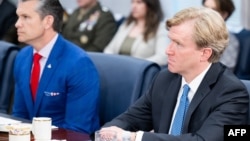
- US Defense Secretary Pete Hegseth won't participate in the Brussels meeting but will instead be represented by his deputy, Elbridge Colby. Widely regarded as the man who might be even more hawkish on spending than his boss, Europeans will make sure not to cross him.
- It is expected that his speech will focus on the need for "the Europeanization of NATO." That means essentially three things -- spending more, European nations getting combat ready, and the need to step up on various capabilities. Few are expected to challenge that.
- But while Colby will be the most observed man in the room, part of the ministerial meeting will also be dedicated to a newbie that many are looking forward to hearing from. At the NATO-Ukraine Council session, the freshly minted Ukrainian defense minister Mykhaylo Fedorov will make his first appearance at the military alliance in his new role.
- There is quite a buzz in Brussels about the 35-year-old "tech guy" and political "whiz kid" who previously worked for several years as the country's minister for digital transformation.
- Officials are especially keen to see how Fedorov, who is one of Ukrainian President Volodymyr Zelenskyy's closest confidants, will cope in reforming and modernizing the still heavily centralized Ukrainian defense ministry.
- But NATO officials actually hope he will also share his knowledge of cutting-edge drone warfare and cyber capabilities. "He is probably the biggest expert in the room on all modern technologies" as one diplomat put it.
- But what about financing for Ukraine? The NATO-led PURL initiative, in which European allies pledge money for US-made weapons heading to Ukraine reached, nearly 5 billion dollars in 2025. There is a push in the alliance to repeat this in the spring as Russia continues to pound the country daily with rockets.
- But it is indicative that NATO no longer publicly announces when new PURL packages are agreed -- following a request from alliance members to remain anonymous and strategic. Some sources, however. fear that this is rather a reflection of both a reduced appetite to buy American in many European countries and mounting fatigue over financing a war that is about to enter its fifth year.
Looking Ahead
European Union leaders will gather in a castle outside Brussels on February 12 for an informal EU summit in which they will discuss how the bloc can become both more competitive on the world stage and get the EU single market going again.
The guests of honor are two former Italian premiers -- Mario Draghi and Enrico Lette -- who have both authored lengthy reports on these issues.
Expect a lot of hand-wringing about the dominance of US tech companies and voracious Chinese state firms, but few concrete actions.
That's all for this week!
Feel free to reach out to me on any of these issues on X @RikardJozwiak, or on e-mail at jozwiakr@rferl.org .
Until next time,
Rikard Jozwiak
If you enjoyed this briefing and don't want to miss the next edition subscribe here .