




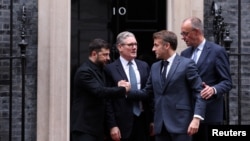
Ukrainian President Volodymyr Zelenskyy met with European leaders seeking to ensure a US-led effort to end Russia's war on Ukraine does not result in a lopsided deal that would reward Moscow for its aggression against its neighbor and leave Kyiv vulnerable to future attacks.
In a media briefing after the meeting Zelenskyy said that Ukraine has no right to cede territories "neither under Ukrainian law, nor under international law, nor from the moral standpoint."
He added that Russia was exerting pressure to make Kyiv give up its territories, but "we don't want to give away anything and that's what we are fighting for."
Without being specific, he said the original 28-point peace plan has shrunk to 20 points as the most controversial conditions for Ukraine have been removed from it.
Zelenskyy met with UK Prime Minister Keir Starmer, French President Emmanuel Macron, and German Chancellor Friedrich Merz in London on December 8. He was to meet with NATO chief Mark Rutte later the same day in Brussels, with European Commission President Ursula von der Leyen and European Council President Antonio Costa also invited.
"We stand with Ukraine and if there was to be a cease-fire, it has to be a just and lasting cease-fire," said Starmer after welcoming the leaders to his residence at 10 Downing Street.
Ahead of visit, Zelenskyy told Bloomberg News that US-led talks on a potential peace deal have yet to produce agreement on territorial control in the eastern region known as the Donbas, where Russia is demanding that Ukraine cede land it continues to hold despite years of attacks.
"There are visions of the US, Russia and Ukraine -- and we don't have a unified view on [the] Donbas," Bloomberg quoted Zelenskyy as saying in a phone interview. He suggested it was one of several "sensitive issues," which also included security guarantees for Ukraine, that would require further discussion.
At the start of the London meeting, Merz said he was "skeptical about some of the details which we are seeing in the documents coming from US side, but we have to talk about it. That's why we are here."
Macron said it's important to find "convergence" between the US position and views shared by Europe and Ukraine.
The talks in London and Brussels follow three days of meetings between Ukrainian and US officials near Miami as negotiators try to find agreement following the release of a US draft peace proposal last month.
The 28-point plan was seen as heavily favorable to Moscow, and Kyiv has pushed back on some of the hard-line demands Russian President Vladimir Putin has pushed since before he launched the full-scale invasion of Ukraine in February 2022.
"We are starting a new diplomatic week right now -- there will be consultations with European leaders. First and foremost, security issues, support for our resilience, and support packages for our defense," Zelenskyy said in his nightly address, recorded on a train on December 7.
Ahead of the talks, Starmer told Britain's Press Association that any peace deal had to be just but "it's also got to be lasting, because we know Putin does not respect agreements that don't have hard-edged security guarantees behind them, so that's what we'll be focusing on."
In Washington on December 7, US President Donald Trump criticized his Ukrainian counterpart, saying he was "a little bit disappointed."
"We've been speaking to President Putin and we've been speaking to Ukrainian leaders, including Zelenskyy, President Zelenskyy, and I have to say that I'm a little bit disappointed that President Zelenskyy hasn't yet read the proposal, that was as of a few hours ago," Trump told reporters.
Ukraine's chief negotiator, Rustem Umerov, said he would report to Zelenskyy on the latest developments on December 8.
One of Kyiv's main goals in the Miami talks was to obtain "all drafts of current proposals in order to discuss them in detail with the President of Ukraine," Umerov wrote on X.
"Today, we will provide the President of Ukraine with full information on all aspects of the dialogue with the American side and all documents."
Details of the proposal following adjustments to the 28-point plan have not been released publicly, and Trump said nothing about its content. US and Ukrainian officials have indicated in recent days that key sticking points included control over territory -- particularly in the Donbas, which includes the Donetsk and Luhansk regions - -- and security guarantees.
In his comments to Bloomberg, Zelenskyy said Kyiv is pushing for a separate agreement on security guarantees from Western allies, above all the United States.
"There is one question I, and all Ukrainians, want to get an answer to: If Russia again starts the war [after a peace deal is reached], what will our partners do?" he said.
Following his meeting in London, Zelenskyy said that European security guarantees for Ukraine are essentially ready. "The strongest security guarantees are those by the US, obviously, provided that they are legally binding and adopted by the US Congress." He said so far the US attitude to the issue was looking positive.
Ukrainian political analyst Volodymyr Fesenko said that while "we don't know don't know exactly what the United States is proposing," a clause from the 28-point plan obliging Ukraine to withdraw its forces from territory it still controls in the Donetsk region could be a major barrier to any agreement.
"The majority of Ukrainians, despite all current difficulties, are unlikely to accept the idea that Ukraine voluntarily leaves the Donbas without receiving anything in return, not even real guarantees of a cease-fire," Fesenko, head of the Penta Center for Political Studies in Kyiv, told Current Time.
In uncompromising comments last week, Putin said Russia would seize control of the Donbas "by military or other means," suggesting that Moscow would not agree to a deal that leaves any part of the region in Ukrainian hands.
He said the same of the part of Ukraine once known in Russia as "Novorossia," indicating Moscow might also demand full control over the Zaporizhzhya and Kherson regions. Ukraine still holds large parts of the two southern regions, including their capitals.
Following the negotiations in Miami, Zelenskyy said he had spoken with US special envoy Steve Witkoff and Trump's son-in-law Jared Kushner, who have led the negotiations on behalf of the White House.
"The American envoys are aware of Ukraine's core positions, and the conversation was constructive though not easy," Zelenskyy said.
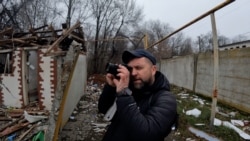

Meanwhile, Russia continued its air strikes on Ukrainian infrastructure as winter temperatures fall.
Russian forces attacked Okhtyrka in the Sumy region overnight on December 8, according to regional authorities. Governor Oleh Hryhorov said seven people were injured in a strike on a nine-story residential building, all of whom were taken to a hospital.
According to Ukrainian emergency officials, firefighters extinguished a blaze on the second to fifth floors and evacuated 35 residents, rescuing seven people, including one child, from damaged apartments. Five people were injured in other Russian attacks in the region, Hryhorov said.
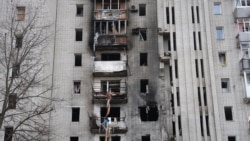
In Chernihiv, an apartment building was damaged as a result of the fall of a Russian drone. Three people were injured, one of whom was hospitalized, emergency officials said in a post to Telegram.
Reparations Loan For Ukraine?
Meanwhile, the leaders of several EU members urged fast action on a proposal to use tens of billions of dollars in frozen Russian assets for a reparations loan to Ukraine, which is starved of cash.
"Supporting Ukraine in their fight for freedom and independence is not only a moral obligation; -- it is also in our own self-interest," the leaders of Estonia, Finland, Ireland, Latvia, Lithuania, Poland, and Sweden said in a letter to Costa and von der Leyen.
"Time is of the essence," they wrote, arguing that agreement on the much-debated proposal at a European Council meeting on December 18 would put "Ukraine in a stronger position to defend itself and a better position to negotiate a just and lasting peace."
After a series of meetings on December 8, Starmer pointed out that "positive progress" has been made to use frozen Russian sovereign assets to support Ukraine.
Von der Leyen noted that "we do not have any more time to lose. Securing financial support will help ensure the survival of Ukraine, and it is a crucial act of European defense. In this new era, geoeconomics goes hand in hand with geopolitics."
She stressed that the sanctions imposed by the West against Moscow are already affecting Russia's economy. "Along with our allies, Europe has the means and the will to increase pressure on Russia to come to the negotiation table."
However, Ukraine is about $800 million short to buy the US weapons it had planned to purchase this year with help from its European allies, Zelenskyy told media after his meetings on December 8.
EU High Representative for Foreign Affairs and Security Policy Kaja Kallas stressed on the same day that "giving Ukraine the resources it needs to defend itself doesn’t prolong the war, it can help end it."
Following his meetings in London, Zelenskyy announced he was flying to Italy on December 9.