



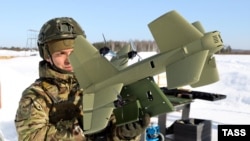

As Vladimir Putin moved down a line of military officers on Red Square in May 2025, a member of the Russian president's security detail was spotted holding an unusual weapon partially hidden under a black cloth.
Since that device was spotted, multiple examples of a drone interceptor featuring the same tail-fin configuration have been filmed purportedly knocking out drones over the battlefields of Ukraine.
The interceptor is known as the Elka (Fir Tree) and is produced by an unnamed Moscow company. The device now appears to be set for widespread adoption by the Russian military as a counter to small reconnaissance and bomb-carrying First Person-View (FPV) drones.
FPV drones controlled through fiberoptic cables have proven nearly impossible to counter since they first emerged in Ukraine in early 2024.

The Elka has no explosive warhead and relies on its own momentum and what appears to be a reinforced, spiked nose to shatter the airframes of enemy drones on impact.
The X-winged interceptor is fired from a pistol-like launcher and reportedly features a targeting system that human operators initiate by locking onto a flying target.
The launched interceptor can then autonomously home in on a drone up to 1.6 kilometers away. The "fire and forget" system removes the need for communication with the user, meaning it cannot be jammed electronically while in flight.
Monika Ahlborn, who runs the popular social media page Drone Wars, told RFE/RL that the apparent success of the Elka is likely due to a combination of "simplicity, [low] cost, and autonomy." No confirmed price for the device has been reported, but some estimates put a single airframe at $500.
"The system seems relatively lightweight, portable, and comparatively inexpensive, which makes it scalable at the unit level rather than being restricted to high-value air defense assets," the drone expert told RFE/RL. Additionally, Ahlborn said, the fire-and-forget targeting system "reduces operator burden in high-tempo environments."
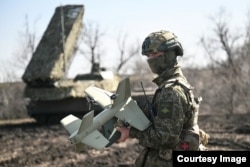
A purported instructional leaflet that includes the shortfalls of the device notes that, "given the material the Elka is made from," the interceptor must be handled carefully. The leaflet also reveals the device can only be used in daytime hours and dry weather.
Crucially, the leaflet advises operators to lock onto targets only against a clear or overcast sky. Videos of the Elka in combat show it tracking and destroying drones flying with steady flight paths against a featureless sky. An FPV drone flying low and erratically against a cluttered background could prove difficult for the Russian device to lock onto.

In Ukraine, a counter to fiberoptic FPV drones has been the adoption of net guns which launch nets that expand out to 3.5-4 meters. The net guns can entangle and down enemy drones within a maximum of 30 meters and cost less than $200.
Jan Ruzicka, who heads the Czech Wings of the Phoenix association that supplies anti-drone devices to Ukrainian troops, told RFE/RL he has delivered around 500 net guns to Ukrainian soldiers and heard of around 40 "kills" of enemy drones using the device. But he notes "this is a weapon of last resort -- when everything else has failed, and the enemy drone is in the final stages of its flight to a soldier or position."
He says the net guns have also been used to pin down dreaded "waiter" drones that sit on standby mode next to roads and paths waiting for signs of movement.
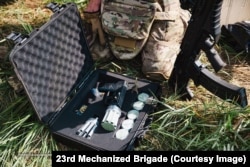
Iryna Rybakova, a press officer with Ukraine's 93rd Mechanized Brigade, says for high-risk missions, net guns are now an established part of anti-drone tactics.
"We take all the weapons with us," Rybakova told RFE/RL when describing driving near the front lines. "In addition to machine guns, we have shotguns, and also small net launchers [made by the Ukrainian company] Ptashka." She too describes the pistol-like net guns as the "last chance" layer of defense.
At least one documented successful use of net guns in combat was recorded in late 2025, while an April 2026 combat video shows a Ukrainian special forces soldier switching between a net gun and rifle as a drone stalks his position.
Ruzicka told RFE/RL that demand for the net guns is growing. "I have many more requests from the military than I can cover," he says but adds that the shortfalls of the first-generation devices are obvious.
The single-shot net guns are painfully slow to reload, he says, meaning soldiers essentially have one chance to take down a hunting drone. Other battlefield veterans predict net guns are a "fad" that are likely to be phased out as the search for a lasting counter to unjammable FPV drones continues.

