


The United States’ swift strike that captured Venezuela’s Nicolas Maduro has sent shock waves well beyond Latin America and is raising questions for one of Caracas’s closest partners: China.
The operation comes as Beijing faces parallel challenges elsewhere: widening protests in Iran, another key energy supplier to China, and brings implications for Taiwan, the self-governing democracy that Beijing claims as its own and has vowed to control, by force if necessary.
To examine what the Venezuela strike reveals about China’s global position, RFE/RL spoke with Michael Sobolik, a senior fellow at the Washington-based Hudson Institute and a former aide to US Senator Ted Cruz. Sobolik closely tracks US-China strategic competition and is the author of Countering China’s Great Game: A Strategy for American Dominance.
The interview below has been condensed and edited for clarity.
RFE/RL: China was a major economic and political partner for Maduro, investing north of $60 billion into Venezuela and Beijing signed an "all-weather partnership" agreement with Caracas. But what does the capture of Maduro and what's materializing in Venezuela now mean for China in Latin America and tell us about Chinese support for its partners?
Michael Sobolik: It doesn't mean that much, and I think that is a really important reality to underscore because Venezuela is not the first partner of the People's Republic of China to come into some trouble and to receive next to no help at all from Beijing.
[In June], during Operation Midnight Hammer, when the United States bombed Iran's nuclear facilities, China couldn't do anything except stand on the sidelines and condemn it, and the past six months have highlighted a huge problem that the People's Liberation Army (PLA) has, which is that it is unable to project power in a meaningful way outside of its near abroad.
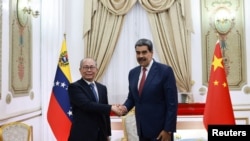
And it shouldn't be overlooked that the operation to capture Maduro took place mere hours after a Chinese delegation met with him. [Editor’s note: Qiu Xiaoqi, China's special representative on Latin American affairs, met with Maduro in Caracas the day before the US strike and reportedly was still in Venezuela when Maduro was captured and taken to stand trial in the United States.]
That is an enormous embarrassment for China. In that meeting, one can only imagine that there were future plans being drawn up [and] maybe some commitments being offered. All of the promises that China made to Venezuela mean very little right now.
It's also an embarrassment for [Chinese leader] Xi Jinping because Venezuela was one of his most prominent beachheads into the Western hemisphere. Taking out Maduro doesn't eliminate all of the inroads for China by any means, but it eliminates a big one.
RFE/RL: You mentioned China’s issues with projecting force and lack of meaningful options to support its partners under pressure. But isn’t there still value in the Chinese being able to use the rhetorical tools that it has and condemn the United States at international bodies to rally countries around it?
Sobolik: Talk is cheap in international politics. If all you have is diplomacy that isn't backed up by force, then you just have words. Words are not enough to secure your interests and words are also not enough for your military to be successful.
I think where China is hopeful that their diplomacy can help them right now is they are already trying to paint the United States as an aggressor and as a violator of international law. I suspect that they are not only hoping that they can get some traction with that approach, but they are also hoping that America oversteps and overexpands right now.
You'll notice that [US] President [Donald] Trump is talking about Greenland again, and talking about how we need Greenland and he's not taking military force off the table. I do not expect there to be a war between the United States and Denmark over Greenland. However, the fact that force is not off the table is an opening for China rhetorically to say, look at what the United States just did in Venezuela. They will send their military wherever they want to send it. They did it with Iran. They did it with Venezuela. They're threatening to do it with a NATO partner.
I'm sure that the Chinese are going to be quick to try to exploit that. And I think that also speaks to the importance of how the United States handles this moment.
RFE/RL: If we can pivot slightly, you mentioned Iran. This is another place where there is rising tension right now. We had strikes this summer from the US and Israel and expanding protests over an economic crisis that are picking up steam each day. If you're Beijing, how do you support Iran?
Sobolik: So it's a different situation for China. While Venezuela is in China's oil import portfolio, it's only about 7 percent of China's oil needs, Iran, on the other hand, is enormous for China when it comes to oil.
So, China is going to have to stomach some embarrassment over Venezuela, but Iran is a different scenario. They depend on Tehran for oil in a substantial way. So the Chinese interests are implicated in a deeper, more core way with Iran than they are in Venezuela.
Of course, the Chinese were not about to do anything to stop incoming B2 bombers with bunker busters in June [2025], but it's an interesting question: What would China be willing to do to shore up their energy security if the politics in Iran change overnight in a way that is unfavorable? That's a lot of hypotheticals, and I don't want to go too deep into that, but I think the important thing here is that the Chinese can afford to get embarrassed with Venezuela and they have the luxury of learning from their mistakes.
If things change rapidly in Iran, however, and they're caught on their back feet, that could be an enormous strategic problem for them. So I expect the Chinese to be communicating with the Trump administration clearly and aggressively, and I expect they will take steps to shore up their energy needs.
RFE/RL: Another thing connecting Venezuela and Iran’s ties to China beyond oil is that both have Chinese military hardware, primarily air defense systems. The US operation that captured Maduro has drawn attention to the US military's abilities to evade the Chinese radar systems that Venezuela possesses, particularly the JY‑27A mobile anti‑stealth radars that are supposed to be capable of detecting fifth‑generation stealth aircraft like US F‑22s and F‑35s. What does this tell us about Chinese military hardware?
Sobolik: Venezuela has a few different Chinese air defense radars. You mentioned the JY‑27A, which is an older generation radar. So, it’s not the latest and greatest.
But it’s important to know how catastrophically those systems failed against the Americans because you had Chinese radars and you had Russian surface-to-air missiles coupled together that should have protected Venezuela. So, every other nation in the world that is a customer of China for air defenses needs to be asking the question: how well are my air defenses going to work, not only against the Americans, but what about the Israelis? What about other nations that are aligned with the United States that have their own security interests?

I do want to be clear: it's not that the latest and greatest tech from China has been tested and found wanting, but systems that should be reliable have been found to be susceptible to countermeasures, not only from the United States, but from partners of the United States as well.
That’s another black mark for China and an embarrassment for their arms export industry. It should call into question for Xi what other capabilities could be suppressed or sabotaged by the Americans, which could decrease his confidence in using his military to secure his interests.
RFE/RL: Since the operation in Venezuela, some have argued that this provides a blueprint for Beijing to move on Taiwan, while other analysts have said that the strike breaks international norms and creates spheres of influence that would embolden China to attack Taiwan.
The Taiwanese government, meanwhile, has said that this deters Beijing as it showcases US military might and a will to use it. How do you see this affecting China's calculus on Taiwan?
Sobolik: I do not think that what happened in Venezuela is heralding a new era of spheres of influence.
The biggest data point that I see that goes against that is that President Trump announced a $1.5 trillion defense budget. That is not the kind of defense budget that is optimized for only the Western hemisphere. That is a global budget for a global military with global missions.
I think that's probably bad news for China. As much as they want the story of Venezuela to be about the United States being a violator of international norms and an aggressor, the real story here is that America was strong enough to secure its interests and China wasn't strong enough to stop it.
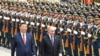
For Taiwan, I think they're absolutely right to say that this bolsters our deterrence for the same reason that our support of Ukraine can bolster our deterrence in the Indo-Pacific. Xi and Vladimir Putin met shortly in February 2022 shortly before Putin's special military operation kicked off. And anyone who says that Xi has not been watching America's and Europe's reaction and response to Putin in Ukraine is fooling themselves. Anyone who says that they weren't watching when we had that disastrous withdrawal from Afghanistan in 2021 is fooling themselves.
Everyone is trying to measure great powers for resolve and capability, so when the United States does a risky military operation like they did in Venezuela without a loss of personnel or equipment, that demonstrates that when the United States says something, it follows through.
That’s the crux of deterrence. Deterrence is a clear, credible threat that is communicated and it works if the other side believes that you're actually going to follow through on that threat. So, I think this makes the Taiwanese safer, it bolsters deterrence.
It's also why standing with Ukraine and making sure that that conflict does not go in Putin's favor matters for Taiwan. It really does. So, I think that Xi has had some of his planning complicated in multiple ways over the past few days, and I think that's a very good thing.