




WASHINGTON -- Estonian Defense Minister Hanno Pevkur has called for unity between the United States and its European allies as US President Donald Trump signals frustration with NATO members after several resisted his calls to help Washington during its military action in Iran.
The dispute, driven by a deepening confrontation with Iran and rising global energy prices, is quickly becoming a broader test of transatlantic cohesion -- and of how the alliance responds to crises beyond its traditional scope.
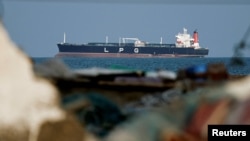
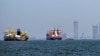
Trump voiced frustration on March 17 after most NATO allies reportedly declined requests to deploy naval assets, including minesweepers and escorts, to secure commercial shipping through the narrow waterway, which carries roughly one-fifth of global maritime energy supplies.
Pevkur told RFE/RL that Tallinn is ready to discuss options with the United States and other allies, emphasizing that cooperation, not division, is critical.
"We are ready to discuss what the options are to solve the situation in the Middle East and also to ensure free trade," he said in an interview in Washington on March 17.
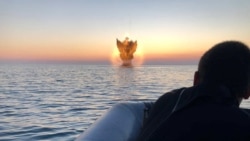
The Trump administration's push comes as Iran's blockade -- using mines, drones, and naval forces -- has effectively shut down the strait, sending oil prices above $100 per barrel and pushing US gasoline prices to their highest levels in months.
Divisions on Capitol Hill
The dispute also has put a spotlight on political divisions on Capitol Hill.
Republican Senator Lindsey Graham of South Carolina has backed the administration's position, warning that allies' reluctance could have "wide and deep" consequences for both Europe and the United States.
He described the situation as deeply frustrating and said it raises broader questions about the reliability of alliances in moments of crisis.
Democrats, however, urged a more cautious approach.
Senator Dick Durbin told RFE/RL that while NATO -- established in 1949 to collectively defend against the Soviet Union, of which Estonia was once a part of -- is being tested, it remains indispensable.
"We need to embrace our allies and build on our friendship," he said. "We don't need to find ways to divide us."

In key European capitals, many have made clear they won't participate in efforts to reopen the strait while active hostilities continue.
French President Emmanuel Macron said Paris would "never" take part in such operations under the current conditions, emphasizing that France is not a party to the conflict. But at the same time, he indicated France and other European countries could contribute to escorting commercial shipping once the situation "has calmed down."
Germany has taken a similarly cautious position.
Foreign Minister Johann Wadephul stressed that the crisis cannot be resolved through military means alone, reflecting broader European concerns about escalation and long-term entanglement.

Behind the reluctance is also a practical concern: that European navies could become responsible for a prolonged security mission in the Gulf, effectively policing the strait after the immediate crisis subsides.
While Western Europe hesitates, some allies on NATO's eastern flank are signaling a more open approach.
Pevkur framed the crisis not only as a security issue but as a global economic one.
"The situation in the Middle East affects oil, gas, fertilizers -- everything," he said, noting that rising costs will impact farmers, industries, and consumers worldwide.
"At the end of the day, this affects every citizen."

He repeatedly stressed that unity within NATO is essential, warning divisions would benefit Russia, especially in its war against Ukraine, which has for more than four years depended on the support of Europe, the United States, and other Western allies to try to keep Moscow at bay.
"This is the time to build bridges, and we cannot lose our unity," he said. "Russia has always wanted to divide us."
According to Pevkur, rising energy prices linked to the Hormuz crisis will strengthen Moscow's position against Ukraine beyond the economic benefits of increased revenues from oil sales.
"When they see cracks in our unity, they are only winning," he said.
"When one ally is asking for support, allies should come together and see what we can do," he said.
He also stressed the importance of continued vigilance toward Russia, even as attention shifts to the Middle East.
"The threat is always there," he said, adding that while a full-scale war with NATO is unlikely, allies must remain alert and maintain close cooperation.
A Coalition Problem, Not Just a Policy Dispute
Veteran US diplomat Daniel Fried said the current impasse between Washington and NATO reflects both shifting European positions and the difficulty of assembling a coalition for a complex, fast-moving crisis.
Speaking to RFE/RL, Fried, a former assistant secretary of state whose career spanned seven US administrations, said European governments had initially signaled an openness to limited military involvement.
He pointed to a March 1 statement by Britain, France, and Germany indicating they would consider supporting defensive actions against Iran, including countering missile and drone attacks -- a position he described as relatively forward-leaning.
Since then, however, several countries have ruled out participating in naval operations to reopen the Strait of Hormuz, highlighting what Fried called a degree of movement "back and forth" in Europe's stance.
At the same time, he said the situation is not fixed.
"It's not clear to me that the Europeans are completely opposed," Fried said, noting that some countries -- including Estonia and potentially others -- have signaled openness to discussions about possible contributions.
He said European reluctance reflects a combination of political, strategic, and practical considerations, including the risks of escalation, public opinion at home, and uncertainty about the scope and duration of any mission.
Even so, Fried argued that European interests are directly engaged, arguing it is "in everybody's interest" to help secure the Strait of Hormuz and defend Gulf states against Iranian attacks, particularly given earlier European signals of willingness to take on a role in the region.
He suggested European governments could still look for ways to contribute, particularly in defensive roles or limited missions consistent with their earlier positions.
Fried also stressed that any such effort would not formally be a NATO operation.

Without invoking Article 5, he said, the more likely framework would be a "coalition of the willing," with individual countries participating on a voluntary basis rather than through the alliance as a whole.
"I think they ought to see what's possible and what they could do," he said.

