




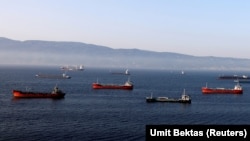
On a mild and cloudy evening in Izmit, western Turkey, a Panamanian-flagged tanker called the Bela 6 dropped anchor and began pumping nearly 100,000 tons of Russian oil.
The January 6 delivery was an outlier for the refinery’s owner, Tupras, which cut Russian crude imports by 69 percent the previous month ahead of an EU sanction taking effect on January 21, according to data from the Center for Research on Energy and Clean Air (CREA).
The new measure bans imports into the European Union of products derived from Russian crude oil and is the latest attempt to cut revenues for Moscow’s war in Ukraine.
It especially hits refineries in Turkey and India which import Russian crude, turn it into products like jet fuel, diesel, or blending components, and ship them on to EU markets.


Taken together with US sanctions on Russian oil majors last fall, a US blockade of Venezuelan supplies, and uncertainty over possible US military strikes on Iran, the EU measures feed into growing volatility in international oil supplies.
“We’re in an extraordinary environment, [with] much global geopolitical gyrations in the system,” David Edward from General Index, a London-based commodities markets intelligence firm, said during a webinar on January 14.
The broader context is a global oil glut that has been widely predicted for 2026, due to high production that saw oil prices fall steeply in 2025. This has already cut Russian oil revenues to their lowest levels since 2022, according to the International Energy Agency (IEA).
Loopholes
The new EU ban was announced as part of the bloc’s 18th sanctions package in July, giving refineries time to cut imports in advance.

“Within the next week, this will be one of the most important talking points around the world,” said Kpler analyst Sumit Ritolia, noting that major Indian refineries had already “self-sanctioned” by announcing they would buy no more Russian crude.
“With Turkey…they are still importing Russian barrels, but it is going down as we speak, their volumes are down 20-30 percent,” he added.
CREA noted that India’s Russian crude imports fell 29 percent in December 2025 to their lowest level since a G7 price cap was imposed three years earlier, although a big part of this would also have been a result of the US sanctions on Rosneft and Lukoil, Russia's largest oil producers.
In any case, critics have warned that some refineries could try to conceal the origin of the crude oil used in their products to evade the EU sanctions.
They’ve also suggested that exemptions for countries, including Britain or Serbia, create an opportunity for oil products refined from Russian crude to be reexported to the EU.

CREA analyst Isaac Levi said the same tactic could be used within individual countries, since the ban relates to ports and refineries importing Russian crude.
“There's a Georgian refinery called the Kulevi refinery on the Black Sea and it buys Russian crude oil, refines it into products…and it looks to be sending those refined products from a different port,” he told RFE/RL.
Levi signed an open letter to EU foreign policy chief Kaja Kallas from an international alliance of around 100 civil society groups calling on the EU to tighten the rules.
He said they received a “thank you” but no response on measures to close the loopholes. Kallas’s spokesperson did not answer RFE/RL’s request for comment.
“We have provided an array of different solutions…one is banning the import of refined fuels from any refinery that has a pipeline connection to Russian crude. So that would mostly be those refineries in China that are connected to a Russian pipeline. Quite a simple method that could stop again hundreds of millions if not billions of euros flowing to the Kremlin,” Levi said.
Enter China?
Some observers have suggested that China could absorb part of the excess Russian oil supplies being abandoned by India, Turkey, or others.
CREA’s data show a 23 percent spike in China’s seaborne crude imports from Russia in December. Several tankers with Urals grade oil apparently shunned by India were reported that month, idling in waters off Chinese ports in the Yellow Sea.

Erica Downs, a senior research scholar focusing on Chinese energy markets at Columbia University, told RFE/RL the key role would be played by small, independent refineries called "teapots."
These account for some 20 percent of Chinese refining capacity and, she said, “shift back and forth” between Russian and Iranian crude chasing “razor thin margins.”
“I think it's safe to say that China is not going to be able to absorb all that India and Turkey turn away. But, especially among the teapots, they are bargain hunters. And if the discount is enough, if they feel like their risk exposure is tolerable, they will take more,” Downs said.
Last year, Washington slapped sanctions on three teapots for dealing in sanctioned Iranian oil. But, Downs said, while China’s big national oil companies were cautious around sanctions, teapots were less concerned.
“Because a lot of them don’t have exposure to the US dollar financial system, you know, they’re much more willing…to deal in sanctioned crudes,” she said. “If the US sanctions an oil terminal in China for taking sanctioned crudes, then the terminal might say ‘OK, we’re already under sanctions, we’ll just keep taking them.’ They are resilient.”
Of course, any Russian oil taken by teapots will also be at a large discount, further choking financial flows to the Kremlin.
“We do think this measure will have an impact and will reduce Russia's export revenues,” said CREA analyst Levi. “But we do think that more needs to be done to enforce it and ensure that the impact really holds and slashes Russia's export revenues.”

