

Welcome to Wider Europe, RFE/RL's newsletter focusing on the key issues concerning the European Union, NATO, and other institutions and their relationships with the Western Balkans and Europe's Eastern neighborhoods.
I'm RFE/RL Europe Editor Rikard Jozwiak, and this week I am drilling down on two issues: why the EU cannot agree on an envoy for Russia-Ukraine peace talks and what safeguards Montenegro could face when it joins the bloc.
Briefing #1: Can The EU Agree On An Envoy For Russia-Ukraine Peace Talks?
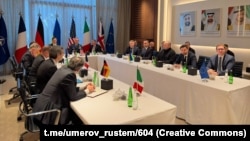
What You Need To Know: As US-led talks between Russia and Ukraine get underway in Abu Dhabi on November 10-11, the European Union and its member states are once again fretting about who will represent them, having failed to secure a seat at the top table in the Emirati capital.
But they will not be completely absent from Abu Dhabi.
The national-security advisers of the so-called “E3” -- France, Germany and the non-EU United Kingdom -- will be there, as will their Italian counterpart.
Bjorn Seibert, European Commission President Ursula von der Leyen’s head of cabinet, Anna Maria Boura, the main foreign policy adviser to European Council President Antonio Costa; and Geoffrey Van Leeuwen, NATO Secretary-General Mark Rutte’s chief of staff, are also attending.
But like the representatives of the four major European nations, they will not be in the negotiating room. Instead, according to European diplomats who spoke to RFE/RL, they will spend their time “waiting in the corridors” and being briefed by the United States before and after the talks.
In that sense, not much has changed since Donald Trump took office in early 2025. Despite multiple rounds of peace talks in various locations and formats, Europe remains very much on the sidelines.
Deep Background: What has made the Europeans particularly nervous this time, however, is a comment by Jared Kushner, the US president’s son-in-law and peace envoy, who last week suggested that a broader European security architecture could be part of any peace deal.
The Europeans have responded defiantly, noting that nothing can be decided about them -- or Ukraine for that matter -- above their heads and without their consent.
They have also pointed out that they have real cards to play here, including the wide-ranging sanctions imposed on Moscow and the freeze on Russian assets. Moreover, it is up to them to decide whether and when Ukraine can join the EU.
Yet despite all the tough talk, they will, once again, spend time this week discussing whether to agree on a single envoy -- or perhaps several -- to represent them in future talks.
Having an envoy should at least improve their chances of securing a seat at the table, according to EU officials supporting the initiative.
The issue will be discussed when EU leaders assemble for an informal summit in Dublin on November 13, and potentially even more informally a day earlier, when leaders from across Europe, with the exception of Belarus and Russia, descend on the Irish capital for the semiannual European Political Community (EPC) gathering.
The debate was prompted by a rather angry letter that Italian Prime Minister Giorgia Meloni sent to Costa last week, and which was seen by RFE/RL. In it, she said that she was “convinced that we all realize how, by projecting the image of Europe acting in an uncoordinated manner, we are simply playing into the hands of those who want this war to continue. I think this is unacceptable, considering that human lives and the future of our security are at stake.”
She was referring to the various formats in which European nations had participated in a seemingly uncoordinated manner according to her, including the recent phone call between Russian President Vladimir Putin and Finnish President Alexander Stubb accompanied by Norwegian Prime Minister Jonas Gahr Store.
Meloni added that “Europe needs to speak with a single, authoritative voice,” but she was also quick to point out that “I am not asking for a place for Italy in this or that format.”
In a more diplomatic response, Costa thanked Meloni for setting out her concerns “so clearly” and underlined that “Europe needs to act with coherence, unity and determination.”
Drilling Down
- Some officials RFE/RL has spoken to wonder whether Costa himself encouraged Meloni to write the letter, especially as the two potentially stand to gain the most from raising the issue.
- Under the EU treaties, the European Council president has a role in representing the bloc internationally. Yet it has become clear that France and Germany are unlikely to give up their own potential seats at the negotiating table in favor of Costa.
- Italy, meanwhile, is another major EU power, behind France and Germany. And while Meloni has made it clear that she isn't seeking special treatment for Rome, she has previously suggested that former Italian leaders, such as Mario Draghi, could serve as an envoy.
- Interestingly, Italy’s national-security adviser is also in Abu Dhabi, even though a more formal decision to include Rome would likely prompt other major EU nations, such as Poland and Spain, to push for a seat at the table, too.
- What is clear is that few want to see Gahr Store and Stubb continue in a mediating role. Other Nordic and Baltic nations, such as Russia hawks Denmark, Estonia, Lithuania, and Sweden, were furious about the call with Putin and the lack of prior coordination among the northern countries.
- Diplomats form several other countries also point out that Norway isn’t an EU member, while Stubb doesn’t attend EU summits, as that is the job of the Finnish prime minister.
- In private, some have also expressed irritation at Stubb's very public efforts to position himself at the center of any negotiations.
- Ultimately, the EU is likely to emerge from the Dublin summit in much the same position as before: without a single envoy to represent the bloc.
- One source noted that “we are constantly seeing pushing and pulling in all directions. The E3 have so far established themselves fairly strongly, and they have not done a bad job.” Another diplomat added that “the E3 won’t go away, that’s for sure.” A third predicted that there might be a “landing zone” agreed in Dublin involving the E3 and “stronger institutional backing but no definite decision.”
Briefing #2: The Safeguards Montenegro (And Other EU Newcomers) Will Face
What You Need To Know: In its annual EU enlargement report last week, the European Commission reiterated its hope that Montenegro will conclude accession negotiations by the end of the year.
To date, 23 of the 33 main policy chapters have been provisionally closed, and the EU executive believes that not only the remaining 10 but also two less talked-about additional chapters -- numbers 34 and 35 – can be concluded by then. Most European diplomats consider that an extremely ambitious goal.
Unlike the 33 main chapters, these two are usually dealt with toward the very end of the accession process, as work on drafting the accession treaty gathers pace. The European Commission hopes the treaty can be signed with Podgorica in June 2027.
We are not quite there yet. The working group tasked with drafting the treaty is still meeting just once a week in Brussels, rather than almost daily, as tends to happen when the process really picks up speed.
Chapter 34 should be relatively straightforward to conclude. It deals with institutions, meaning the rules needed to ensure that Montenegro is fairly represented in EU institutions, including having its own commissioner and a number of members in the European Parliament that reflects the size of its population.
Deep Background: Chapter 35, however, might prove to be trickier.
Nominally titled “Other Issues,” it allows EU member states to include a wide range of additional provisions.
Sometimes the chapter contains little of substance, but this time Montenegro may not be so lucky.
The EU is planning to include new safeguard clauses proposed by the European Commission in early October.
These measures essentially create something of a two-tier system between current EU member states and newcomers, who could now face being stripped of both money and voting rights more easily than is possible for the bloc’s current crop of 27 countries.
As the frontrunner for EU accession, Montenegro would be the first test case for the new rules, other countries hoping to join in the coming years -- including as Albania, Moldova, and Ukraine – could also face these safeguards.
Brussels has proposed the measures partly to reassure member states skeptical of further enlargement and, as several EU diplomats put it, “to avoid another Hungary.”
This is, of course, a reference to Brussels’ decade-long struggles with Viktor Orban’s government over various rule-of-law issues, which never resulted in Budapest losing its voting rights as that move required unanimity -- something that always proved elusive.
Drilling Down
- So, what is the European Commission proposing and how will the member states incorporate the measures into Montenegro’s accession process? Diplomats from EU member states held an initial discussion in late October, and they will return to the issue in the coming weeks. A readout seen by RFE/RL shows deep divisions among European capitals over how strict the safeguards should be.
- Three of the safeguards -- covering economic issues, home affairs, and the EU's internal market -- were also on the table in previous enlargement rounds. If the European Commission or a current member state identifies problems involving a newcomer in one of these areas, the EU can quickly introduce temporary restrictions to prevent those problems from affecting other member states. Previously, these safeguards could be activated only during the first three years after accession. The Commission is now proposing to “significantly extend” that period, although it has not specified a new limit.
- In discussions among EU member states, two of the main enlargement skeptics, France and the Netherlands, have called for even more safeguards in other areas, saying that that they are necessary to secure both public and parliamentary backing for adding new members to the union. Denmark agreed with this, while Belgium and Finland also spoke positively about the measures.
- Several other member states, however, including Italy and Spain, said that the proposed measures should be exceptional and temporary and should not create some sort of second-tier membership. Austria, one of the biggest supporters of EU enlargement in the Western Balkans, added that debates over safeguards must not delay Montenegro's accession
- Then there is the “postponement clause” -- another tool available to the European Commission and current member states can use. As the name suggests, the idea here is to simply delay another state joining the bloc if rule-of-law issues in the candidate country are considered a threat.
- Normally, this clause applies for only one year, but the idea is now to extend this period given that it often takes more than 12 months to ratify a new EU accession treaty. Again, judging from discussions among diplomats, countries like Belgium, Denmark, and France are very much in favor of a strong postponement clause.
- But it is another safeguard, an entirely new one, that has provoked the most debate: the institutional safeguard clause. Under the commission's proposal, it could apply for up to 15 years after accession and, if triggered, could lead to the suspension of Montenegro's EU funding and even its voting rights in the Council -- measures reminiscent of those some EU countries have previously sought against Hungary..
- The big difference, however, would be the voting threshold. Under the proposed safeguard mechanism, sanctions put forward by the European Commission would be "deemed adopted" unless rejected by a qualified majority of member states -- a procedure known in Brussels as reverse qualified majority voting.
- Some countries, including Greece and Spain, have voiced their opposition to this new, potential tool but others ae very much in favor, including heavyweights such as France and Germany, as well as Denmark and the Netherlands.
- The biggest unresolved question is how to trigger the clause. The Netherlands, Germany, and Denmark support reverse qualified majority voting, while countries such as Spain and Poland want at least a qualified majority of member states (55 percent representing 65 percent of the total EU population) voting in favor before the sanctions can take effect.
Looking Ahead
The big events this week will be the two summits in Dublin: first, the meeting of the European Political Community on November 12, followed by an informal EU summit the next day.
Also worth watching is the European Parliament's two-day plenary session in Brussels on November 11-12, where lawmakers will discuss efforts to secure the return of Ukrainian children abducted by Russia, as well as the prospect of further EU sanctions against Moscow.
That's all for this week!
Feel free to reach out to me on any of these issues on X @RikardJozwiak, or via e-mail at jozwiakr@rferl.org.
Until next time,
Rikard Jozwiak
If you enjoyed this briefing and don't want to miss the next edition subscribe here.