




US President Donald Trump said Russia and Ukraine had agreed to an energy cease-fire, following his earlier decision to ease restrictions on Russian diesel exports and his subsequent call for a change in leadership in Kyiv.
"Effective immediately, there is an ENERGY CEASEFIRE in the War between Russia and Ukraine," he wrote on October 11 on Truth Social. "Both parties have agreed. Do not break it!"
Shortly after, Ukrainian President Volodymyr Zelenskyy said Kyiv supported the initiative and was waiting for details from Washington. He had earlier signaled a willingness to halt strikes on Russian oil refineries, provided Moscow stopped attacking Ukraine's energy infrastructure.
"It is important that Russia support it as well," Zelenskyy wrote on X. "Ukraine always FULLY supports steps toward de-escalation, the protection of lives, and the decisions needed to end the war and guarantee lasting peace."

There was no immediate confirmation from Moscow of Trump's announcement, which came amid continued Russian strikes on Ukrainian cities and Ukrainian drone attacks on technology facilities inside Russia.
Previously, the Kremlin has been rejecting calls for any cease-fire agreements, seeking to pressure Kyiv into unfavorable deal by heavily targeting energy sites in Ukraine and leaving thousands without heat or electricity amid freezing temperatures in winter.
Trump has in the past declared that the sides had agreed to cease attacks on energy sites -- most recently on September 14 -- only to see Russia continue its strikes, ending any hopes of a lasting truce.
Trump's latest statement came two days after Russian President Vladimir Putin and Trump announced a deal to temporarily loosen curbs on Russian diesel exports, a decision Zelenskyy characterized as a sign of US "weakness" and a "gift" to Putin.
The Ukrainian president argued that renewed Russian energy revenues would encourage Moscow to prolong its long-running invasion, now in its 56th month.
Trump later said that Ukraine should "get a new leader," blaming Zelenskyy for the lack of a deal to end Russia's war against his country and demanding Kyiv "damn well stop" hitting Russian oil refineries amid a global energy shortage largely caused by the US war with Iran.
The US president made ending Russia's war on Ukraine war a priority when he began his current term in January 2025, but Kyiv and Moscow remain far apart in their negotiating positions.
The Kremlin has been offering no concessions and has been sticking to hard-line demands including Russian control over the portion of the Donbas it has been unable to seize in battle.
In addition, Russia has continued its relentless bombardment of Ukrainian regions. Since the beginning of this year, however, Kyiv has increasingly responded with a campaign of its own.
Ukrainian long-range strikes have been targeting Russian military and oil-refinery facilities in an effort to curb revenues for the invasion.
"Ukraine will be ready to stop attacks on Russian refineries if Russia stops attacking our energy infrastructure. Any de-escalation steps must be mutual and with real guarantees," Zelenskyy wrote on Telegram on October 11.
Moscow Continues Daily Strikes, Kyiv Targets Yandex
Hours after Trump's announcement of the energy cease-fire, Ukrainian officials reported fresh Russian strikes on the country's civilian and energy infrastructure.
In the country's second-largest city of Kharkiv, at least three people, including two teenagers, were killed and 25 others were injured when Russian forces struck near a local grocery store, regional governor Oleh Syniehubov said.
Zelenskyy said Russia had also targeted energy infrastructure in the region. "Unfortunately, Ukrainian skies have been infested with Russian Shahed drones all day today," he added in his daily video address.
Three more people were killed in a jet-powered drone strike in Ukraine's western region of Ivano-Frankivsk. The attack damaged a local hotel and left three other people injured, according to the city authorities.
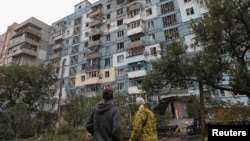
Earlier in the day, in Slovyansk, in the eastern Donetsk region, a Russian air strike damaged two apartment buildings, destroying an entire entrance section of a five-story block. At least four people were reported injured, while rescuers worked to free residents trapped in apartments, according to RFE/RL's Ukrainian Service.
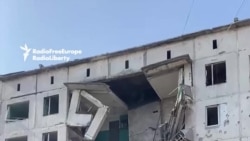

"I can't breathe," local resident Svitlana told RFE/RL at the site of the aftermath with her hands shaking. She was walking on crutches, she said, adding that rescuers have carried her down from her ruined apartment on the fourth floor.
"I feel bad," Svitlana said. "We were sleeping... Now nothing in the apartment is left intact."
Elsewhere, in the southeastern city of Dnipro, Russian drones damaged an apartment building and set fire to warehouses and vehicles, injuring four people, including two eight-year-old girls, according to regional authorities.
In the southern port city of Odesa, an attack late on October 10 damaged a two-story residential building, destroying three apartments and setting the roof ablaze.
Ukraine has meanwhile continued its retaliatory strikes on Russian technology infrastructure, targeting facilities operated by Yandex, the country's leading Internet search and technology company.
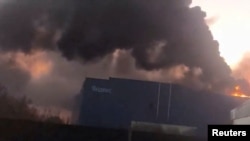
A drone strike on October 11 forced the complete shutdown of a Yandex data center in Russia's Vladimir region.
Yandex said the facility had ceased operations and that some of its services were unavailable as a result. It reported no casualties. According to Russian reports, Yandex's taxi and food delivery services were disrupted in Moscow following the drone attacks.
Often described as the Russian Google, Yandex operates widely used search, mapping, and other digital services, and is a major developer of artificial intelligence. Its data centers support both consumer services and computing infrastructure used to develop AI models, making their disruption potentially significant for Russia's technology sector.
The latest attack followed a strike on Yandex's Sasovo facility in the Ryazan region overnight on October 7-8, which reportedly disabled two of the company's three main AI-development supercomputers, and another on October 9 that knocked out part of its data center in Kaluga.
European Leaders Back Ukraine
Amid Trump's harshest criticism of Zelenskyy since the two had improved ties following a highly contentious meeting at the White House in February 2025, European leaders have reaffirmed their support for the Ukrainian president and country's defensive efforts.
"This is not the time to ease pressure on Russia, and Europe won't," EU foreign policy chief Kaja Kallas wrote on X on October 10, condemning the diesel agreement and warning it would increase Moscow's war revenues.
She added that EU foreign ministers planned to approve new sanctions listings on October 12. Meanwhile, some of the bloc's biggest member states, including Germany, confirmed they would maintain their strict sanctions regime despite Washington's shift.

Finnish Prime Minister Petteri Orpo described Trump's agreement with Russian President Vladimir Putin as a "terrible disappointment," while Swedish Prime Minister Ulf Kristersson noted that the upcoming EU package would target 1,600 entities within Russia's military-industrial complex.
Over the past day, Zelenskyy had a series of phone with French President Emmanuel Macron, Finnish President Alexander Stubb, and Norwegian Prime Minister Jonas Gahr Store, discussing air defense and continued pressure on Moscow.
“The Russians must feel that they will have no capacity left to prolong the war,” Zelenskyy said after speaking with Macron.
He also confirmed that Finland would deliver specialized ammunition for Ukraine's F-16 fighter jets in the coming days to assist in intercepting Russian Shahed drones.
Separately, UK Prime Minister Andy Burnham said on October 10 that “the past 24 hours had been difficult for Ukraine,” according to Downing Street, adding that the UK would continue strengthening sanctions on Russia independently.
Meanwhile, the US-based Institute for the Study of War (ISW) warned in an assessment on October 9 that the unilateral easing of restrictions would benefit Russia's war effort without securing a comparable concession from Moscow.
In a follow-up assessment on October 10, the think tank noted that Putin utilized the call to blame Ukraine for stalled peace talks, citing alleged Ukrainian strikes on Russian election infrastructure during September's State Duma elections.
ISW said that this allegation was unsupported by evidence and that Putin's "unchanged war aims demonstrates the Kremlin’s continued unwillingness to accept any compromised peace proposals on any terms that fall short of fulfilling Russia’s maximalist demands of Ukraine’s complete capitulation."

