



Welcome back to The Farda Briefing, an RFE/RL newsletter that tracks the key issues in Iran and explains why they matter.
I'm RFE/RL correspondent Kian Sharifi. In this edition, I'm looking at a mysterious recruitment flyer that appeared near Russia's embassy in Tehran, offering Iranians cash to fight in Ukraine. Is it real, a scam, or something else entirely?
What You Need To Know
• A Shadow Job Ad: A strange recruitment flyer appeared near the Russian Embassy in central Tehran this week, promising Iranians tens of thousands of dollars to join Moscow's war in Ukraine. The offer sits in a gray zone between plausible and absurd, and that ambiguity is why's it worth watching.
• Lawyer Death Triggers Calls For UN Investigation: The December 5 death of Khosrow Alikordi, an attorney known for representing political prisoners, has prompted Iranian human rights lawyer Nasrin Sotoudeh to call for a UN fact-finding committee to investigate the case. She told RFE/RL's Radio Farda that "there are ample ground to doubt" the coroner's report, which listed his cause of death as a heart attack.
• US Seizes Iran-Linked Tanker Off Venezuela: The United States this week seized an oil tanker off the coast of Venezuela that had been under Treasury Department sanctions since 2022 for allegedly helping smuggle Iranian oil as part of a network led by Ukrainian national Viktor Artemov. Analyst Dalga Khatinoglu said the seizure undermines Iran's "shadow fleet" and deals a financial blow to the IRGC, which exports about a third of Iran's oil.
The Big Issue
$20,000 And A Contract
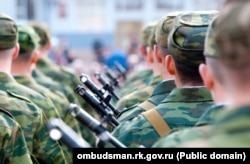
The ad bears a black‑and‑white Russian coat of arms and claims to represent Russia's Defense Ministry. It targets Iranian men aged 18–45, and women only if they have medical training. The flyer promises a $20,000 signing bonus and around $2,000 in monthly pay, plus housing and language classes, while noting an unspecified commission will be deducted from the first salary.
The contact details are anything but official: a WhatsApp number registered in Armenia, a Gmail address, and a Telegram channel. The positions listed range from assault troops and drone operators to drivers and support roles.
On December 9, the Russian Embassy in Tehran publicly disowned the flyer, calling it the work of "opportunistic individuals" and stressing that no Russian state body is involved. The embassy went further, branding the document -- and any similar letters -- as fake and "criminal" in nature.
But that doesn't quite settle it. Russia has repeatedly relied on deniable, semiofficial, and outright clandestine channels to recruit fighters abroad, and the structure of the offer in Tehran broadly mirrors those seen elsewhere: quick cash, foreign adventure, and a vague promise of status and residency.
RFE/RL's Radio Farda contacted the person behind the Armenian WhatsApp number. They insisted the ad was "official" and claimed it had been coordinated with Iranian authorities, but offered no evidence. Tehran, for its part, has kept quiet; Iranian officials have yet to comment publicly.
Why It Matters: Whatever the status of the Tehran ad, it surfaces against the backdrop of an aggressive Russian push to bring in foreign fighters. Ukrainian officials say Moscow has recruited at least 18,000 foreign nationals from 128 countries, while more than 11,000 North Koreans are reportedly serving in Ukraine under a military cooperation agreement with Pyongyang.
Russia's shopping list for manpower now spans Cuba, Syria, Central Asia, Nepal, India, Kenya, Jordan, and beyond. The methods range from promises of fast money and passports to thinly veiled coercion, including pressure on migrant workers inside Russia who face the loss of residency or citizenship if they refuse to sign up.
This foreign recruitment drive allows the Kremlin to delay or dilute another mobilization at home. The September 2022 draft triggered a rush for the borders and deepened public unease. Since then, Moscow has clearly preferred checkbook incentives and expendable foreign labor over politically risky domestic conscription.
Western intelligence estimates suggest Russia has suffered more than 1 million casualties, including about 250,000 killed, since the full‑scale invasion began in February 2022.
What's Being Said: John Hardie, deputy director of the Russia program at the Foundation for Defense of Democracies in Washington, told Radio Farda he cannot verify whether the Tehran flyer is genuine, but it fits within a broader pattern. Russia, he noted, has built up a track record of recruiting foreign nationals from poorer countries to fight in Ukraine, often targeting men with limited economic prospects.
At the same time, Hardie pointed out that the design and wording of the Tehran brochure do not fully match Russia's usual recruitment materials. That inconsistency is one reason some analysts suspect either a sloppy local operation, a scam piggybacking on Russia's war, or some form of low‑cost intelligence fishing.
Nicole Grajewski of the Washington, D.C.-based Carnegie Endowment voiced similar doubts, arguing that if Moscow truly wanted to tap Iran as a manpower pool, a more likely pathway would be coordination with the Iranian state.
If the advertisement is authentic, however, it would be the first known attempt to openly recruit Iranian citizens into the Russian military, following earlier efforts in Central Asian states and Cuba.
That's all from me for now.
Until next time,
Kian Sharifi