




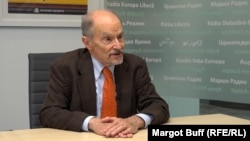
WASHINGTON -- The United States has new powers to increase economic pressure on Russia, but their impact will depend on whether the Trump administration uses them consistently and makes clear what it wants Moscow and other governments to do, former US diplomat Daniel Fried told RFE/RL.
“The administration needs to stop sending mixed messages,” Fried said in an interview on September 29, arguing that the newly enacted Russia sanctions law could provide Washington with meaningful leverage over Moscow if implemented alongside diplomacy and coordination with US allies.
Fried, whose national-security career spanned seven US administrations, including service as US ambassador to Poland and as the State Department’s coordinator for sanctions policy, said the law gives the administration tools to target Russia’s energy revenues and countries that continue to purchase Russian oil and gas.
“The right moment is right now,” said Fried, who retired from the State Department in 2017.
Fried said that if he were still serving as sanctions coordinator, he would be traveling to countries such as China and India to discuss reducing their purchases of Russian energy and to negotiate arrangements that could lower their reliance on Moscow.
The Lindsey O. Graham Sanctioning Russia and Iran Act of 2026, which President Donald Trump signed on September 18, targets Russian officials, banks, the energy sector, and vessels associated with Russia’s so-called shadow fleet of sanctions-evading oil tankers. It also provides the administration with authority to impose tariffs on countries that continue significant purchases of Russian oil and gas.
The law is not perfect, Fried said, but it provides sufficient flexibility to be useful.
“I could have done it, and if I could do it, somebody else could,” he said.
“What you need to do is have that law reduce Putin’s income from oil and gas sales,” Fried said. “If you do that, you’ve done something.”
Fried also said sanctions could affect Russia indirectly by forcing it to sell oil at a larger discount. “If they do that, every dollar that they don’t earn is a success for the law,” he said.
But Fried said the legislation would have limited effect if other signals from Washington suggested that the administration was more concerned about keeping Russian energy supplies on global markets than reducing Moscow’s revenues.
He cited Trump’s comments that Ukrainian attacks on Russian refineries were contributing to higher diesel prices. “That sends a mixed message that we really want to see more Russian oil and diesel on the market rather than less,” Fried said.
“Those mixed messages from Washington undercut the law, but, more importantly, they undercut good policy,” he added.
New Test For Washington’s Russia Policy
Fried’s comments came as new reports pointed to a possible expansion of US-Russia economic discussions alongside diplomatic efforts to end Russia’s war against Ukraine.
The Atlantic reported that US special envoy John Coale has proposed a plan under which Russia could release political prisoners in exchange for some sanctions relief. The proposal was first raised several months ago and remains at an early stage, according to the report.


The initiative could potentially open the way to renewed US-Russian economic engagement while the war continues, The Atlantic reported.
The State Department has not commented publicly on the report.
Coale has pursued a similar approach with Belarus, which has released some 500 people considered political prisoners in exchange for sanctions relief. Washington has also begun discussions with Belarus over expanded economic ties, including a potential US purchase of Belarusian potash.
Russia has entered those discussions because European sanctions could require Belarusian potash to be transported through Russian territory, according to The Atlantic.
Meanwhile, Kirill Dmitriev, a senior envoy for President Vladimir Putin, met with Trump’s envoy Jared Kushner on September 28, a senior US administration official confirmed to RFE/RL on condition of anonymity. The official provided no further details.
Dmitriev reportedly met on September 29 with officials from the US Treasury and Energy departments.
Dmitriev has been a key Russian interlocutor in contacts with the Trump administration and has previously participated in discussions involving economic and energy issues as well as efforts to resolve the war.
Fried said the new sanctions law’s flexibility could be useful precisely because Washington can combine economic pressure with negotiations.
He said the US should tell other governments that it intends to enforce the restrictions while also offering them ways to reduce their purchases of Russian energy.
Fried also stressed the importance of working with European governments and the G7.
“A message just from America is going to have less weight than a message from all of the economic pillars of the free world,” Fried said.
Lawmakers Urge More Pressure
The possibility of sanctions relief has drawn opposition from lawmakers who support maintaining economic pressure on Moscow.
Senator Dick Durbin of Illinois, the top Democrat on the Senate Judiciary Committee, told RFE/RL on September 29 that he hoped "the president will use his power under the Sanction Act to tell the major trading partners of Russia” to comply with the new US measures.
The bipartisan Congressional Ukraine Caucus also said on September 29 that the United States should continue increasing sanctions pressure on Russia while its full-scale invasion of Ukraine continues.
The statement was issued by the caucus’s four co-chairs -- Democratic Representatives Marcy Kaptur of Ohio and Mike Quigley of Illinois, and Republican Representatives Brian Fitzpatrick of Pennsylvania and Joe Wilson of South Carolina.
“Two weeks ago, Congress passed the most significant Russia sanctions legislation since 2017,” the lawmakers said.
“As long as Russia’s full-scale invasion to conquer Ukraine and threaten our European allies continues, the United States must take every step necessary to stop war criminal Vladimir Putin in his tracks.”
They specifically responded to reports that the administration was considering easing sanctions in exchange for political-prisoner releases.
“Sanctions relief will embolden Russia and prolong the war,” the lawmakers said.

