

'Of Course,' Iran Will Play In Soccer World Cup, FIFA Chief Says
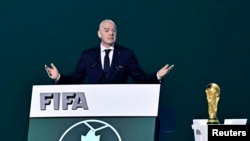
FIFA President Gianni Infantino said "of course" Iran will compete in World Cup matches in the US during a meeting of the soccer governing body's congress in Vancouver, Canada -- held without the Iranian delegation after an incident at the airport upon its arrival.
"Let me start at the outset. Of course, Iran will be participating at the FIFA World Cup 2026. And, of course, Iran will play in the United States of America," Infantino said on April 30.
"And the reason for that is very simple, we have to unite. It is my responsibility, our responsibility."
US President Donald Trump said he was "OK" with Iran playing at the world's most-watched sporting event.
"Well, if Gianni said it, I'm okay. Did Gianni say it?...You know what? Let them play. Well, Gianni's fantastic, he's a friend of mine. He talked about it," Trump told reporters.
Iran qualified for the tournament, set for June 11-July 19, but its participation has been in doubt amid the ongoing US-Israeli war with Iran.
Tehran requested alternative venues for matches in the US, but the request was denied.
Iranian soccer federation officials, including President Mehdi Taj, were scheduled to attend the congress but turned back at the Toronto airport after what Tehran described as “unacceptable behavior” by Canadian immigration authorities.
Taj is a former member of Iran's Islamic Revolutionary Guards Corps (IRGC). Canadian officials said entry decisions were made on a case-by-case basis and individuals linked to the IRGC, which Canada designates as a terrorist organization, would not be allowed in the country.
With reporting by Reuters
Israel Says May Be Forced To 'Act Again' Against Iran
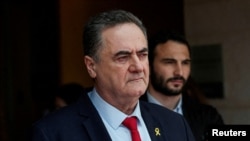
Israeli Defense Minister Israel Katz said on April 30 his country may be forced to "act again" against Iran to ensure that Tehran is not "a threat" again.
"US President Donald Trump, in coordination with Prime Minister Benjamin Netanyahu, is leading the efforts to achieve the campaign's objectives, to ensure that Iran does not once again become a threat to Israel, the United States, and the free world in the future," a statement published by Katz's office said.
"We support this effort and are providing the necessary support, but it is possible that we may soon have to act again to ensure these objectives are met," it added.
The joint US-Israeli military campaign against Iran stopped on April 8 due to a cease-fire agreed upon between Washington and Tehran.
A cease-fire between Israel and Lebanon followed, significantly reducing hostilities in the region. However, both Israel and Hezbollah have continued to exchange attacks in southern Lebanon.
A militant group and political party that controls much of southern Lebanon, Hezbollah is considered a terrorist organization by the US, while the European Union has blacklisted its armed wing but not its political branch.
Starmer Accuses Iran Of Trying To Harm British Jews
British Prime Minister Keir Starmer accused Iran on April 30 of trying to "harm British Jews."
"We need stronger powers to counter the sinister threat from countries like Iran, because we know they want to harm British Jews," he said, according to a statement from the British prime minister's office.
His remarks came a day after a man attacked two Jewish men with a knife in a street in north London.
Starmer has previously stated that Iran has been trying to target British Jews. In late February, he warned that the Iranian regime poses a direct threat to the Jewish community in the UK. He reiterated those concerns in mid-April about malign state actors using proxies against Jewish targets.
Starmer did not provide further details in his April 30 statement about how Iran was trying to harm Jews -- or if Iran was connected to the stabbing in north London.
Since the US-Israeli war with Iran began, attacks on Jews have increased in Britain
Trump Urges Merz To Prioritize Ukraine Over Iran
US President Donald Trump has said that German Chancellor Friedrich Merz should "spend more time on ending the war with Russia/Ukraine" and "less time on interfering with those that are getting rid of the Iran Nuclear threat."
Trump made the comments on his TruthSocial platform.
Trump has been at loggerheads with Merz in recent days after the German chancellor said that the Iranians were humiliating the United States in talks to end the war.
The US president responded on April 28 that Merz didn't know what he was talking about. On April 29, Trump said that Washington was "studying and reviewing" the possible reduction of US troops in Germany.
Iranian Parliament Speaker Says Again That Iran Intends To Control Strait Of Hormuz
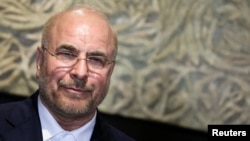
Iran parliament speaker, Mohammad Baqer Qalibaf, has reiterated Tehran's intention to control the Strait of Hormuz.
In a post on X to mark Persian Gulf National Day, Qalibaf said that "by exercising control over the Strait of Hormuz, [Iran] will ensure that it and its neighbors enjoy the precious blessing of a future free from the presence and interference of America.
Persian Gulf National Day marks the anniversary of a historic military victory in 1622, when forces of the Safavid Empire expelled the Portuguese from the Strait of Hormuz.
"After 115 years of occupation, we expelled the European colonizers from the Persian Gulf, and we celebrate Persian Gulf Day in honor of this victory," Qalibaf said.
Iran has effectively closed the Strait of Hormuz, a key artery for global oil and gas supplies, to most international shipping, while the US Navy is stopping Iranian ships entering or exiting Iranian ports.
There have been reports that the US is considering a new proposal from Iran to end the war in which Tehran would open the Strait of Hormuz to international shipping.
Moscow's Military Axis With Iran Impacting Battlefield, Ex-Pentagon Analyst Matthew Tavares Says
WASHINGTON -- The deepening military partnership between Moscow and Tehran has moved beyond simple arms deals and into a sophisticated cross-continental defense ecosystem, according to a former Pentagon analyst.
Matthew Tavares, who specialized in Russian military strategy and US foreign policy, suggested the West is no longer facing a partnership of convenience but a strategic alignment that spans the tactical, operational, and strategic levels of warfare.
In an interview with RFE/RL on April 29, Tavares breaks down the "democratization" of precision strikes, the vulnerability of high-end US assets, and why the externalization of Iran's defense industry may make its military infrastructure nearly impossible to dismantle.
To read the whole interview, click here.
Supreme Leader Mojtaba Khamenei Issues Rare Statement, Says Iran To Secure Strait Of Hormuz
- By Kian Sharifi
Iran's Supreme Leader Mojtaba Khamenei has issued a defiant statement where he pledged to secure the Gulf region and eliminate what he described as "the enemy's exploitation of the waterway," a reference to a US blockade of vessels calling at Iranian ports after passing through the Strait of Hormuz.
In a rare statement since he was made leader following the death of his father, Ayatollah Ali Khamenei in US and Israeli air strikes on February 28, Khamenei said Iranians both inside and outside will guard the country's maritime, land, and air borders.
The younger Khamenei, 56, has not appeared in public since his father's death, and US officials have said that he is believed to have been severely wounded in the strikes.
Blockage of the strait -- Iran has blocked all maritime traffic except those vessels it approves -- has ravaged a key supply route, sending oil prices higher and compounding concerns about the war's effects on the economy, both globally and at the gas pump, where prices have also jumped.
Iran's Currency Falls To Record Low As War, US Blockade Rattle Economy
Iran's currency has fallen to a record low against the US dollar as the two-month-long conflict rattles the country's sanctions-hit economy.
Air strikes by the United States and Israel, launched at Iran on February 28, along with the American naval blockade on Iranian ports and vessels, have disrupted Tehran's vital oil exports, hampered domestic production, and fueled inflation.
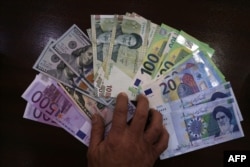
Iran's national currency, the rial, dropped to a new low of 1.81 million to the US dollar on April 29 before rebounding the next day. The rial has seen its value fall by nearly 15 percent in recent days, according to Iranian media.
To read the full report, click here.
Iranian President Says US Naval Blockade 'Doomed To Failure'
Iranian President Masud Pezeshkian said on April 30 that the US naval blockade of Iranian ports is contrary to the interests of regional countries and will ultimately fail.
In a written message read by government spokeswoman Fatemeh Mohajerani at a meeting marking Persian Gulf National Day, Pezeshkian said the security of the region "only makes sense in light of collective cooperation and mutual respect for the sovereignty of its coastal states."
"Any attempt to impose a blockade and maritime restrictions on it is contrary to international law and against the interests of the nations of the region and global peace and stability, and is doomed to failure," he said.
The US military began a naval blockade of Iran on the orders of US President Donald Trump on April 13, after Iran-US talks in Islamabad reached a deadlock. In contrast, Tehran, which had blocked the Strait of Hormuz since the start of the US-Israeli war with Iran on February 28, continues to tightly control the strategic waterway.
In his latest remarks, Trump said on April 29 that he intends to keep Iran under a naval blockade until Iran's government agrees to a deal to address US concerns about its nuclear program.
The global price of crude oil reached an unprecedented jump of $126 per barrel after Trump's announcement.
Trump Welcomes UAE Decision To Leave OPEC
US President Donald Trump welcomed the decision by the United Arab Emirates (UAE) to withdraw from the Organization of the Petroleum Exporting Countries (OPEC).
"I think it's great," Trump said at a news conference, calling UAE President Mohammed bin Zayed Al Nahyan "very smart" and saying "he maybe wants to go his own way."
OPEC is a group of major oil-producing countries that coordinate how much oil they produce to influence global oil prices.
Trump called the UAE's move "a good thing for getting the price of gas down."
The UAE announced on April 28 its decision to withdraw from OPEC and OPEC+ as of May 1.
This was not unexpected for experts, as the UAE's oil production capacity is greater than the amount allocated to the country under OPEC regulations.
Trump hinted that the UAE's decision would likely be problematic for OPEC.
Following the announcement of the UAE's decision, oil prices temporarily declined. The impasse in Iran-US negotiations, and especially Trump's recent announcement that the United States will continue its blockade of Iranian ports, caused another significant jump in oil prices.