

Turkey Reportedly Preparing Buffer Zone Against Potential Wave Of Iranian Migration
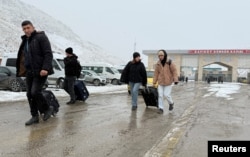
Reporting in Turkish media says the country’s Foreign Ministry told members of the parliament’s Foreign Affairs Committee that in the event of any intervention in Iran or instability there, the creation of a “buffer zone” along the Iran–Turkey border would be necessary to prevent migrants from entering Turkish territory.
According to Turkiye Today, a Turkey-based English news site that often cites official sources, the Turkish Foreign Ministry briefed lawmakers behind closed doors on the latest developments in the Middle East, particularly the situations in Iran and Syria, and said Ankara has prepared a Plan A, B, and C “for every situation.”
The report, published over the weekend, said officials stressed during the meeting that Turkey “does not view favorably any intervention in regional countries or destabilization of the region” but at the same time is preparing itself for all scenarios.
"In the event of migration, we believe there needs to be a buffer zone to ensure those coming stay on the Iranian side," officials were quoted as saying
Turkish Foreign Ministry officials also presented casualty figures in Iran’s recent protests, telling lawmakers that more than 4,000 people have been killed and around 20,000 injured during the unrest. Other sources have indicated that the actual death toll could be much higher.
Turkey has previously established buffer zones along its southern border with Syria -- a move that at the time was aimed at controlling the security and migration fallout from Syria’s civil war.
Roger Waters Apologizes For Iran Comments
Singer-songwriter and former Pink Floyd bassist Roger Waters has posted a message on X seeking to clarify controversial comments he made last week to British TV presenter and media personality Piers Morgan in which he said that "Iranians do not want regime change."
Waters apologized and stated that he "misspoke" when he said "I support the regime."
"What I support is the country of Iran and I support its people's right to self-determination," he said.
You can watch his full statement here:
Some Iranian Officials 'May Oppose Crackdown," Says Think-Tank
The Institute for the Study of War (ISW), a US-based defense and security think tank, says the fact that some Iranian officials have continued to leak "damning information" about Tehran's brutal suppression of the recent anti-government protests "indicates that some regime personnel may oppose the regime’s crackdown."
The ISW also said in its January 25 update on the situation in Iran that the government has still not reestablished international Internet access in the country and that there "continues to be an internal debate within the regime about restoring it."
"The debate primarily seems to be between regime factions that assess that restoring the internet could cause a resumption of protests and factions that assess that the economic toll of the internet shutdown could cause internal unrest," the institute said.
Reza Pahlavi Thanks Iranian Health-Care Workers
The son of Iran's last shah, former crown prince Reza Pahlavi, who lives abroad, has posted a message on X for health-care workers in Iran, expressing "heartfelt gratitude" to them for playing a "vital role" in treating those wounded in the protest crackdown "beyond the reach and sight of the regime’s unclean hands."
His post on January 25 came on the same day that the Iran Human Rights group said that Iranian security forces have unleashed a new wave of repression by "violently arresting" doctors and volunteers who were helping injured protesters.
Good morning. The US-based rights organization HRANA, whose figures RFE/RL has been regularly citing since the violent crackdown began in Iran, says its confirmed death toll as of Day 29 of the protests is now 5,848 and the number of fatalities still under investigation is 17,091.
We are now closing the live blog for today. We'll be back again tomorrow morning at 7:30 a.m. Central European time to follow the latest developments in Iran.
Iranian Doctors Targeted By Security Forces, Human Rights Group Says
The Iran Human Rights group says that Iranian security forces have unleashed a new wave of repression by "violently arresting" doctors and volunteers who were helping injured protesters.
"Security forces are violently arresting doctors and volunteer citizens by raiding homes and clinics, and destroying their property," the Norway-based organization reported on January 25.
Citing unnamed sources inside Iran, the report stated that at least four doctors have been arrested for treating those injured in a brutal crackdown on protesters, adding that their fate remains unknown.
A volunteer paramedic, Khosrow Minaei, who had turned his private home into a shelter for the injured, is believed to be among those arrested after security forces raided his home on January 14. According to the report, Minaei had sheltered and treated more than 20 injured people there, and two of the wounded died at his home due to the severity of their injuries.
Daughter of Iranian Security Chief Loses Post At US University
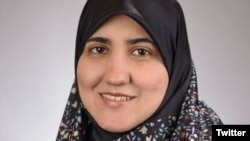
The profile page of the daughter of Iranian security chief, Ali Larijani, has been removed from the website of Emory University in the US state of Georgia.
On January 24, an image of a letter from the dean of Emory University’s medical school circulated on X stating that Fatemeh Ardeshir Larijani is “no longer an employee of Emory.”
Reports of the end of her employment -- and, according to some accounts, her dismissal -- followed weeks of calls by Iranian activists and US politicians for her removal because of her family ties to the Iranian government. Among them was Earl Buddy Carter, a Republican member of the US House of Representatives from Georgia, who wrote to Emory University urging her dismissal.
The United States on January 14 sanctioned Ali Larijani, accusing him, in his role as secretary of Iran’s Supreme National Security Council, of coordinating the repression of protests and ordering the use of force against demonstrators.
UN Voices ‘Deep Concern’ Over Reports of Sexual Violence in Iran’s Protest Crackdown
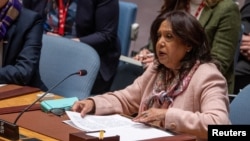
Pramila Patten, the UN’s special representative on sexual violence, has expressed “deep concern” about "disturbing" reports of sexual abuse in the context of political unrest in Iran.
"Such acts, whether committed in detention facilities, during arrest, or in the context of the intimidation of protesters, constitute grave violations of fundamental human rights and may amount to crimes under international law," she said.
Because of the Internet shutdown in Iran, reports of possible sexual violence related to the protests are impossible to verify. The Kurdistan Human Rights Network (KHRN) has reported that a number of detained persons were subjected to sexual abuse in Kermanshah.
Amnesty International reported in 2023 that "security forces in Iran used rape and other forms of sexual violence...to intimidate and punish peaceful protesters" during the 2022 “Woman, Life, Freedom” uprising.
The recent violence has drawn criticism from a senior Sunni cleric inside Iran.
Molavi Abdolhamid Esmailzehi, the Friday prayer leader in Zahedan, called the killings a “systematic massacre” in a post on X.
“This tragedy has created a deep and irreparable rift between the people of Iran and the ruling establishment,” he said.
Iran is a Shi'a-majority country, with about 90 percent of the population belonging to that branch of Islam. The Sunni Islam minority is about 5-10 percent, according to recent statistics.