




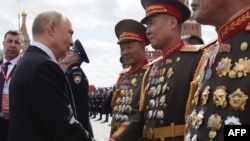
WASHINGTON -- The growing strategic partnership between China, Russia, Iran, and North Korea has become one of the defining security challenges facing the United States and its allies. In their recently published book Axis of Aggressors, Rear Admiral (Ret.) Mark Montgomery and his co-authors Bradley Bowman and Elaine Dezenski document more than 600 instances of cooperation among the four authoritarian states, arguing their coordination extends across military, technological, economic, and cyber domains.
Montgomery, senior director of the Center on Cyber and Technology Innovation and senior fellow at the Foundation for Defense of Democracies, says the West continues to underestimate both the scale of this alignment and the risks it poses. RFE/RL spoke with him about Ukraine, Iran, simultaneous conflicts, and what the US military must do to prepare for them.
RFE/RL: Is Washington underestimating China, Russia, Iran, and North Korea as an integrated authoritarian axis and how closely they coordinate?
Mark Montgomery: To a great degree we underestimate their level of coordination, and therefore our responses to their collective actions are sometimes underwhelming. In the US, you can see this with Ukraine.
Ukraine is clearly fighting Russia, Iran, North Korea, and China. Iran is providing Shahed drones -- not just thousands of drones, but also the technology to produce them domestically. The Russians are now producing their own Tehran-designed drones.
North Korea provided 12,000 soldiers, and people focus on that. But they also supplied 5 to 6 million rounds of artillery and mortar ammunition. That's more than all of NATO has produced over the last few decades. Finally, China is backstopping Russia's war effort by providing microelectronics for ballistic, hypersonic, and cruise missiles that are striking Kyiv today.

Ukraine has to fight all four countries. The US, even under the Biden administration, was very slow to provide the right weapon systems with the necessary range, and it never deployed US forces into Ukraine for training purposes. President [Donald] Trump has done even less, cutting security assistance by 99 percent compared to the Biden administration.
You can see the same problem in Europe when the US is confronting Iran. Iran is a 47-year-old authoritarian regime that has supported terrorism for almost that entire period. It has killed more than 1,000 American soldiers in Iraq and Afghanistan, around 500 NATO troops, and hundreds of Europeans in terrorist attacks. It supports proxies including the Houthis, Hezbollah, and armed groups in Iraq and Syria. It has also killed more than 30,000 of its own people in a single weekend.
Europe still looks at this conflict and says these are two co-equal belligerents: Iran and the US. That's ridiculous. Iran is backed by Russia. It's backed by China. In the past, it has been backed by North Korea. Yet we still cannot get Europe to support us against Iran.
RFE/RL: You have repeatedly warned about the risk of coordinated crises stretching US forces across multiple theaters. How close is the Pentagon to reaching a point where it could no longer sustain two or three simultaneous conflicts?
Montgomery: There are really two things you worry about here. One is force structure: ships, aircraft squadrons, tanks, battalions. The second is munitions. Our force structure is in somewhat better shape. We're reasonably close to being able to handle simultaneous conflicts, but we're not there. We need more investment and higher defense spending. Even though we criticize European countries for freeloading, US defense spending has also declined -- from around 4 to 5 percent of GDP at the end of the Cold War to roughly 3 percent, and even below that at the end of the Biden administration.
The bigger problem is munitions. Our stockpiles were already insufficient after 25 years of underinvestment. They've now been heavily stressed by support for Ukraine and operations involving Iran. [This] presents the more serious challenge in a simultaneous conflict.

RFE/RL: Your research shows Chinese microelectronics fueling both Iranian missile production and Russian weapons programs. US officials often point to sanctions as the primary response. Can sanctions really work when Beijing serves as the technological and economic backstop for the entire axis?
Montgomery: One of the challenges with microelectronics is that many components are dual-use. A product can be exported to China for a legitimate civilian purpose and then repurposed for military use before being transferred to Russia. That makes sanctions very difficult to enforce. Beyond that, enforcement of sanctions on Iranian and Russian oil exports has often been weak and, in many cases, simply ignored.
There's discussion now about new legislation, like the Lindsey Graham bill, to increase pressure on Russia. But the reality is that many of the authorities the government needs already exist. We simply don't enforce them properly or we allow overly broad waiver policies.
RFE/RL: As Washington weighs diplomacy with Tehran, you've argued against rushing into negotiations. What is the greatest strategic risk if an agreement fails to dismantle Iran's broader military infrastructure and proxy network?
Montgomery: It's difficult to identify just one priority. Obviously, Iran cannot be allowed to obtain a nuclear weapon or the ballistic missiles capable of delivering one.
The good news is that Iran's nuclear program has been set back by somewhere between five and 10 years because of the combined bombing campaign over the last year and a half. There has been significant damage to facilities, the deaths of engineers, and substantial setbacks to missile production. Although Iran can compensate through imports from Russia or China, that has become much more difficult.
Another major issue is the Strait of Hormuz. Iran's geography gives it significant leverage over the waterway. Oman has the same geographic advantage but respects international law. Iran does not. Negotiating with the Iranians is difficult because the IRGC [Islamic Revolutionary Guards Corps] can impose enormous suffering on the Iranian people without bearing those costs itself.

RFE/RL: You recently visited Ukraine's front lines. Is the war effectively serving as a live operational laboratory where this authoritarian axis is refining future warfare?
Montgomery: Yes, for both sides. For the US, for the broader West, and for Russia, Ukraine is a laboratory. The difference is that the US is not taking full advantage of it.
The US maintains only a minimal military presence in Ukraine, largely associated with the embassy. We don't have nearly enough personnel learning lessons directly from the battlefield. Russia, meanwhile, is aggressively passing those lessons to China, North Korea, and Iran.
North Korea is learning firsthand. It initially deployed 12,000 soldiers, and there are now reports of as many as 30,000 North Korean troops fighting alongside Russian forces. They're gaining firsthand experience in this new form of adaptive warfare.
RFE/RL: As Russia and Iran exchange targeting data and battlefield experience, how rapidly is this combat feedback loop improving the ability of America's adversaries to counter US weapons and military doctrine?
Montgomery: There are two separate dynamics. First, Russia is learning very quickly on the battlefield. It adapts rapidly, and those lessons eventually get shared with the other countries. That primarily makes Russia itself more capable, but over time it strengthens the others as well.
The second dynamic is what Russia provides in return for their support. Iran receives targeting information about US forces in the Middle East.
North Korea receives space-related assistance that directly supports the development of intercontinental ballistic missiles capable of one day reaching the US. North Korea has shared missile technology with Iran before and could do so again. China is probably receiving the greatest benefits. Reports suggest Russia is providing submarine quieting technology, which addresses one of China's biggest military disadvantages relative to the US.
Russia is also reportedly providing technology and training for large-scale helicopter air assault operations that could support a future cross-strait invasion of Taiwan. These are major transfers of military capability that Russia had never previously been willing to provide. They are part of the price Moscow is paying for support in its war against Ukraine.

RFE/RL: What is the single most important structural reform the US military must make over the next decade to deter this increasingly coordinated authoritarian axis?
Montgomery: The biggest structural change has to be in procurement, specifically, accepting more risk in order to move much faster.
For decades, the US could afford a very deliberate process because no country could seriously challenge us. We spent 15 years designing and building a ship. We spent 10 years designing and fielding a new aircraft. Those timelines have to shrink dramatically.
When we're talking about drones, counterdrone systems, or munitions, procurement should be measured in months, not years. Even for major platforms like ships and aircraft, development should be measured in years, not decades. Ultimately, success will depend on procurement reform and on building the speed and agility necessary to compete with our adversaries.

