




CHISINAU -- What do a fugitive Moldovan tycoon and a Kyrgyz-based cryptocurrency have to do with Russia's efforts to evade Western war sanctions and build an entirely new financial system separate from the West?
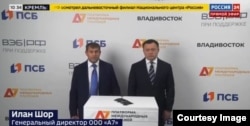
Russian President Vladimir Putin provided a clue in early September when he attended a virtual ribbon-cutting ceremony for the opening of a financial services company's new branch in the Pacific port city of Vladivostok.
It's not the type of event Putin typically attends. Newly launched battleships? Yes. Kremlin medal-award ceremonies? Yes. Branch openings? Not so much.
But the company, A7 LLC, is not your typical financial services firm.
That is a phenomenal amount of money. That is enormous, for an organization that didn't exist a year ago.
Its top executives include Ilan Shor, a fugitive oligarch implicated in what's been called the "theft of the century": a scandal involving more than $1 billion stolen from Moldova, one of the poorest countries in Europe. His co-executive heads Russia's eighth-largest bank, closely tied to Russia's military-industrial complex -- and happens to be the son of a former Russian prime minister and former intelligence director.
In short speeches to Putin via video link, the two boasted of how much money their company had handled in the 11 months since A7's establishment: more than 7 trillion rubles ($12.4 billion).
If true, that's a lot of money: as much as 12 percent of the foreign trade of all Russian businesses taken together, according to one calculation.
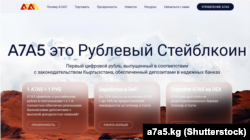
And then there's the cryptocurrency A7 launched in January.
Called A7A5, the coin recorded $41.2 billion in total transfers by July; by August, it was up to $51.2 billion. As of November, A7A5 -- which is the world's first ruble-pegged stablecoin -- had reported some $79 billion in volume since its launch, according to Chainanalysis, a New York-based firm that has done extensive research on A7.
"That is a phenomenal amount of money. That is enormous, for an organization that didn't exist a year ago," said Elise Thomas, an Australian researcher and author of multiple reports by the Center for Information Resilience, a London-based NGO that focuses on rights abuses and war crimes. "That's wild. The scale of it is really significant."
"The personal involvement of Putin in opening their Vladivostok office, that shocked me as well, that he was sort of willing to personally put his face in connection with the opening of A7," she said in an interview.
With a thread running from Moldova to the glittery skyscrapers of Moscow's Federation Tower to Kyrgyzstan, whose leaders want the small Central Asian country to be a mecca for crypto innovation, A7A5, Western and Moldovan officials say, is key to the Kremlin's efforts to blunt Western sanctions imposed following Moscow's 2022 all-out invasion of Ukraine.
"The A7A5 token…is a unique sanctions evasion tool," said Andrew Fierman, head of national security intelligence at Chainanalysis.
What Was Moldova's "Theft Of The Century"?
In the early 2010s, a series of mysterious transactions from three Moldovan banks to offshore companies blindsided regulators, prompting an emergency bailout of the country’s central bank. In total, more than $1 billion disappeared -- an estimated one-eighth of the country’s GDP. Ilan Shor was found by Moldovan courts in 2017 to be the mastermind of the theft. He fled to Israel, where he has long had citizenship, and later moved to Moscow.
And not just sanctions evasion. The Kremlin's wider goal is to build a parallel financial system, experts say, outside the existing networks where Western banks and the US dollar dominate.
"It's a big deal because of who Ilan Shor is, and the fact this is designed…to try to operate outside of the reach and influence of the US-dollar denominated, traditional financial systems," said Carole House, who has served as White House national security council adviser for cybersecurity policy.
"It's wild to see that kind of support coming directly from the government, but also not surprising given the objectives they want, to offset the impact of sanctions," she said.
The efforts have not gone totally unnoticed in the West.
It's a big deal because of who Ilan Shor is, and the fact this is designed to operate outside of traditional financial systems.
On October 23, the European Union announced sanctions against A7A5, A7, and related companies, calling the cryptocurrency "a prominent tool for financing activities supporting [Russia's ] war of aggression."
Neither A7 nor A7A5 responded to e-mails sent by RFE/RL seeking comment. Shor did not respond to an interview request.
A Central Asian Mecca For Crypto
Since at least 2021, the government in Bishkek has tried to turn Kyrgyzstan into a cryptocurrency hub, seeking to attract investors, miners, and exchanges. As of 2025, it reported at least 13 crypto exchanges registered, and it has laid the groundwork for a national cryptocurrency called USDKG.
Corporate registry documents obtained by RFE/RL from the Kyrgyz Justice Ministry show that the issuer of the A7A5 stablecoin is a Kyrgyz company called Old Vector, which was first registered in December 2024. The documents also show that the company providing the coin to Old Vector is A7-Kyrgyzstan LLC.
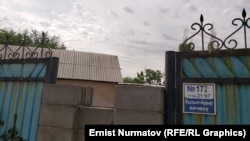
Between January and July, the registered headquarters for Old Vector was a small, ramshackle house surrounded by newer, more upscale buildings and single-family homes.
In July, when RFE/RL reporters visited the house, which is set back from the dirt road behind a rusting blue metal fence and concrete blocks, two young boys who answered the door said they were unaware of any company that was registered at their address. A next-door neighbor said there was no company by that name at that address.
About a month later, Old Vector's corporate headquarters moved to a different address on the outskirts of Bishkek, a multistory building called South Park made up mainly of apartments.
A7 itself has registered a number of interrelated companies in Bishkek, according to Justice Ministry documents obtained by RFE/RL.
A7-Kyrgyzstan, which was registered on January 17, is housed on the upper floors of a complex that used to be a major shopping center. RFE/RL reporters tried to access the floor where the offices were reported to be, but security guards blocked them from entering.
Another Shor-related entity called Evrazia has also registered trademarks for several similarly named companies in Bishkek. Established in Moscow as a nonprofit organization, Evrazia has been implicated in a range of activities aimed at destabilizing elections in Moldova. The European Union hit Evrazia with sanctions in October 2024.
Though launched in January, A7A5 itself did not begin trading publicly until February, when it appeared on a Moscow cryptocurrency exchange called Garantex.
Garantex had drawn scrutiny for years from Western law enforcement, which alleged it served as a conduit for funds used in money laundering, ransomware, computer hacking, and sanctions violations. The exchange was popular because, among other things, it allowed an easy way to exchange cryptocurrencies for more popular stablecoins like USDT, which is pegged to the dollar, making it easier to cash out for less volatile currencies.

In 2022, the US Treasury Department hit Garantex with financial sanctions. But it wasn't until three years later that the exchange shuttered operations after two of Garantex's principal operators were indicted by a US grand jury for money laundering. US authorities seized several Garantex websites. German and Finnish agencies confiscated servers hosting Garantex's operations. More than $26 million in cryptocurrencies that officials said was used for money laundering was also seized by the US Secret Service.

In the weeks immediately preceding and following the March 2025 seizure, analysts said billions of A7A5 coins were shifted away from Garantex to a new exchange called Grinex, which was first registered in Kyrgyzstan the previous December. The vast majority of A7A5's transactions now occur on Grinex and a smaller exchange called Meer.kg.
The connection between Grinex and A7 is unclear. A Kyrgyz man named in Justice Ministry filings as the founder of Grinex refused to comment to RFE/RL on whether his company is related to the crypto exchange of the same name.
US financial investigators, however, say Grinex was created specifically to help traders whose funds were frozen when Garantex was shut down recoup their money -- using A7A5.
A Tug-Of-War In Chisinau
Moldova has been at the center of a tug-of-war between Europe and Russia for years.
The 2020 election of Maia Sandu, a Western-trained economist who worked at the World Bank, tilted the scales to the West. Shor wants to tip the scales back toward Russia.
In 2014, Moldova was roiled by a massive bank fraud that resulted in more than $1 billion being siphoned out of the country -- nearly one-eighth of its gross domestic product (GDP). Authorities accused Shor of being the mastermind of the "theft of the century" and he fled the country in 2019, splitting his time between Israel, then Moscow. He was sentenced in absentia to 15 years in prison in 2023 by a Chisinau court; his eponymous political party has been banned.

Over at least three election campaigns, Moldovan and Western officials say Shor has repeatedly sought to buy votes, spread disinformation, and even recruited and trained young Moldovans to stoke unrest and provoke police. Among the schemes officials say they uncovered were money transfers to Moldovans using bank cards issued by Promsvyazbank, the state-owned Russian bank that Shor has partnered with.
Shor worked with "Russian individuals to create a political alliance to control Moldova's parliament, which would then support several pieces of legislation in the interests of the Russian Federation," the US Treasury Department said in October 2022, when he was first sanctioned.
In the run-up to last year's presidential election, Moldovan authorities accused Shor of orchestrating a scheme that funneled more than $15 million from Russian banks to the accounts of more than 130,000 Moldovan citizens.
The scheme included sending pre-loaded bank cards, using the Russian "Mir" card payment system, to people who could travel to the breakaway Transdniester region to withdraw cash. Officially part of Moldova, Transdniester operates in a legal twilight zone, with close economic ties to Moscow.
Shor's Moscow-based nonprofit group Evrazia also recruited hundreds of young Moldovans to participate in an outreach program, offering free trips to Russia, fine dining, and a shot at millions of rubles in grants.
Moldova's prime minister later said Russian agents spent nearly $220 million in total trying to influence the 2024 vote, which Sandu won with about 55 percent of ballots cast. A simultaneous referendum asking Moldovans about joining the European Union passed but was far closer than predicted.
Days before September's parliamentary elections, Moldovan authorities said they had uncovered another destabilization campaign and conducted raids at scores of locations around the country, arresting more than 70 people. Some of those arrested had allegedly traveled to Bosnian and Serbian camps for training to confront and provoke police. The campaign, Moldovan authorities said, used "the Shor group's network and external resources."
"The sanctions evasion and the [Moldovan] political interference, I don't think they are directly connected," Thomas said. "I think the sanctions evasion is the main game at the moment. Having said that, obviously, Shor has significant personal stakes in Moldova and probably cares about it a lot at a personal level."
"What Shor's doing, it's not just a Moldovan problem," said one Moldovan official who spoke on condition that he not be named. "He provides Russia with a service, to evade sanctions, and he makes money off of it."
Promsvyazbank did not respond to messages seeking comment.
'An Infrastructure Resilient To Any External Influences'
Since around 2022, much of Russia's banking system has been isolated from Western financial networks, in response to the Ukraine war. The banking sector has been cut off from SWIFT, the messaging system that is essential for global banking operations, while Visa and Mastercard have cut off Russia from their payment systems and Western banks have frozen Russian government accounts.
As a result, Russian authorities have tried to build a parallel financial system. Other countries have signaled support for the effort, including China, Brazil, India, and other major economies.
What Is A Stablecoin?
A7A5 is what’s known in cryptocurrency terms as a stablecoin -- a virtual currency linked, or “pegged,” to a real-world currency such as the US dollar or the euro. As the name implies, these currencies are seen as more stable than non-stablecoins, whose values can fluctuate wildly. Bitcoin and Ethereum -- two of the most popular cryptocurrencies -- are non-stablecoins.
"The development of the A7A5 token appears to be the next logical step in Russia's efforts to develop alternative payment systems to circumvent sanctions," Fierman said.
As Putin watched at the September 4 event in Vladivostok, Shor appeared nervous, shifting from side to side as he described the goals of the "financial hub" called the Far Eastern International Financial and Settlement Center.
"To date, in 10 months of operation, we have conducted more than 7.5 trillion rubles worth of transactions," he said. "Today, given that more than 50 percent of all our settlements are made to Asian countries, we have decided to open a financial hub here."
Standing alongside Shor was his co-executive: Pyotr Fradkov, who has headed the Moscow-based Promsvyazbank since 2018. His father is Mikhail Fradkov, Putin's prime minister from 2004-2007 and director of the Foreign Intelligence Service for nine years after that.
Known as PSB, Promsvyazbank was nationalized by the Russian government that same year amid a banking crisis and repurposed to serve Russia's growing military industrial sector. In 2022, PSB was hit by Treasury sanctions, as was Pyotr Fradkov.
Promsvyazbank holds 49 percent of A7. The rubles the A7A5 coin is pegged to, making it a stablecoin, are deposits held by the bank.
A7 is housed in the gleaming new modern skyscrapers of Moscow's Federation Tower -- the same location Garantex was registered at, along with several companies alleged to be tied to notorious ransomware schemes.
A7 is also making its own push to become a "brick-and-mortar" company by opening up branches for customers to make deposits, withdraw cash, trade cryptocurrencies, and make cross-border payments. Aside from Moscow and Vladivostok, the company says it is setting up branches in cities abroad such as Harare, Zimbabwe, and Lagos, Nigeria.

In July, A7 announced that PSB clients would be able to buy A7A5 tokens using PSB bank cards.
That same month, the European Union targeted A7 for the first time, saying it was "linked to efforts to influence the presidential elections and the 2024 constitutional referendum on EU accession."
Around the same time, the number of A7A5 coins in circulation surged by more than 240 percent, according to Elliptic, an analytics firm, with over $1 billion in daily transfers of A7A5.
Chinese companies and individuals are reported to be the largest user of A7 payment platforms to date, according to corporate marketing documents published online and highlighted by the Center for Information Resilience.
Western authorities are struggling to keep up.
In mid-August, about three weeks before Shor and Fradkov appeared in the video conference with Putin, US and British authorities hit A7 and more than a half dozen interrelated companies, including Grinex and Old Vector, with more sanctions.
A month later, however, A7A5's total market capitalization -- essentially, the value of all the coins in circulation -- skyrocketed by nearly 250 percent, making it the largest stablecoin not pegged to the US dollar.
"We have already proven that a national digital currency can be not only an alternative to the dollar but also a driver of global change," A7A5 said in a triumphant post to Telegram.
The European Union then responded on October 23 with more sanctions targeting Russian-linked crypto assets and its second round targeting A7.
In a post to Telegram, A7A5 mocked the announcement.
"What will this change? Nothing!" the company said. "Because from the very beginning, we built an infrastructure that was resilient to any external influences and restrictions."