




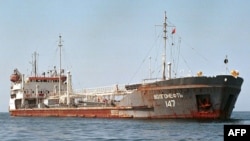
WASHINGTON -- The United States has again temporarily eased sanctions on Russian oil, issuing a new waiver that allows certain shipments already at sea to be delivered and sold, even as Washington publicly insists it is maintaining pressure on the Kremlin.
On April 17, the US Treasury Department’s Office of Foreign Assets Control (OFAC) released General License 134B, authorizing transactions tied to Russian crude and petroleum products loaded onto vessels as of that date. The waiver runs through May 16 and replaces a previous license that expired on April 11.

The move comes at a moment of sharp volatility in global energy markets, driven in part by tensions surrounding the Strait of Hormuz amid the ongoing conflict involving Iran.
Oil prices dropped significantly the same day the waiver was announced after Iran signaled that the key shipping route would reopen to commercial traffic.
Policy Reversal Raises Questions
The timing has fueled confusion in Washington. Just two days earlier, Treasury Secretary Scott Bessent had told reporters the administration would not extend the earlier waiver, signaling what appeared to be a firmer stance on Russian energy exports.
That position has now shifted.
The renewed license is narrowly tailored -- it applies only to oil already loaded onto ships -- but critics say the repeated use of such waivers risks undermining the broader sanctions regime imposed after Russia’s full-scale invasion of Ukraine.

Leading Senate Democrats, including Chuck Schumer of New York, Elizabeth Warren of Massachusetts, and Jeanne Shaheen of New Hampshire, condemned the decision as a “180-degree reversal,” arguing that it sends a mixed signal at a time when Russia continues its military campaign.
“This decision is shameful,” they said in a joint statement, linking the move to ongoing Russian attacks in Ukraine and warning that it could prolong the war.
Between Market Stability And Sanctions Pressure
Administration officials have previously framed such waivers as technical measures aimed at preventing sudden disruptions in global supply -- particularly during periods of geopolitical instability affecting major oil transit routes.
But some experts say the policy reflects a deeper dilemma.
“The energy shocks coming out of Asia and Oceania into Western markets are rapidly backing Washington into a corner,” said sanctions expert Brett Erickson of Obsidian Risk Advisors.

“At some point, the only solution left is letting Moscow ride to the rescue and dramatically damaging the sanctions architecture the West has spent years building,” Erickson told RFE/RL on April 17.
Others see the approach as part of a broader -- and risky -- balancing act. Matthew Murray, former deputy assistant secretary of commerce for Europe, the Middle East, and Africa, argues that relying solely on sanctions has not produced the desired political outcomes.
“The question now is whether President Donald Trump can successfully apply both carrots and sticks,” said Murray, now an adjunct professor at Columbia University and Georgetown University. He suggested that selective relief may be intended to influence Moscow’s behavior, even if the results remain uncertain.
Ukraine Warns Of Consequences
From Kyiv’s perspective, any easing of pressure carries clear risks.
Vladyslav Vlasiuk, a senior adviser to President Volodymyr Zelenskyy, has consistently argued that sanctions are working -- and should be strengthened, not diluted.
“The more sanctions are applied against Russia, the quicker we will see success in peace negotiations,” he told RFE/RL earlier this week, warning that even temporary waivers can translate into billions of dollars in additional revenue for Moscow’s war effort.

He also questioned the economic logic behind the waivers, noting that Russian oil volumes are too small to offset disruptions in the Strait of Hormuz, a critical artery for global energy supplies.
A Pattern Emerging
The latest decision follows a series of recent steps by US authorities that have drawn scrutiny in Washington and among allies.
On March 31, the Treasury Department removed sanctions on several Russian-flagged commercial vessels -- including the Sv Nikolay, Fesco Moneron, and Fesco Magadan -- which had previously been listed for links to sanctioned entities and activities tied to Russia’s war in Ukraine.
The delisting allowed those ships to reenter certain parts of the global shipping system, including access to services such as insurance and port operations.
This was followed by the initial issuance of General License 134A in March, which temporarily authorized the delivery of Russian oil already in transit. That license expired on April 11.
For shipping companies, insurers, and commodity traders, the current waiver provides a defined legal pathway to complete transactions involving cargo already at sea, including services necessary for vessel safety and delivery.
For governments, it underscores the ongoing challenge of reconciling sanctions enforcement with the practical realities of managing global energy flows during periods of disruption, experts say.

