


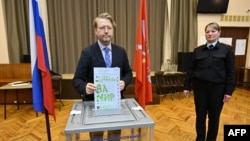
There was no letup in fighting between Russia and Ukraine on September 20, as voting in Russia's parliamentary elections ended, with a political party calling for peace excluded.
As expected, the Kremlin-controlled United Russia party was set to be handed a big victory in the tightly controlled election -- the first vote to fill the State Duma, Russia's lower house of parliament, since President Vladimir Putin ordered the full-scale invasion of Ukraine in 2022.
Shortly after polls closed, the Central Election Commission claimed that with about 25 percent of the ballots counted in the nationwide voting by party list, United Russia had more than 57 percent.
Preliminary data from the Central Election Commission also showed that no candidate from Yabloko, Russia's oldest liberal political party, was currently leading in any of the single-member districts in the State Duma elections.
In a highly managed process held September 18-20, voters could choose between United Russia and several parties in the "systemic opposition," which critics say provide a veneer pluralism but are largely loyal to the Kremlin.
"It gave Putin an opportunity to further promote war against Ukraine, for example, by glorifying veterans, many of whom ran for political office," Dominika Hajdu, director for policy and programming at GLOBSEC, a think tank, told RFE/RL on September 20.
Real political opposition is repressed in Russia, with even small acts of dissent -- online or in the real world -- often followed by stiff prison sentences, loss of employment, or other penalties.
Fighting Continues
Ukraine attacked Russia with drones and missiles on September 20, launching what Moscow's mayor claimed was the "largest ever" barrage on the capital, while Ukraine reported Russian drone attacks on numerous targets nationwide.
As Russians voted, their country’s war on Ukraine continued unabated. Ukraine's military reported 138 Russian attack drones striking at 17 locations nationwide, and authorities said four people were killed in the Kyiv region, including three children, one of them four years old.
Kyiv officials said Russia continued to target the capital thoughout the day, with short breaks, and residents said loud explosions rang out overhead in the evening.
Ukrainian forces also struck in Russia, hitting the major Kapotnya refinery on the outskirts of Moscow. Officials in the region ringing the capital said two people were killed there, a 44-year-old woman and an elderly man, when drones hit their residential buildings.
Moscow Mayor Sergei Sobyanin claimed that Ukraine launched 1,600 Ukrainian drones at Russia overnight, including more than 400 targeting Moscow. He said one aprtment building in the city was hit and nobody in Moscow was killed.
Sobyanin's numbers were not confirmed by Ukrainian sources and could not be independently verified. The Russian military said its forces shot down more than 1,100 drones.
Ukrainian forces also fired domestically-produced Flamingo cruise missiles, according to both Russian authorities and Ukrainian President Volodymyr Zelenskyy, who said Ukraine also used a new short-range ballistic missile, the Pelican, in the strikes.
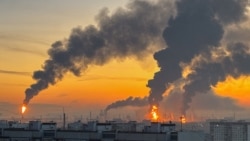
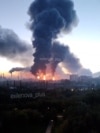

Russian officials said the Ukrainian attacks were aimed at disrupting the election process. However, there were no reports of polling stations being hit and the strikes occurred overnight while they were closed.
Instead, the strikes appeared to be a continuation of a campaign that over several months has curtailed Russia’s capacity to refine and export oil products. The Ukrainian attacks have impacted an industry that is vital for bankrolling the Kremlin’s war effort while also bringing the war home to ordinary Russians in the form of fuel shortages and long lines of frustrated drivers at gasoline stations.
The Central Election Commission claimed turnout exceeded 56 percent -- about five percentage points higher than in the last Duma election, in 2021.
Since Putin came to power over a quarter-century ago, the Kremlin has increasingly stifled dissent, marginalized political opponents, and manipulated elections, leaving little room for surprises.
Over the three days of voting -- as well as earlier voting in some regions -- reports of alleged violations mounted.
Among other things, they included evidence pointing to ballot-box stuffing, pressure on state-sector workers to vote, and incidents in which observers from parties other than United Russia were obstructed from monitoring the balloting, including through physical force.
Past presidential and parliamentary elections have been marred by evidence of widespead fraud. Anger over alleged cheating in favor of United Russia in a December 2011 Duma vote led to a series of large demonstrations known as the Bolotnaya protests. The state cracked down hard.
United Russia was on track to maintain its dominance in the Duma, where it holds more than 300 of the 450 seats. The others with seats in the current Duma are the Communist Party, the nationalist Liberal Democratic Party of Russia (LDPR), A Just Russia, and New People.
Yabloko, a liberal party that would have been the only party on the ballot calling for an end to the war on Ukraine, was disqualified in August on what its leaders said were "absurd" grounds.
Analysts said the Kremlin feared that Yabloko's message could have drawn a substantial number of voters and undermined the Kremlin's narrative of lockstep support for the war.
The ban showed Putin is "afraid of any kind of opposition," said Hajdu.
“If Yabloko had been allowed to run a more meaningful, full-fledged, and (maybe most importantly) legal anti-war campaign for 6-8 weeks, that could challenge the image of total consolidation around Putin and the war,” Mikhail Komin, a research fellow at the Center for European Policy Analysis (CEPA), said before polling began. “This is the main reason why Yabloko was disqualified."
The elections came amid what appears to be rising frustration in Russia over the progress of the war, and opinion polls have shown falling approval ratings for Putin, who is widely believed to have expected Russia to subjugate Ukraine within weeks of the full-scale invasion in February 2022.
Urging Russians to vote in a speech released on September 16, Putin said the elections would "demonstrate that millions of people stand behind our troops, that we are a united people bound by shared values, historical memory, and love for the Motherland."
In addition to Russia, Putin's government was holding the balloting on Ukraine's Crimean Peninsula, which Russia has controlled since 2014, and in the Russian-occupied portions of four other Ukrainian regions that Moscow baselessly claims are part of Russia. Kyiv has denounced the effort.
Zelenskyy said late on September 20 that he had spoken to US President Donald Trump and that they agreed to meet in New York, where the annual UN General Assembly takes place September 22-28.
Trump made ending Russia's war against Ukraine a priority when he began his current term in January 2025, and in recent weeks his administration has sought to rveive diplomacy that had been largely dormant since the start of the US-Israeli war with Iran in late February of this year.

