





US officials publicly accused Russia of threatening a Finnish-operated commercial satellite that provides imagery and intelligence to Ukraine and other nations, calling the move "deliberately reckless."
In response to the accusations, made during a United Nations debate on October 21, Russia broadly described US claims as "absurd" and accused Washington of its own "aggressive military space ambitions."

The back-and-forth came days after a Russian military satellite known as Kosmos-2612 moved "dangerously" near to ICEYE-X36, a satellite registered in the United States and operated by a Finnish company called ICEYE.
The Russian satellite came "exceptionally close" -- within 200 meters, by some estimates -- something that space officials and amateur satellite watchers said was extremely unusual.
"This was not a routine conjunction or 'fly by,'" LeoLabs, an aerospace intelligence company, told RFE/RL. "The behavior is consistent with sophisticated rendezvous and proximity operations."
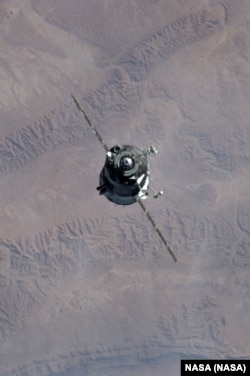
ICEYE-X36 carries a radar technology that can gather detailed terrestrial images, even through cloud cover. The Finnish company in January signed a contract with the Ukrainian Defense Ministry to provide intelligence.
Kosmos-2612 "exhibited threatening behavior by intentionally maneuvering dangerously close to a commercial satellite," Brian Hardesty, an adviser to the US Delegation to the Conference on Disarmament, said during a meeting in New York of the UN First Committee, a body that debates arms control and disarmament issues. "These behaviors appear consistent with an on-orbit weapons operation."
"The decision to conduct these activities was deliberately reckless," he said.
Russia's representative who could not be immediately identified, did not directly address the assertion.
"We call on member states to give the proper response to the aggressive military space ambitions of the United States," he said.
He also referenced comments made last month by the secretary of the US Air Force, the top civilian official for that military branch.
Speaking to a conference outside of Washington, Troy Meink's comments that Washington has in fact deployed actual weapons in space -- "on-orbit space control weapons capable of defending the Joint Force against hostile adversary action" -- caused a jolt among policy experts.
Other longtime space watchers, however, said, the announcement merely stated publicly what had already been obvious for some time.
"The United States did not suddenly weaponize space by acknowledging that it possesses these capabilities," wrote Mallory Stewart, a former top arms control secretary at the US State Department. "An arms race in space has been under way for years."