



Accessibility links

Breaking News

What's Behind Russian Support For Putin's War In Ukraine?

A column of vehicles paraded through the streets of Volgograd on March 6 to express support for the invasion of Ukraine. Some of the cars displayed the letter Z, which is used as an unofficial symbol of the Russian troops fighting in the war.

A woman fleeing the shelling of the northeastern Ukrainian city of Kharkiv by Russian forces on March 6 stopped for a moment to ask the Russian people a question that many Ukrainians and other foreigners have been asking: Why don't they protest what is being done in their name?

"You were able to do it before, back in our [shared] history in the 1990s," the woman told an RFE/RL journalist through a mixture of tears and rage as her teenage son looked on.

"In the Soviet Union, everyone rose up. Everyone! Where are you now? Why don't you rise up now? Why do you believe [Russian President Vladimir Putin]? Why don't you defend your own sons, your own children? Rise up, please. Protect them. I'm begging you. Please."

Although the collapse of the Soviet Union was primarily driven by enormous protests in the Baltic states, Armenia, Azerbaijan, Georgia, and other non-Russian republics dating back to the late 1980s, hundreds of thousands of Russians also took to the streets during the death throes of the U.S.S.R. On March 10, 1991, for instance, an estimated 500,000 Muscovites packed a huge square outside the Kremlin, calling for the resignation of Soviet leader Mikhail Gorbachev and the dissolution of the Soviet Union.

By contrast, Russian opposition to the war in Ukraine has been limited to relatively modest rallies, single-person protests, the signing of petitions and open letters, and social media posts. OVD-Info, a nongovernmental organization that monitors political repression, reports that more than 13,800 people have been detained across Russia for anti-war activities.

In addition, many of those who oppose the war have already fled Russia, either in recent years or since Putin launched the invasion on February 24. Despite international sanctions and the collapsing ruble, tens of thousands of Russians have left the country since the beginning of the month.

At the same time, however, there were no mass displays of support for the war -- either state-orchestrated or spontaneous -- during the first days following the invasion. Later, such demonstrations began to emerge, many of them focused on the Z symbol that was painted on many of the vehicles in the Russian invasion force.

According to some reports, participation in some of these demonstrations, such as a self-proclaimed "flash mob for peace" in the Tatarstan capital, Kazan, on March 10, was compulsory.

'I Support Putin In Everything'

With the war in Ukraine in its third week, a clearly defined picture of public opinion about it in Russia was elusive because two decades of Putin's authoritarian rule have made detailed and reliable polling in the country all but impossible. Independent pollsters and sociologists have been marginalized, while a pall of fear and self-censorship hangs over a country that has myriad ways of persecuting dissenters.

State-connected polling agencies have published results purportedly showing strong support for the war. The government-controlled pollster VTsIOM claimed on March 5 that 71 percent of Russians support what the state calls the "special military operation" in Ukraine. On March 3, another state-controlled agency, FOM, reported a poll conducted on February 25-27 that found 65 percent of Russians supported the war.
An independent poll commissioned by CNN just before the Russian invasion found that 50 percent of Russians said it would be "right for Russia to use military force to both prevent Ukraine from joining NATO…and if it feels threatened by foreign activity in former Soviet countries" -- two of the narratives that Putin has used to justify Russian aggression against Ukraine.

The accuracy and dynamics of such numbers are impossible to gauge in Russia, but evidence suggests a substantial portion of the population supports the government, and it is not difficult to find Russians who say as much.

"I am for Putin," said one woman on March 3 when a Current Time correspondent tried to show her photographs of the destruction in Ukraine. "I support Putin. I'm not even going to look at any photographs. I am for Putin. I support Putin in everything."

How Russians Reacted When We Showed Them Pictures From Ukraine How Russians Reacted When We Showed Them Pictures From Ukraine
please wait

No media source currently available

0:00 0:02:32 0:00

'Shame And Revulsion'

Diverging opinions about the war in some cases have deeply strained friendships and familial relations.

Yekaterina, a 28-year-old fitness trainer in Rostov-on-Don, near the Ukrainian border, told RFE/RL's Caucasus.Realities that her mother so fiercely defends Putin that Yekaterina can hardly recognize her.

"At first, her main argument was, 'There is nothing we can do and nothing depends on us,'" said Yekaterina, who asked to be identified only by her first name because of her opposition to the war. "Later, her argument was even worse: 'They asked us for help.' The war didn't shake her. It hasn't evoked any emotions in her. I was just shocked by her reaction.

"Now, I am asking myself, 'Who is this woman?" she continued, noting that her mother "sheds tears" over Soviet sacrifices during World War II every year on May 9, which is marked in Russia as Victory Day. "Do I even know her? How can a living person become so hard-hearted about a war started by her own government?"

Corpses In The Street: Mariupol Is Being Devastated By Relentless Russian Attacks

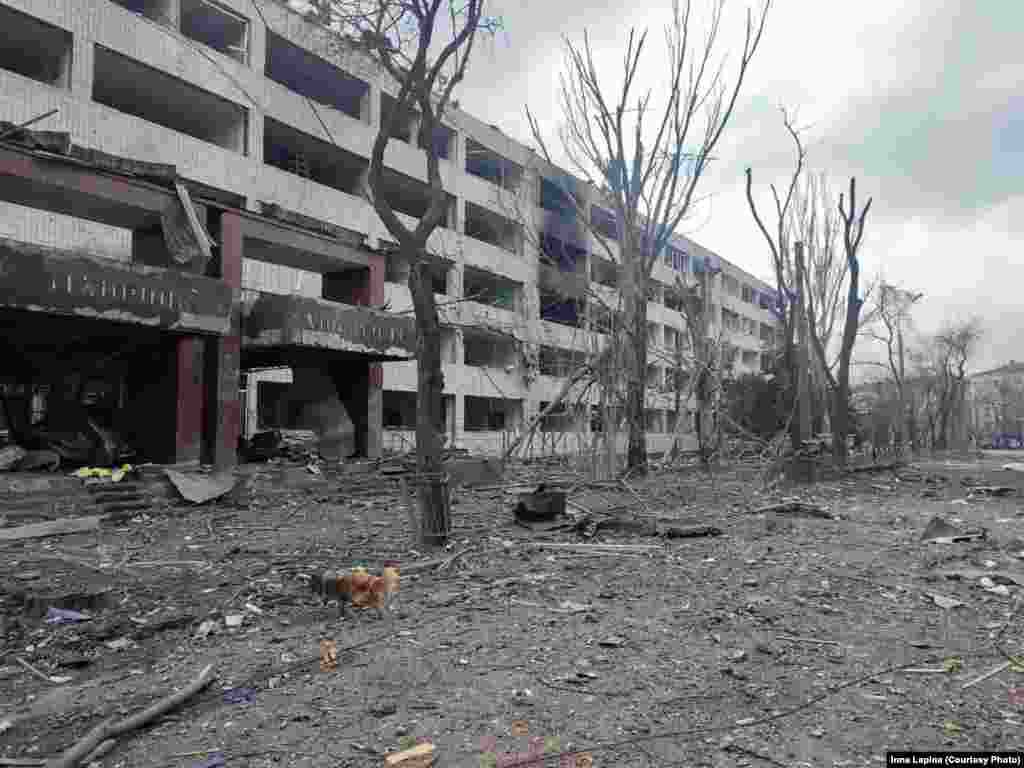
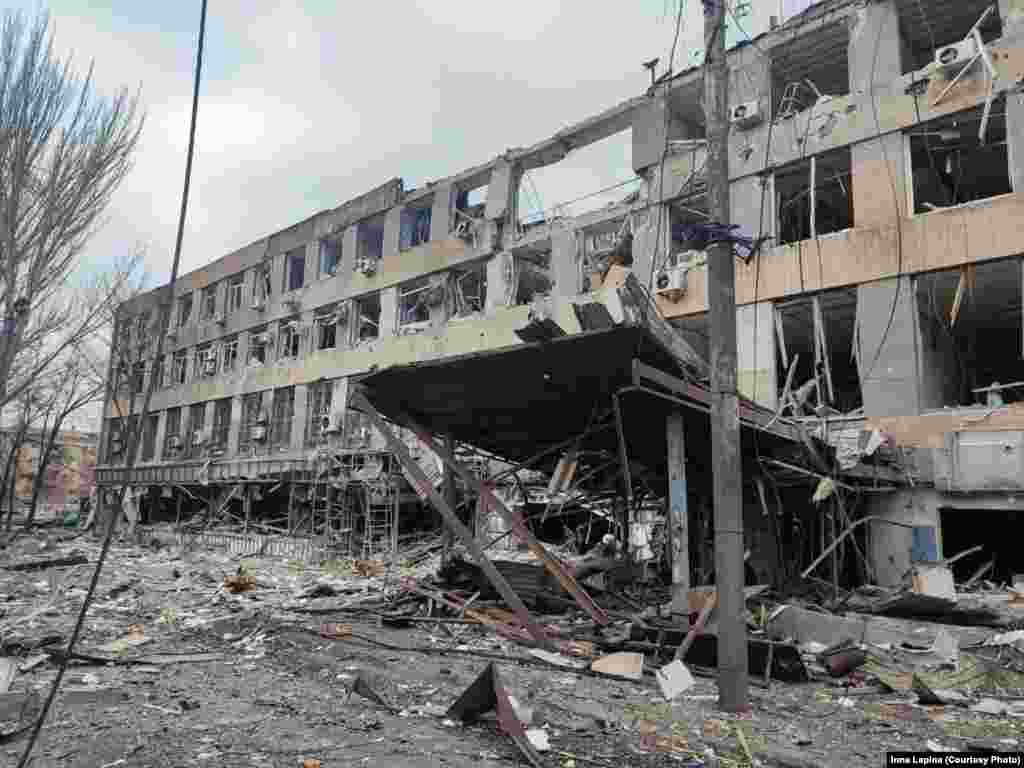
Buildings in Mariupol have been gutted by Russian strikes and the fires they cause.
1/20 Buildings in Mariupol have been gutted by Russian strikes and the fires they cause.
Ukraine's southeastern port city of Mariupol is surrounded by Russian forces, cut off from the rest of Ukraine, and devastated daily by artillery barrages and air strikes.
2/20
Ukraine's southeastern port city of Mariupol is surrounded by Russian forces, cut off from the rest of Ukraine, and devastated daily by artillery barrages and air strikes.
Destruction of a residential district after shelling in Mariupol. The blockaded city has been hit by shelling and air strikes for more than a week. Mariupol has no electricity, gas, food, or water. 
3/20 Destruction of a residential district after shelling in Mariupol. The blockaded city has been hit by shelling and air strikes for more than a week. Mariupol has no electricity, gas, food, or water. 
Ukraine's southeastern port city of Mariupol is surrounded by Russian forces, cut off from the rest of Ukraine, and devastated daily by artillery barrages and air strikes.
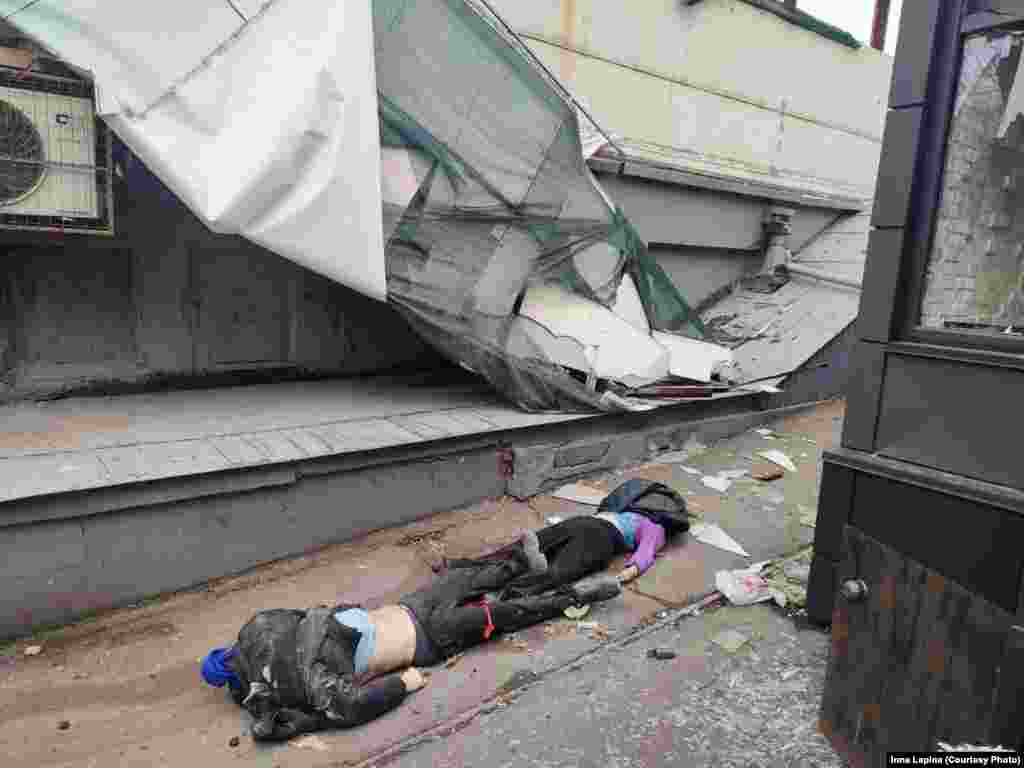
Dead civilians on the ground next to a destroyed building in Mariupol. Mariupol's deputy mayor, Sergei Orlov, said on March 9 that around 1,200 civilians have died in the city since the Russian invasion began on February 24.
4/20 Dead civilians on the ground next to a destroyed building in Mariupol. Mariupol's deputy mayor, Sergei Orlov, said on March 9 that around 1,200 civilians have died in the city since the Russian invasion began on February 24.
Ukraine's southeastern port city of Mariupol is surrounded by Russian forces, cut off from the rest of Ukraine, and devastated daily by artillery barrages and air strikes.
5/20
Ukraine's southeastern port city of Mariupol is surrounded by Russian forces, cut off from the rest of Ukraine, and devastated daily by artillery barrages and air strikes.
<br />
<br />
&nbsp;
6/20

 
Ukraine's southeastern port city of Mariupol is surrounded by Russian forces, cut off from the rest of Ukraine, and devastated daily by artillery barrages and air strikes.
7/20
Ukraine's southeastern port city of Mariupol is surrounded by Russian forces, cut off from the rest of Ukraine, and devastated daily by artillery barrages and air strikes.
8/20
Ukraine's southeastern port city of Mariupol is surrounded by Russian forces, cut off from the rest of Ukraine, and devastated daily by artillery barrages and air strikes.
9/20
Ukraine's southeastern port city of Mariupol is surrounded by Russian forces, cut off from the rest of Ukraine, and devastated daily by artillery barrages and air strikes.
10/20
Ukraine's southeastern port city of Mariupol is surrounded by Russian forces, cut off from the rest of Ukraine, and devastated daily by artillery barrages and air strikes.
11/20
Ukraine's southeastern port city of Mariupol is surrounded by Russian forces, cut off from the rest of Ukraine, and devastated daily by artillery barrages and air strikes.
12/20
Ukraine's southeastern port city of Mariupol is surrounded by Russian forces, cut off from the rest of Ukraine, and devastated daily by artillery barrages and air strikes.
13/20
Ukraine's southeastern port city of Mariupol is surrounded by Russian forces, cut off from the rest of Ukraine, and devastated daily by artillery barrages and air strikes.
14/20
Ukraine's southeastern port city of Mariupol is surrounded by Russian forces, cut off from the rest of Ukraine, and devastated daily by artillery barrages and air strikes.
15/20
Ukraine's southeastern port city of Mariupol is surrounded by Russian forces, cut off from the rest of Ukraine, and devastated daily by artillery barrages and air strikes.
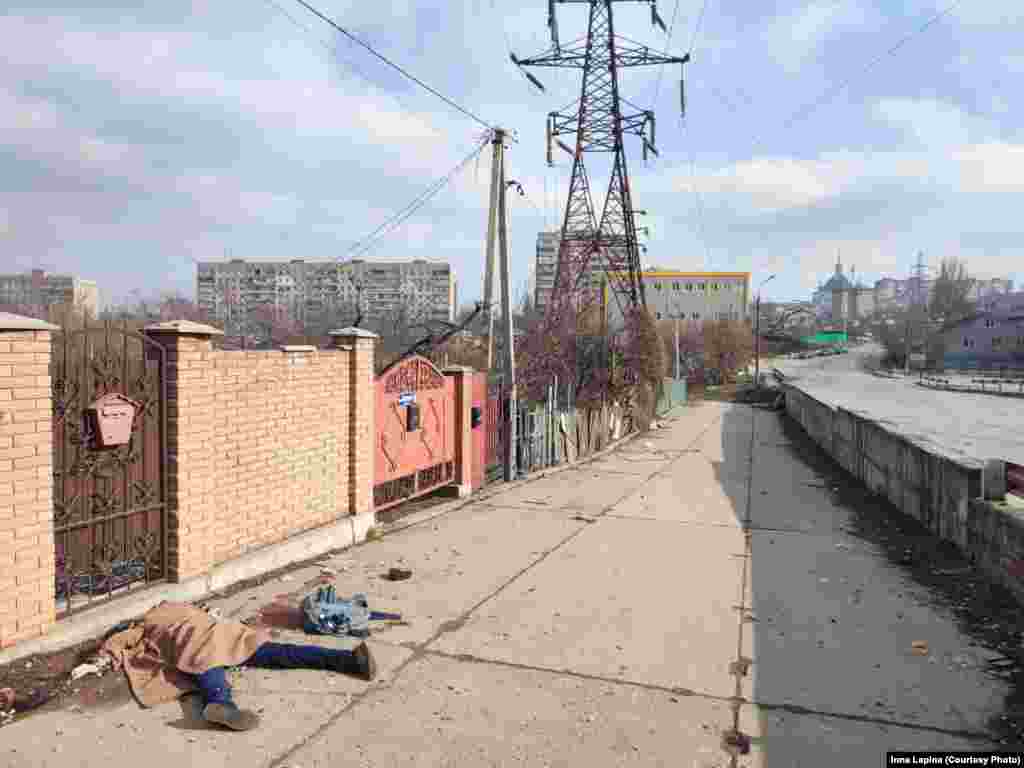
A corpse covered with a blanket lies on a sidewalk in Mariupol.
16/20 A corpse covered with a blanket lies on a sidewalk in Mariupol.
Ukraine's southeastern port city of Mariupol is surrounded by Russian forces, cut off from the rest of Ukraine, and devastated daily by artillery barrages and air strikes.
17/20
Ukraine's southeastern port city of Mariupol is surrounded by Russian forces, cut off from the rest of Ukraine, and devastated daily by artillery barrages and air strikes.
18/20
Ukraine's southeastern port city of Mariupol is surrounded by Russian forces, cut off from the rest of Ukraine, and devastated daily by artillery barrages and air strikes.
19/20
Ukraine's southeastern port city of Mariupol is surrounded by Russian forces, cut off from the rest of Ukraine, and devastated daily by artillery barrages and air strikes.
20/20
Ukraine's southeastern port city of Mariupol is surrounded by Russian forces, cut off from the rest of Ukraine, and devastated daily by artillery barrages and air strikes.
Previous slide
Next slide

Viktoria, a 24-year-old illustrator in Rostov-on-Don who also spoke on condition that she be identified only by her first name, told a similar story.

"The day after the war started was my mother's 45th birthday, and I went home, although I wasn't sure I should," she recalled. "We agreed not to talk about politics, but I could hear how she and papa were watching the news on television and commenting about everything: 'We're protecting our own.' 'We didn’t do that -- the Ukrainians did.' I had a strong urge to run into the room and scream, 'Wake up!' But I knew it wouldn't help.

"For the first time in my life, I felt real shame and revulsion toward my parents," she said. "Since then, I have hardly spoken to them."

The false narratives the Kremlin has pushed throughout the military campaign in Ukraine -- that Russia is the main force against fascism in the world, that NATO and Western countries are plotting to destroy Russia, that Russian language and culture are under siege -- have been cultivated in classrooms and museums, in films, on state-controlled television, and elsewhere almost since the beginning of Putin's reign in 2000.

"Since the early 2000s, Russia has witnessed a rebirth of patriotic mobilization," the International Crisis Group said in a 2018 report. "This revival is not spontaneous: It is underpinned by a concerted state effort to instill patriotic values, celebrate Russia's military past, and promote Moscow's recrudescence as a global power. [T]his mobilization appears to have helped build support among ordinary citizens for Moscow's more assertive foreign policy, including its increasingly bitter standoff with the West and interventions in countries of the former Soviet space."

Crimean Kids With Kalashnikovs: Critics Warn Of Growing Emphasis On 'Patriotic' Education
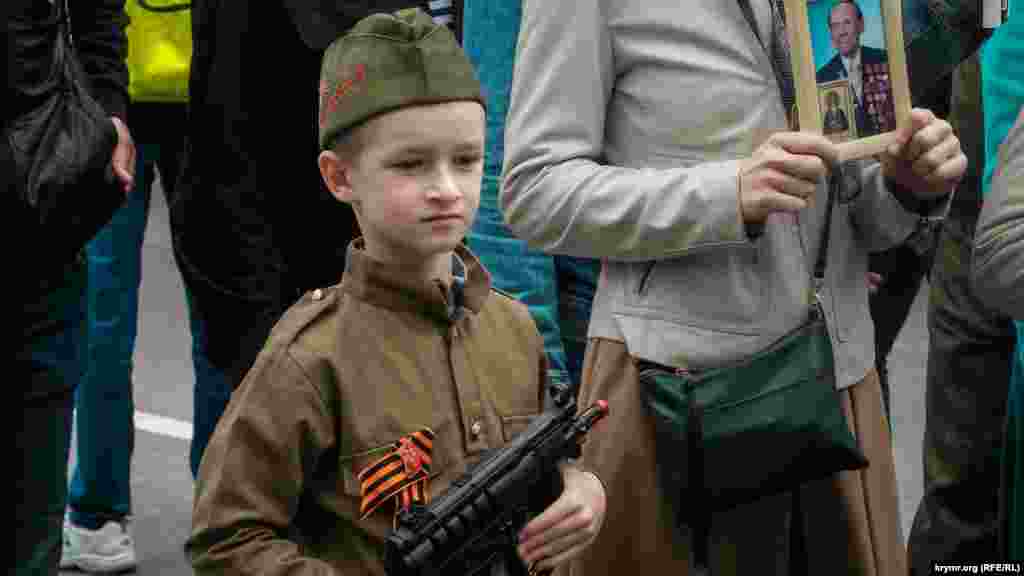
A young participant carries a toy gun in Sevastopol, Crimea, during the Immortal Regiment march on Victory Day, observed on May 9.
1/16 A young participant carries a toy gun in Sevastopol, Crimea, during the Immortal Regiment march on Victory Day, observed on May 9.
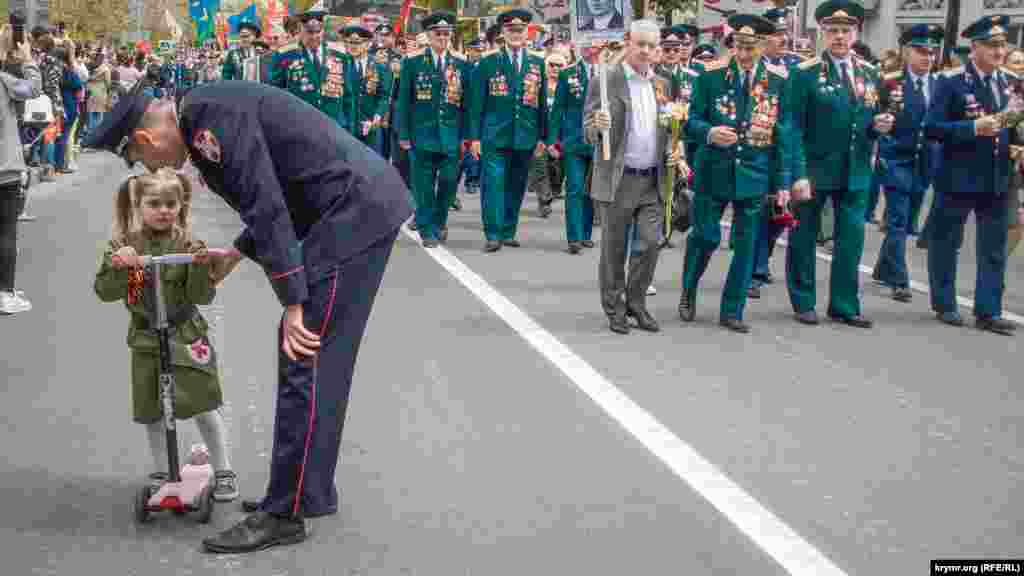
The annual Immortal Regiment march is held in Russian towns and cities, as well as in Russian-controlled Crimea, to honor those who died in World War II. Critics say the Kremlin hijacked the event after it began as a grassroots movement in 2012.&nbsp;
2/16 The annual Immortal Regiment march is held in Russian towns and cities, as well as in Russian-controlled Crimea, to honor those who died in World War II. Critics say the Kremlin hijacked the event after it began as a grassroots movement in 2012. 
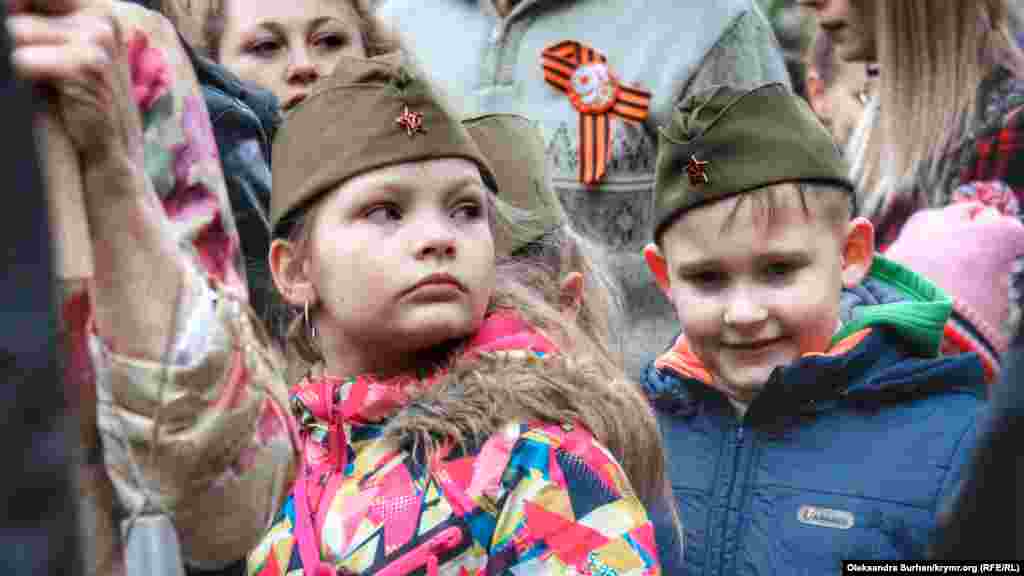
Children in Sevastopol wear the orange and black ribbon of St. George, a Russian military symbol.&nbsp;
3/16 Children in Sevastopol wear the orange and black ribbon of St. George, a Russian military symbol. 
Children wait to place flowers by the eternal flame in a park named after cosmonaut Yury Gagarin in Simferopol, Crimea.
4/16 Children wait to place flowers by the eternal flame in a park named after cosmonaut Yury Gagarin in Simferopol, Crimea.
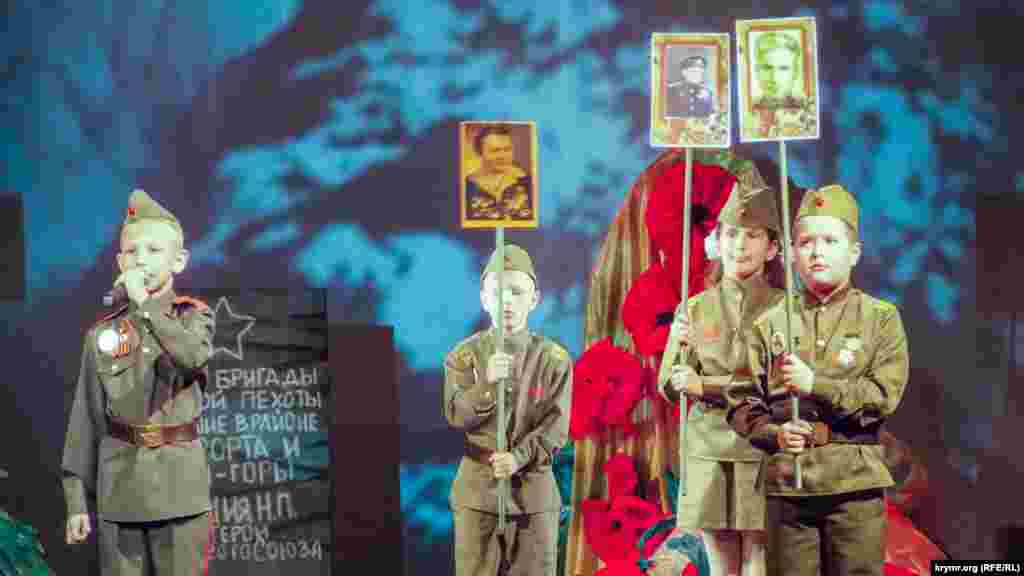
Kids wear replicas of Soviet military uniforms during a performance titled &quot;We are the heirs of victory&quot; on April 19 in Sevastopol.
5/16 Kids wear replicas of Soviet military uniforms during a performance titled "We are the heirs of victory" on April 19 in Sevastopol.
A woman helps a child aim a weapon during an exhibition of Russian military equipment in Sevastopol on April 12.&nbsp;
6/16 A woman helps a child aim a weapon during an exhibition of Russian military equipment in Sevastopol on April 12. 
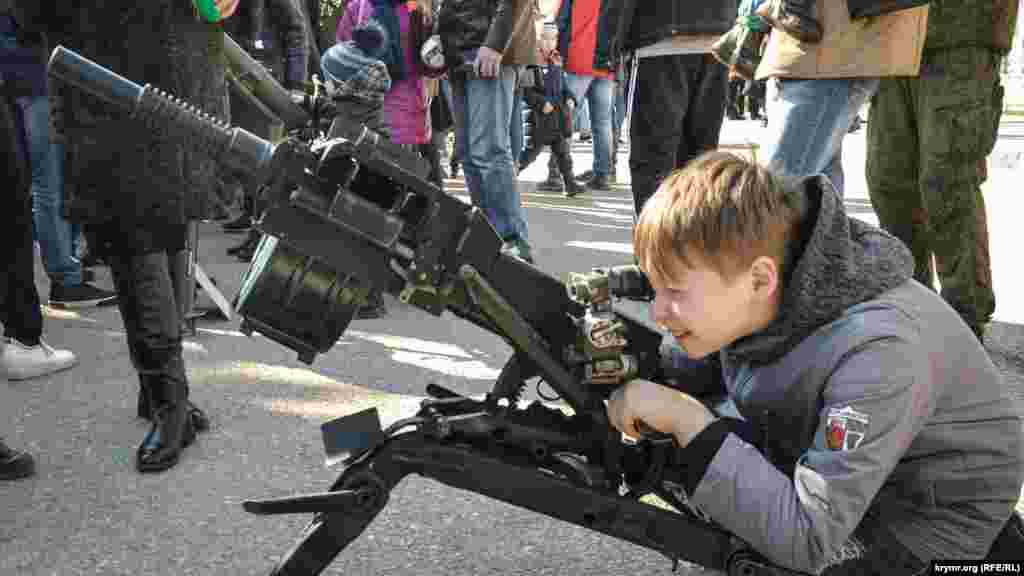
A child looks through the sights of a grenade launcher at an exhibition of Syrian weapons in Sevastopol on April 3.
7/16 A child looks through the sights of a grenade launcher at an exhibition of Syrian weapons in Sevastopol on April 3.
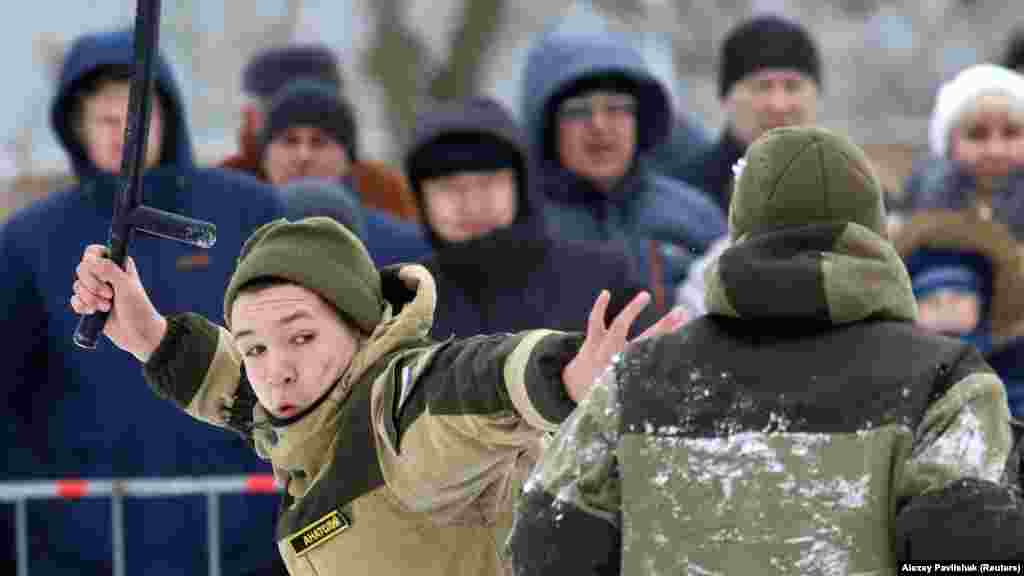
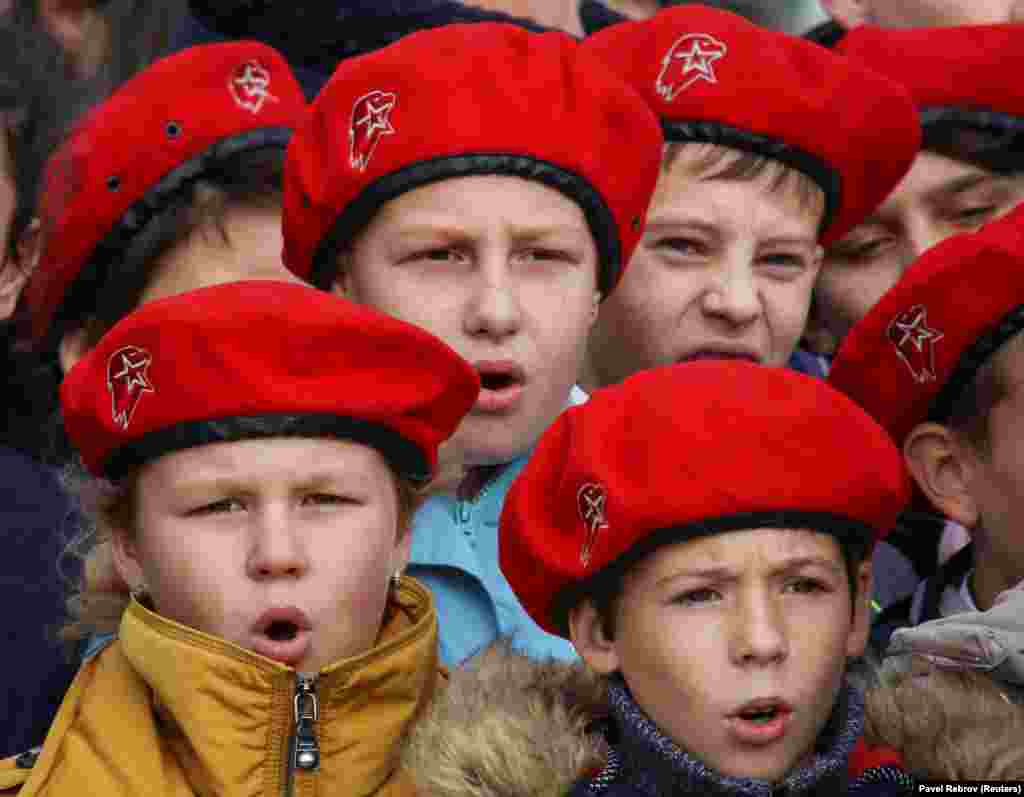
School children in Yalta join the ranks of the Russian military-patriotic youth movement Yunarmiya, which is funded through the Defense Ministry.&nbsp;
8/16 School children in Yalta join the ranks of the Russian military-patriotic youth movement Yunarmiya, which is funded through the Defense Ministry. 
A girl receives a beret as part of her Yunarmiya uniform.&nbsp;
9/16 A girl receives a beret as part of her Yunarmiya uniform. 
Young members of a military-patriotic club perform during an event in Yevpatoria, western Crimea, marking Defenders of the Fatherland Day on February 23.
10/16 Young members of a military-patriotic club perform during an event in Yevpatoria, western Crimea, marking Defenders of the Fatherland Day on February 23.
Students demonstrate their aim during Defenders of the Fatherland Day in Yevpatoria.
11/16 Students demonstrate their aim during Defenders of the Fatherland Day in Yevpatoria.
New recruits are sworn in to Yunarmiya in the Black Sea port of Sevastopol on October 27, 2018.
12/16 New recruits are sworn in to Yunarmiya in the Black Sea port of Sevastopol on October 27, 2018.
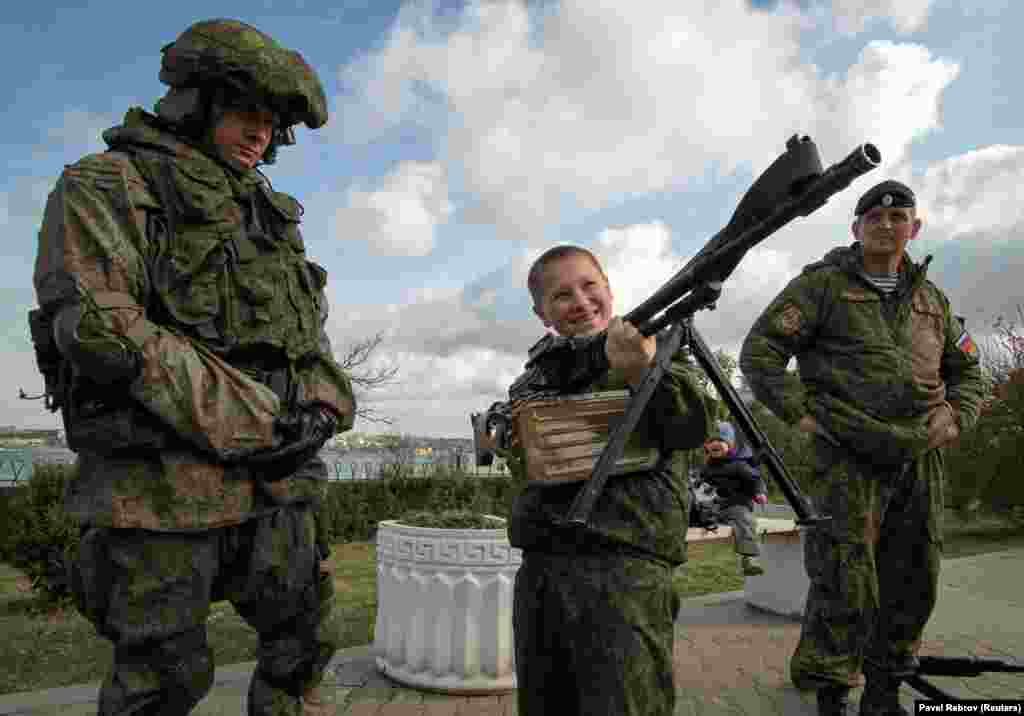
A boy holds a weapon at a military exhibition during for new recruits of Yunarmiya in Sevastopol.
13/16 A boy holds a weapon at a military exhibition during for new recruits of Yunarmiya in Sevastopol.
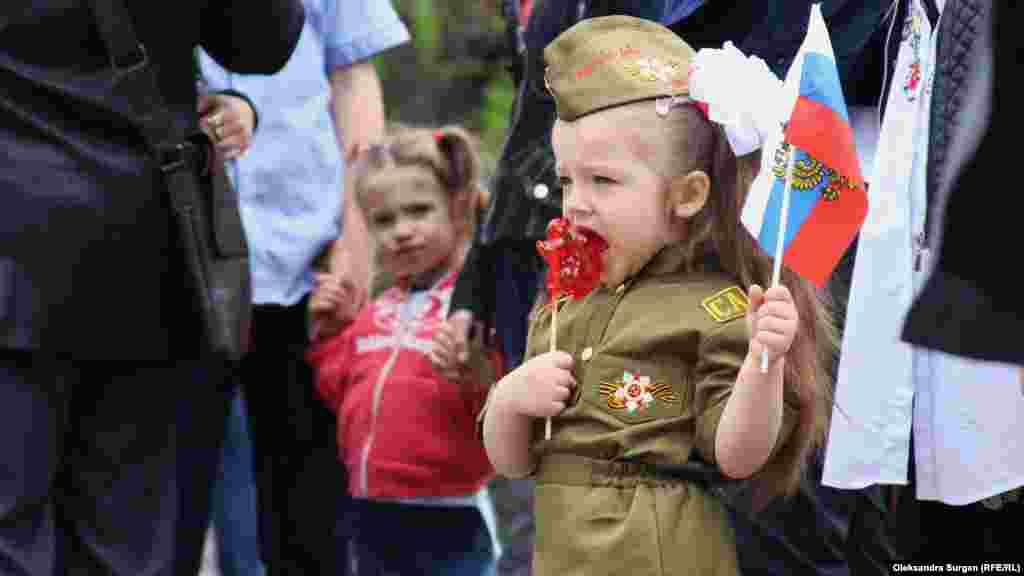
A young Crimean girl wears military-type clothes during a Victory Day celebration in Sevastopol on May 9, 2018.
14/16 A young Crimean girl wears military-type clothes during a Victory Day celebration in Sevastopol on May 9, 2018.
An exhibition of weapons in Sevastopol during Russian Navy Day on July 29, 2018
15/16 An exhibition of weapons in Sevastopol during Russian Navy Day on July 29, 2018
A young girl&#39;s cap reads &quot;Thank you, Grandfather&quot; at Victory Day celebrations in Sevastopol on May 9, 2018.
16/16 A young girl's cap reads "Thank you, Grandfather" at Victory Day celebrations in Sevastopol on May 9, 2018.
Previous slide
Next slide

The massive effort included "patriotic" textbooks and academic programs, the Immortal Regiment ritual and the cult of the Soviet role in World War II, the funding of "patriotic" films and museum programs, the cultivation of nostalgia for the Soviet Union, and the rehabilitation of notorious Soviet dictator Josef Stalin. There is even a chain of Russian "history parks" designed to present the Kremlin's spin on the country's 1,000-year history.

'Psychologically Impossible'

Nobel Prize-winning writer Svetlana Alexievich, in a March 5 interview with RFE/RL's Belarus Service, said that "all the money that Russia earned during the fat years went to propaganda and the military."

The result, she said, has been a seething aggressiveness in much of Russian society.

"I recently had a conversation with a Russian in Berlin," she said. "You see a man sitting in a nice car, wearing a nice suit, but there was such hatred in him when we talked about Ukraine."
Belarusian sociologist Pyotr Rudkouski said the Russian government's narratives about the war in Ukraine have been effective because they are based on "necessary preconditions" that have been cultivated over time.

"It is difficult for Russia to try on the role of aggressor, to identify with the Nazi aggressors who also bombed Kyiv [during World War II]," he said. "This is psychologically impossible for most of society."

Sociologist Iskander Yasaveyev, who lives in Kazan and has demonstrated against the war, also pointed to an aggressive tension in Russian society.

"I am not a psychologist, but I think that some sort of internal tension has arisen in people. They understand they are being lied to, that they are getting propaganda. But they want to be deceived,” he said. “It is simpler for them, easier for them to suppress their inner conflict."

While such factors could prevent support for the war from eroding rapidly, Yasaveyev said that Russian society could “sober up” fast if military losses and economic pain continue to mount.

“A significant number will begin to compare their situation with what is being reported in the news,” he said. “And they will inevitably realize that they are getting lies and propaganda.”

Written by Robert Coalson based on reporting by Current Time; RFE/RL's Russian, Belarusian, and Ukrainian services; Idel.Realities, and Siberia.Realities.
  • 16x9 Image

    Robert Coalson

    Robert Coalson worked as a correspondent for RFE/RL from 2002 to 2024.

This item is part of
XS
SM
MD
LG