




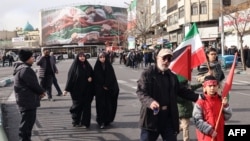
Iran has stayed the executions of protesters, President Donald Trump said, quoting "very important sources on the other side," but tensions continued across the Middle East as the possibility of US military action against Tehran remains.
Reports appear to indicate the massive protests, and the brutal crackdown that authorities unleashed to quell the unrest -- leaving thousands dead -- have abated.

But with a near total Internet blackout in its seventh day according to watchdog Netblocks, tensions remain high and information scarce. Netblocks noted that the "online information vacuum is resulting in the amplification of pro-regime accounts, AI fakes, and other agendas."
Trump told reporters at the White House on January 14 that he had received assurances from "very important sources on the other side" that Tehran would not go ahead with any executions of protesters detained by security forces.
"They've said the killing has stopped and the executions won't take place -- there were supposed to be a lot of executions today and that the executions won't take place -- and we're going to find out," Trump said.
"We've been told on good authority, and I hope it's true."
On January 15, White House Press Secretary Karoline Leavitt said that "800 executions that were scheduled and supposed to take place" were halted.
However, Leavitt reiterated Trump's earlier warning to the hard-line rulers in Tehran, saying they will face "grave consequences" if the killings continue.
"All options remain on the table for the president," she said.
On the same day, US Treasury Secretary Scott Bessent said the United States had imposed sanctions on Iranian officials and banking networks, accusing them of violently cracking down on protests and laundering oil revenues.
"At the direction of President Trump, the Treasury Department is sanctioning key Iranian leaders involved in the brutal crackdown against the Iranian people," Bessent said in a statement.
"Treasury will use every tool to target those behind the regime's tyrannical oppression of human rights."
Iranian authorities have waged one of the most brutal crackdowns ever after people across the country took to the streets in anti-government protests seen as one of the biggest challenges to clerical rule since the 1979 Islamic Revolution.
The independent US-based rights monitor HRANA said that according to its confirmed and verified data on January 14 the death toll in the protests had risen to 2,615 protesters, with more than 18,000 others arrested. Norway based Iran Human Rights said its research showed at least 3,428 protesters have been killed.
Different activist groups have put the death toll far higher, but an internet blackout has made it difficult to verify the information.
A journalist inside Iran who managed to send a report to RFE/RL's Radio Farda on January 13 said a taxi driver they talked to spoke of security forces attacking medical centers, kidnapping wounded protesters, and killing those who could not be transported.
His claims could not be independently verified by RFE/RL, but they do match up with human rights sources and other reports from inside the country about the severity of the crackdown on the protests and the "mass killing" of protesters.
In light of the reports of the violent crackdown, Trump had warned several times that the United States may intervene to halt the killings while urging Iranians to continue their protests.



Rights groups had reported that one detained protester, 26-year-old Erfan Soltani, would be executed on January 14, six days after his arrest on charges of "waging war against God" over his role in the protests.
Trump said late on January 13 in an interview with CBS News that if the authorities carried out the execution -- the first of a participant of the current wave of protests -- "you're going to see some things."
The Norway-based Hengaw rights group, citing relatives of Soltani, said late on January 14 that the execution had not taken place, though "serious and ongoing concerns" remain.
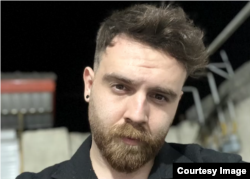
Iran's judiciary said on January 15 that the charges against Soltani, who is being held at the central penitentiary in the city of Karaj, do not carry a death sentence.
The Iranian Judiciary Media Center said reports Soltani faced execution were "fabricated" and that he is charged with "gathering information and colluding against the country's internal security and propaganda activities against the regime."
Trump has not elaborated on what actions the United States may take against Iran and when, but some personnel have been advised by Washington to leave the main US air base in the region after Tehran warned neighboring countries hosting US troops that it would retaliate against American bases if Washington carries out its threats.
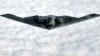
Iran's Islamic leadership has weathered previous protests, but the latest unrest comes as Tehran is still recovering from last year's war with Israel -- when the United States joined in a set of air strikes aimed at Iran's nuclear facilities -- and its regional position is weakened by blows to regional allies.
Trump is thought to be mulling options including limited military strikes, a more concerted campaign of strikes against the Islamic Revolutionary Guards Corps (IRGC), or nonmilitary moves such as a full economic blockade or cyberattacks to disrupt the communication and decision-making systems of Iranian security agencies.
In an interview with Reuters, published on January 14, Trump said there was a chance Iran's clerical government could collapse, though in truth, he added, "any regime can fail."
"Whether or not it falls or not, it's going to be an interesting period of time," Trump said.
If that were to happen, Trump said it isn't clear who would fill the void.
He said opposition figure Reza Pahlavi, the son of the late shah of Iran, who was ousted from power in 1979, "seems very nice." But the US leader also expressed uncertainty over whether Pahlavi would be able to muster support within Iran to eventually take over.
"He seems very nice, but I don't know how he'd play within his own country," Trump said. "And we really aren't up to that point yet.
"I don't know whether or not his country would accept his leadership, and certainly if they would, that would be fine with me."

