



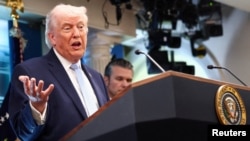
US President Donald Trump said his representatives are traveling to Islamabad, Pakistan, for another round of talks on April 20 with Iran as the Strait of Hormuz remains closed. Tehran has not yet confirmed it will take part.
Writing on his Truth Social platform on April 19, Trump said that “the US was "offering a very fair and reasonable DEAL, and I hope they take it because, if they don’t, the United States is going to knock out every single Power Plant, and every single Bridge, in Iran. NO MORE MR. NICE GUY!”
The latest remarks by Trump come just days ahead of the expiration of a two-week cease-fire with US and Israel forces on April 22.
Earlier in the week, there were hopes that the strait, which usually accounts for around one fifth of the global oil trade, would open up after a more than a month of being closed as Tehran announced that it was open to commercial shipping traffic for the remainder of a separate 10-day cease-fire between Israel and Lebanon, which came into force on April 16.
The hope remained short-lived, however, amid reports that Iranian forces had attacked at least three civilian ships, two of which reportedly were Indian and one French-flagged vessel.
Earlier on April 19, the semiofficial Tasnim news agency, which is close to the Islamic Revolutionary Guards Corps, said that Botswana- and an Angola-flagged vessels were forced to change course over what the Iranian report described as “unauthorized transit” of the crucial waterway.
In the same social media post on April 19, Trump also claimed that Iran’s threat to close the strait was redundant because a US naval blockade of Iranian ports, which entered into force on April 13, had “already closed it.”
Iranian Foreign Ministry spokesman Esmail Baqaei criticized the US blockade of Iranian ports as a violation of the cease-fire agreement.
In a post on X on April 19, Baqaei wrote that it was “both unlawful and criminal” adding that “by deliberately inflicting collective punishment on the Iranian population, it amounts to war crime and crime against humanity.”
The first round of US-Iranian peace talks took place in Islamabad on April 11-12 but ended without an agreement, even though Trump has maintained that the two parties “are very close to a deal”.
A Pakistani military delegation led by army chief Asim Munir, who was one of the key mediators in the first Islamabad talks, landed in Tehran on April 15 carrying a new message from Washington, in the latest effort to revive negotiations.
Iran has not formally confirmed it will attend the new round of talks, and the country's semiofficial Tasnim news agency has cited a source familiar with the matter as saying no further negotiations will take place while the US blockade remains in force.
The Iranian side has also sounded more skeptical that any sort of agreement is close.
Iran’s lead negotiator, the parliamentary speaker, Mohammad Baqer Qalibaf, said that they were "still far from the final discussion," in a televised address earlier on April 19, adding that "we made progress in the negotiations, but there are many gaps and some fundamental points remain."
Previously the Supreme National Security Council, the country’s top security body, said that it was reviewing “the new proposals” delivered by Munir, but added that the Iranian negotiating team “will not make even the slightest compromise, retreat or leniency,” and would defend national interests “with all its strength.”