




WASHINGTON -- Ukraine hopes a temporary cease-fire that enabled humanitarian aid deliveries and civilian evacuations from the Russian-occupied city of Oleshky could serve as a model for wider de-escalation efforts, top officials said.
Top Ukrainian officials, speaking at a news conference at the Ukrainian Embassy in Washington on November 6, described the operation as a practical test of mechanisms that could eventually help monitor a broader truce.
Ukrainian human rights ombudsman Dmytro Lubinets and David Arakhamia, head of President Volodymyr Zelenskyy's parliamentary faction, said the six-day humanitarian initiative had demonstrated that even amid the ongoing war, the two sides could agree on and implement a localized cease-fire with international involvement.

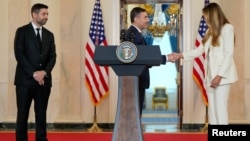
The operation, facilitated by US first lady Melania Trump, involved a temporary halt in fighting around Oleshky in Ukraine's occupied Kherson region, allowing roads to be cleared of mines, humanitarian supplies to reach residents, and civilians wishing to leave to be evacuated.
"We have chosen humanity over war," Melania Trump said at a White House event on November 5 recognizing the initiative.
Lubinets said the cease-fire, which began at 3 a.m. Kyiv time on October 27 and ended late on November 1, was the longest such arrangement since Russia launched its full-scale invasion in February 2022.
He described the operation as a breakthrough not only because of the humanitarian assistance delivered but also because it established a new mechanism for negotiating, monitoring and verifying a cease-fire.
The Oleshky Model
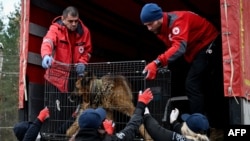
The operation unfolded in several stages, Lubinets said. After the cease-fire took effect, Russian forces began demining roads leading to Oleshky, a process that continued through October 29. Humanitarian supplies, including food, medicine, drinking water, and specialized hospital equipment, were then delivered.
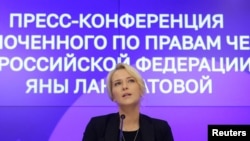
Lubinets and his Russian counterpart, Yana Lantratova, accompanied by their teams and journalists from Ukraine, the US, and Russia, subsequently entered the occupied city to oversee the distribution of aid and assist residents seeking evacuation.

Residents were given three options: remain in Oleshky and receive humanitarian assistance, leave for Ukrainian-controlled territory, or travel to Russia or territory under Russian control.
"All people who wanted to be evacuated from Oleshky to Ukraine are now in Ukraine," Lubinets said.
He said he had personally overseen the evacuation process and spoken with residents to establish whether their decisions were voluntary.
Some chose to remain despite the lack of electricity and heating, while others initially stayed because they doubted the humanitarian mission would succeed.
Lubinets said his office had since received additional requests from residents seeking evacuation and expressed hope that another operation could be organized.

Arakhamia said the Ukrainian delegation was considering extending the approach to other difficult areas, although he declined to identify potential locations, saying publicizing them could jeopardize negotiations with Moscow.
The humanitarian track would focus on two priorities, he said: returning people whose cases have remained unresolved, including civilians separated from their families, and replicating the Oleshky operation in other occupied or otherwise difficult-to-access areas.
He said the two sides were also considering keeping humanitarian negotiations separate from the broader political process, so that disagreements over a peace settlement would not derail efforts to help civilians.
'A Pilot' For Monitoring Broader Cease-Fire
Beyond its immediate humanitarian impact, Arakhamia said, the Oleshky initiative offered a real-world test of truce-monitoring arrangements previously developed during earlier rounds of trilateral negotiations involving Ukraine, Russia, and the US.
Those discussions had produced a comprehensive document outlining how a cease-fire could be monitored if a wider peace agreement were reached, he said.
The Oleshky operation allowed the sides to test some of those principles on a smaller scale, including the use of drones to monitor the area and verify potential violations.
"One thing is doing a theoretical exercise, another thing is seeing in practice how it's going to work on a smaller scale," Arakhamia said.
Lubinets said the operation was particularly significant because he was the first Ukrainian official since 2022 to enter Russian-occupied Ukrainian territory as part of an official humanitarian mission.

The delegation also experimented with drone surveillance and direct communication between Ukrainian and Russian military representatives to monitor compliance. Arakhamia said the experience had helped demonstrate how localized cease-fires could be verified rather than relying solely on competing military intelligence claims.
The Ukrainian delegation seeks to use the lessons from Oleshky in the next round of negotiations in Abu Dhabi, scheduled for next week. Arakhamia also said Kyiv would favor involving European representatives in future monitoring arrangements, arguing that Europe should have a central role in any postwar security architecture.
Kyiv Rejects Equivalence Over Deported Children
The Ukrainian officials also addressed President Donald Trump's meeting with Russian envoy Kirill Dmitriev at the White House on November 5, which took place without a corresponding meeting with the Ukrainian delegation.
Arakhamia said the Ukrainian side had not expected or requested a meeting with Trump as part of the Oleshky mission and regarded the encounter with Dmitriev as a separate diplomatic track.
He said he did not believe the meeting necessarily concerned Ukraine directly, adding that Kyiv remained in regular contact with US and European national security officials.
Asked whether the encounter amounted to negotiations about Ukraine without Ukraine, Arakhamia reiterated that the principle remained valid.
He said Washington had generally kept Kyiv informed when discussions with European or Russian representatives touched on Ukrainian issues.
Arakhamia suggested that US negotiators Jared Kushner and Steve Witkoff were trying to broaden the diplomatic conversation beyond the most intractable territorial questions in Donbas and toward a wider European security arrangement.
The idea, he said, was to encourage Russia to consider compromises within a broader framework, although he cautioned that it remained unclear whether the approach would succeed.
Asked about references to the return of both Ukrainian and Russian children, Lubinets said Ukraine had never prevented Russian citizens, including children, from leaving Ukrainian territory.
He said Kyiv welcomed Melania Trump's assistance in bringing Ukrainian children back from Russia but questioned the use of language suggesting that Ukrainian and Russian children were being returned under equivalent circumstances.
Winter Is Coming
Despite expressing cautious optimism about the humanitarian initiative and the next round of negotiations, Arakhamia warned that the wider war was intensifying and that Ukraine faced a particularly difficult winter.
He said repeated Russian attacks on electricity infrastructure threatened not only power supplies but also water and sewage systems, raising the risk of public-health emergencies.
He described the diplomatic effort as urgent, saying Ukraine was prepared to pursue further rounds of negotiations in Abu Dhabi in the hope of securing some form of de-escalation.
Arakhamia also offered a more optimistic assessment of Ukraine's prospects for securing additional US financial and military assistance, saying he believed the chances had at least doubled.
He attributed his assessment partly to what he saw as reduced political obstacles in Washington, while acknowledging that the final outcome remained uncertain.
The Ukrainian delegation also rejected suggestions that the Oleshky cease-fire had been used by Russia as a cover for major military movements.
Lubinets said military vehicles seen in footage from the period were part of the agreed demining operation and had been marked with Red Cross insignia and yellow identification markings.
He said Ukrainian and Russian representatives had maintained regular contact throughout the cease-fire and had publicly confirmed that neither side had violated the agreement.
Arakhamia added it was possible some repositioning had occurred on a limited scale but said there was no indication that it had significantly undermined Ukrainian military positions.
Urgent Evacuations
Lubinets recounted receiving a message from a woman whose seriously ill mother remained trapped in Oleshky.
The woman had been told her mother might have only weeks to live. The mother was evacuated to Kyiv, where she is now receiving hospital treatment and has been reunited with her daughter for the first time since 2022, Lubinets said.
“For this meeting, we have to do everything," he said. "We need to negotiate with the Russian side. We need to do everything to save our people.”
Arakhamia acknowledged that many Ukrainians remained deeply skeptical of diplomatic initiatives with Moscow, particularly as Russian attacks continued elsewhere in the country.
But he argued that even a limited reduction in violence could create an opening for something larger.

