




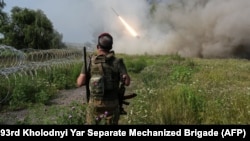
Sometime around late May, as Russia's all-out invasion neared the 4 1/2-year mark and the summer fighting season shifted into higher gear, Ukrainian commanders quietly ordered some of the country's most battle-hardened units into positions about 50 kilometers north of the Donetsk region city of Slovyansk.
Mainly taken from Ukraine's Third Army Corps, the units confronted a bulge in the 1,100-kilometer front line where Russia's 20th Combined Arms Army had been grinding westward, pushing out from a bridgehead on the west bank of the Zherebets River amid villages, farmland, and rolling fields. The goal for Russia: cut off supply lines for Ukrainian forces in Slovyansk, one of two main Ukrainian-held cities in the Donetsk region.
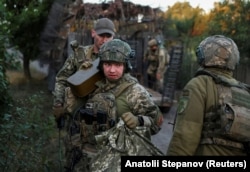
Over the summer months, Ukrainian forces battled northward out of the town of Lyman while also pushing to the south toward the villages of Ridkodub, Katerynivka, and Nove.
That effort, according to open-source researchers, experts who have traveled to the battlefield, and Ukrainian and Russian war bloggers, is nearing a remarkable success for Ukrainian forces: Much of the Russian force in the area has been pushed back to the Zherebets River, with small pockets of soldiers encircled and likely to be captured or killed in the coming days.
By most accounts, it is shaping up to be one of the largest shifts on the battlefield in months, possibly in a year.
For the moment, the success relieves some pressure on the Ukrainian defenses trying to hold the line of cities, towns, and roads running north to south and encompassing Slovyansk and the city of Kramatorsk, a swath known as an "agglomeration."
Moreover, the nearly four-month offensive also took place in an unusual information vacuum, with virtually no information leaking out among war bloggers on Telegram in Ukraine or Russia until recent days.
"Ukrainians took back some of the territory. Russia lost more territory," Konrad Muzyka, a Polish-based military expert who has spent substantial time on Ukraine's front lines, told RFE/RL. "It's significant, not because of what's happening around Lyman, but because I think it thwarted a big Russian plan that was seeking to envelop the Slovyansk-Kramatorsk agglomeration from the north and from the south."
"The Russians keep trying this envelopment" of the entire Donetsk region, said Dara Massicot, an expert on the Russian military with the Carnegie Endowment for International Peace, a Washington-based think tank. "For now, it looks like the northern attempt is blunted."
A chorus on Russian war channels on Telegram, meanwhile, has also pointed to significant Ukrainian gains.
"A rout on the Lyman front," said one prominent Telegram blogger named Anatoly Shariy, a former Ukrainian politician who has been convicted in absentia of high treason in Ukraine and sentenced to 15 years in prison.
"The situation at Lyman is alarming," said Rybar, a Telegram blogger previously affiliated with the Russian Defense Ministry.
"We suffered an unpleasant tactical defeat," said another channel, called Dnevnik Desantnika. "However, encirclement did not occur; most of our personnel were withdrawn, and now everything depends on whether [Ukrainian] forces can exploit this success east of the Zherebets River."
At least one pro-Russian blogger, Yury Kotenok, complained specifically about the lack of information that has leaked out from Ukrainian sources.
"Ukraine is conducting an offensive near Lyman under information silence," he wrote. "Silence on our part is already customary, but on the enemy's side it seems somewhat unusual, which is alarming. Here we have a deliberate, targeted regime of silence."

Ukraine's military press office declined to comment, citing ongoing operations. But in a statement released on September 15, the commander for the Third Army Corps, Brigadier General Andriy Biletskiy, broadly confirmed the counteroffensive.
"We confirm reports of a Ukrainian Army offensive in the north of Donetsk Oblast. Maintaining information silence, the units eliminated pockets of enemy infiltration," he was quoted as saying. "There is currently a lot of information in open sources suggesting that the ultimate goal of our offensive operations is to reach the banks of the Zherebets River…. There will be good news."
The Russian Defense Ministry did not respond to a query seeking comment.
The battlefield success is unlikely to translate into any broader strategic shift for Ukraine, military experts said. Overall, Kyiv remains at a disadvantage, outnumbered and in many places outgunned by Russia.
Despite suffering astronomical casualties and losing ground in some places, Russia continues to grind forward along parts of the front line.
Military commanders have prioritized trying to capture Slovyansk and Kramatorsk, which would give them control over the entirety of the Donetsk region -- and the entire Donbas.
That is a major priority for Putin and the Kremlin. Russia has vowed to capture all of the Donbas by force if Ukraine refuses to cede the territory it still holds, a step Kyiv has firmly ruled out. The issue of territorial control in the Donbas is a key sticking point in the on-again, off-again US-led peace efforts.
Still, 2026 has been a relatively stable year for Ukraine's frontline troops; in some places, Kyiv has taken back more territory than Russia has gained.
The success of the Lyman counteroffensive also highlights the fighting prowess of some of Ukraine's best units -- including the Third Army Corps -- and some of the continuing problems Russia has had on the battlefield, particularly as it sends new volunteers to the front with minimal training.
"I think it shows that the Russians can concentrate [only] in one main sector at a time, which right now is in southern Donetsk. That occasionally opens a few weaker spots elsewhere that can be exploited," Massicot said.
"I get the sense that the 20th Combined Arms Army wasn't the strongest and so it might have been a good spot [for Ukraine] to push on," she said.
"Ukraine has now effectively removed the encirclement threat to [Lyman] and are threatening the Russian salient north of the city," said Black Bird Group, a Finnish-based research organization.
"The Russian summer campaign of 2026 can be considered a failure," said Emil Kastehelmi, the group's co-founder.