


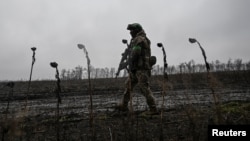
Amid a fast-paced flurry of diplomacy over a US push for a peace deal, Ukrainian President Volodymyr Zelenskyy said on December 8 that Kyiv has no legal or moral right to cede any of its land.
"Of course, Russia insists that we give up territory. We certainly do not want to give anything up. That is what we are fighting for," said Zelenskyy, whose country has battled Russian military aggression since 2014 and a full-scale invasion by Moscow's forces since February 2022.
Sounds straightforward. But in the same online chat with journalists, he said negotiations with Washington involve "complex issues concerning territory" and that "no compromise has been found there yet."
Here's a look at territorial control in Ukraine, one of the highest hurdles on the path to peace.
The Donbas
The objectives and obsessions that drove Russian President Vladimir Putin to launch the invasion go far beyond a land grab, encompassing a desire to subjugate Ukraine, weaken the West, and roll back some of the results of the Cold War and the collapse of the Soviet empire. But control over the Donetsk and Luhansk regions, which make up the Donbas, is clearly a core aim. And along with dominion over Crimea and parts of the Zaporizhzhya and Kherson regions, it may be the least Putin believes he can accept, for the time being, without being seen at home as failing in a war he initially hoped would bring Ukraine to its knees within weeks.
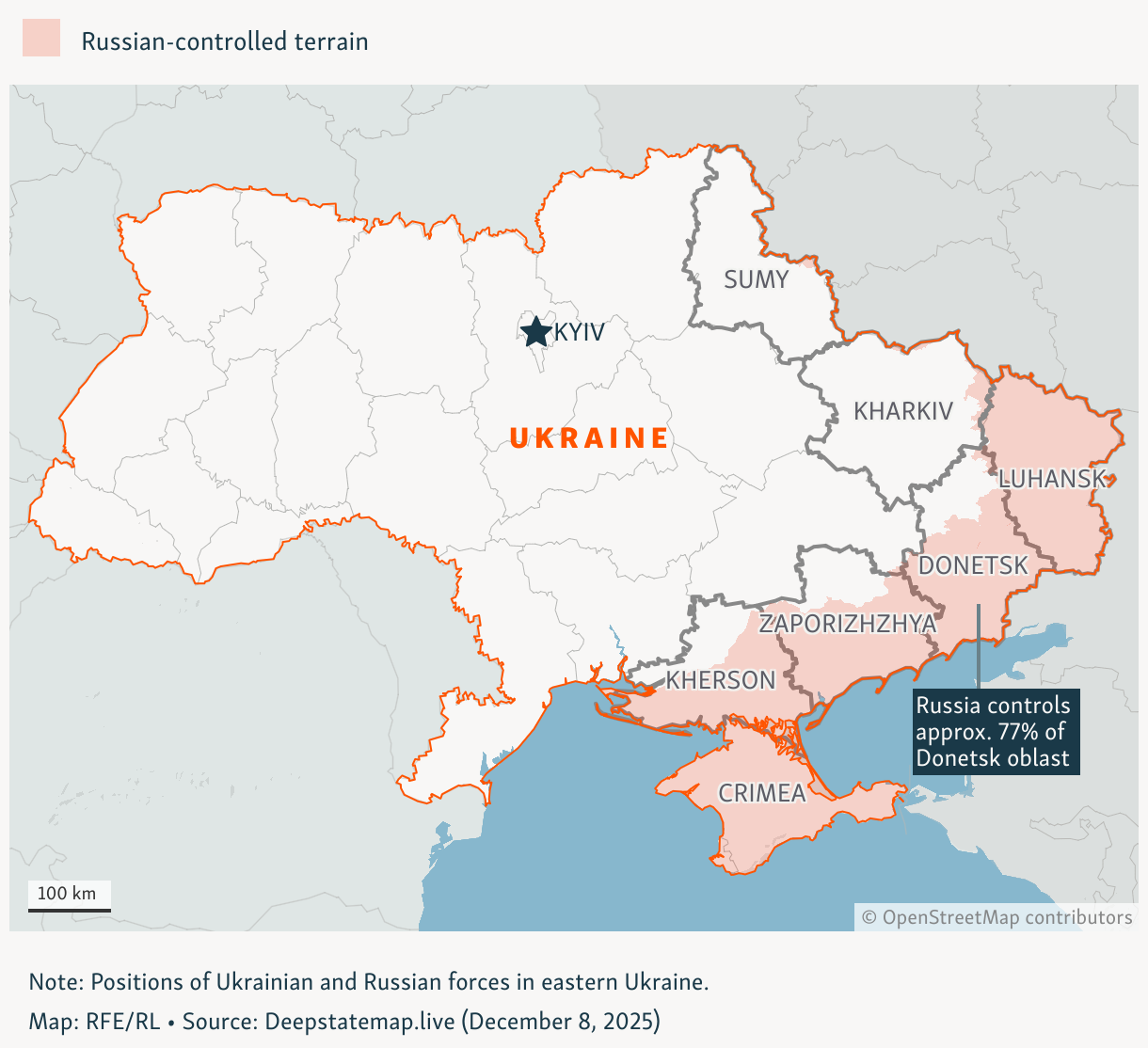
The problem, for Putin, is that his forces have been unable to seize the entirety of the Donbas. All but a few patches of land in the Luhansk region are Russian-occupied, part of the nearly one-fifth of Ukraine that Moscow controls. But Donetsk has proved harder: Russian troops control about 77 percent of the region after inching forward in a long and grueling offensive, but they have failed to definitively take the ruined city of Pokrovsk, and several other population centers remain under Kyiv's control.
The massive cost in terms of Russian soldiers killed may have reinforced Putin's determination to complete the capture of the region, lest the bloodshed be seen as having taking place in vain. In any case, he has made full control over the Donbas a fundamental demand in any peace deal, saying last week that Russia would seize the remaining part by force if diplomatic efforts do not result in a Ukrainian withdrawal.
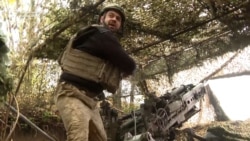

For Ukraine, the portion of the Donbas that it still controls is just as crucial, if not more so. Any peace deal that cedes territory to Russia or solidifies Kremlin control over land it occupies would be seen widely in Kyiv and the West as rewarding Moscow for its aggression -- but a pact obliging Ukraine to retreat from land its forces have managed to defend, also at a huge human cost, would be even harder to swallow. It could have major political consequences for Ukraine and Zelenskyy, which is one reason why Putin wants it to happen.
As Zelenskyy pointed out on December 8, there is also a firm legal hurdle to handing land over to another country: the Ukrainian Constitution, which states that any territorial alterations "are resolved exclusively" though a nationwide referendum.
De Facto, De Jure
Another complication, if only because Putin insists on making it one, is Moscow's claim -- unfounded in reality but enshrined in Russian law for over three years -- that the Luhansk, Donetsk, Zaporizhzhya, and Kherson regions are part of Russia, not Ukraine. Putin seeks to drive this rhetorical point home by stating that Russia will "liberate" the remainder of the Donbas rather than saying it will seize or occupy Ukrainian territory.
The seemingly irreconcilable conundrum of the Donbas was reflected in the 28-point US peace proposal that set off a whirlwind of diplomacy when it emerged last month.
The draft was widely seen as highly favorable to Russia, and Ukraine has pushed back in talks with US officials as well as European leaders who have rallied to support Kyiv's efforts to avoid a lopsided deal.
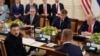
But the wording on the Donbas, which clearly caused ire in Ukraine, also seemed unlikely to please Russia. Along with Crimea, which Russia occupied in 2014, the draft proposal said the Donetsk and Luhansk regions would be "recognized as de facto Russian" -- not de jure, which is what Moscow wants. It also said that Ukraine would withdraw its forces from the part of the Donetsk region that it holds, and that this land would become a "neutral demilitarized buffer zone" that would be "internationally recognized" as belonging to Russia but that Russian forces would be barred from entering.
Among other potential pitfalls, such as the question of who would monitor compliance in the Donbas, some analysts said that de facto recognition is a contradiction in terms: Recognition, particularly set out in a peace pact, suggests formal acknowledgement, while de facto implies informal acknowledgement of the facts on the ground.
Zelenskyy said on December 8 that the US draft had been whittled down from 28 points to 20, with some of the sections least favorable to Ukraine removed. But it has not been released publicly, and how it deals with territory is unclear -- though from Zelenskyy's comments, it was clear that Kyiv was not satisfied on that score at that point. On December 9, Zelenskyy said Ukraine and European backers would be ready to send a "refined" proposal to the United States soon.
Kherson And Zaporizhzhya
Beyond Crimea and the Donbas, the Zaporizhzhya and Kherson regions also pose a challenge for would-be peacemakers. Russia holds part of each region, giving it a "land corridor" from the Russian border to the isthmus that links Russian-occupied Crimea to mainland Ukraine, as well as control over the Zaporizhzhya nuclear power plant -- which is the largest in Europe and another thorny issue in peace talks.
But after Ukraine recaptured the city of Kherson in a major counteroffensive in the fall of 2022, Russia does not hold the capital of either region. Amid the US push for peace that began when Trump took office in January of this year, Moscow has at times seemed open to an agreement that would leave Ukraine in control of the land it holds, as the 28-point proposal stipulated.
But Putin cast doubt on that notion in his bellicose comments last week, asserting that Russia would take not only the Donbas but "Novorossia" by force if Ukraine does not withdraw its troops, using a highly contentious term that harks back to imperial Russia's dominion over swaths of eastern and southern Ukraine.
In addition to Crimea, Luhansk, Donetsk, Zaporizhzhya, and Kherson, Russia controls much smaller amounts of territory in the Kharkiv, Sumy, and Dnipropetrovsk regions. The 28-point plan said that "Russia will relinquish other agreed territories it controls outside the five regions," but it gave no details.

