



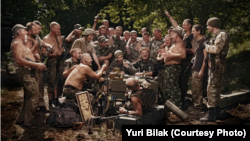

A painting of Ukrainian Cossacks raucously defying a hostile foreign power in the 17th century has taken on new relevance amid the Russian invasion of Ukraine, sparking a trend of Ukrainian soldiers replicating the iconic scene.
Soldiers began posing to mimic Reply of the Zaporizhian Cossacks in 2014, when fighting erupted between Russia-backed separatists and Ukrainian forces in the Donbas. Since then several Ukrainian military formations have recreated the uproarious scene.
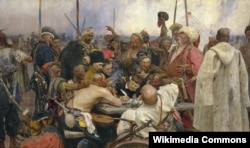
Reply of the Zaporizhzhyan Cossacks was painted by realist painter Ilya Repin between 1880 and 1891 and depicts Cossacks in the late 1600s penning an insulting reply to an ultimatum issued from the Ottoman Sultan.
According to the story that inspired the art, the Muslim ruler had failed to conquer the Zaporizhzhyan warriors in battle but threatened to return with a larger force unless they submitted. The Cossacks' letter is apocryphal but the painting has become a symbol of freedom for Ukrainians.
Repin was born near Kharkiv in today's Ukraine in 1844. The region was then a part of the Russian Empire.
Perhaps the most meticulous recreation of the artwork is Emeric Lhuisset's image, titled From Far Away, I Hear The Cossacks' Reply. The French photographer spent a full day on the banks of the Dnieper River near Kyiv in the summer of 2023 working with members of Ukraine's 112th Separate Territorial Defense Brigade to compose a photographic echo of Repin's masterpiece.
In the photo, a vape pen replaces tobacco pipes, and instead of swords RPGs are slung over the shoulders of the modern warriors. A drone buzzing nearby further contemporizes the scene, made up of soldiers who had recently seen combat.
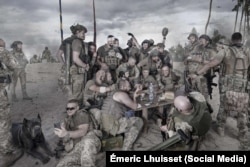
Lhuisset told RFE/RL the photo is "the culmination of extensive research into Russian colonialism in Ukraine and the use of culture as a weapon of war."
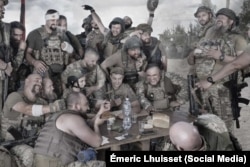
In the center of the modern image Roman Hrybov sits holding a walkie-talkie. Hrybov is the Ukrainian border guard who issued the famous "Russian warship, go F*** yourself," response to the naval advance on Ukraine's Snake Island in 2022. Sitting Hrybov in place of the scribe in the historic painting, Lhuisset says is "repeating the story of the response of the 17th century Cossacks."
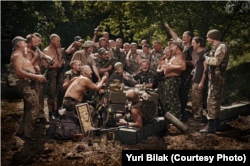
"Repin's painting immediately transports me to this period where the spirit of freedom of the Zaporizhzhya Sich is felt," Andriy Malyk, a spokesman for the 112th Brigade, told RFE/RL's Ukrainian Service. "And it echoes to this day. In my opinion, Repin's painting will never become outdated," he said.
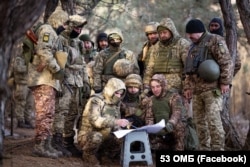
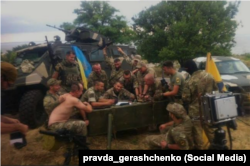
The caption to the above photo, made by Ukraine's 53rd Mechanized Brigade declares, "Previously, the Cossacks wrote a letter to the Turkish Sultan, now they note down a concrete plan of action for the destruction of the enemy and the complete liberation of Ukrainian lands."
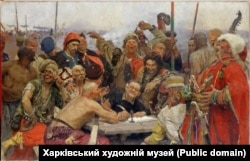
The original painting by Repin, measuring some 3.6 meters in width, is held at the State Russian Museum in St. Petersburg, having been purchased by Russian tsar Alexander III in 1892. A later version of the painting (above), which remained unfinished, is held by the Kharkiv Art Museum.
As for the now well-known modern recreation of the painting by photographer Lhuisset, after printing it in large format, he donated it to the Kherson Art Museum in in late 2024.
During the formal handover of the photo, he told museum staff and soldiers from the photo, "I hope that one day we can all meet up during a visit to the museum before going to eat a watermelon on the banks of the Dnieper without fearing a drone attack or artillery fire."

