



Ukrainian President Volodymyr Zelenskyy has unveiled the latest draft of a US-brokered peace agreement aimed at ending Russia's war against Ukraine as it nears its fourth anniversary.
During a briefing with journalists on December 23, Zelenskyy presented a 20-point plan developed over recent weeks by negotiators from the United States, Ukraine, and European countries.
The draft outlines a full and unconditional "nonaggression agreement" between Russia and Ukraine, though sticking points such as territorial control over eastern Ukraine and the fate of the Zaporizhzhya nuclear power plant, the largest atomic energy facility in Europe, remain.
The Kremlin said Russian President Vladimir Putin had been briefed on the draft and that Moscow was now formulating its response.
"This is a document referred to as a framework -- a foundational document on ending the war, a political document between us, America, Europe, and the Russians," Zelenskyy said.
"We are ready for a meeting with the United States at the leaders’ level to address sensitive issues. Matters such as territorial questions must be discussed at the leaders’ level."
Security Guarantees For Ukraine
The draft envisions strong security guarantees for Ukraine, including maintaining the Ukrainian Armed Forces at 800,000 personnel in peacetime.
It is also sees the United States, NATO, and European signatory states providing Ukraine with security guarantees that mirror Article 5, a central element of the alliance's structure that states an attack against one member is considered an attack against all.
The agreement would be supplemented by US-Ukraine bilateral security and reconstruction agreements, and Ukraine would be allowed to join the European Union within a specifically defined period of time, the plan states.
In a sign the Kremlin could be probing to see how the public is reacting to talk of a possible peace settlement, state polling firm VTsIOM on December 24 released a survey showing seven in 10 Russians expect 2026 to be a more "successful" year than 2025.
It added that 55 percent of those optimistic for next year said their expectations were linked to a possible end to the war.
Meanwhile independent pollster Levada, designated a "foreign agent" by the Russian government, said about two-thirds of Russians support peace talks, the highest reading since the start of the war in February 2022.
Putin recently has said that Ukraine should cede some 5,000 square kilometers of its eastern Donbas region that Moscow has been pushing to take by force and that Kyiv should officially renounce its intention to join the NATO military alliance.
"The line of troop deployment as of the date of this agreement is de facto recognized as the line of contact," Zelenskyy said.
"A working group will convene to determine the redeployment of forces necessary to end the conflict, as well as to define the parameters of potential future special economic zones."
A NATO diplomat told RFE/RL that security guarantees and settling territorial issues are "the crux of the matter."
"I think the most important thing for us is, is that Ukraine approves. As said earlier; Europeans won’t support a deal without Ukrainian approval," the diplomat, who requested not to be named, added.
French President Emmanuel Macron said on December 24 that he had spoken with NATO chief Mark Rutte to discuss the situation in Ukraine and the work undertaken by a group of Kyiv's allies, known as the Coalition of the Willing.
"Starting in January in Paris, we will continue the work begun within this framework to provide Ukraine with solid security guarantees, a prerequisite for a robust and lasting peace," Macron said in a post on X.
Sticking Points Remain
Zelenskyy said a mechanism will be established to control the line of contact using space-based unmanned monitoring and to ensure early notification of violations.
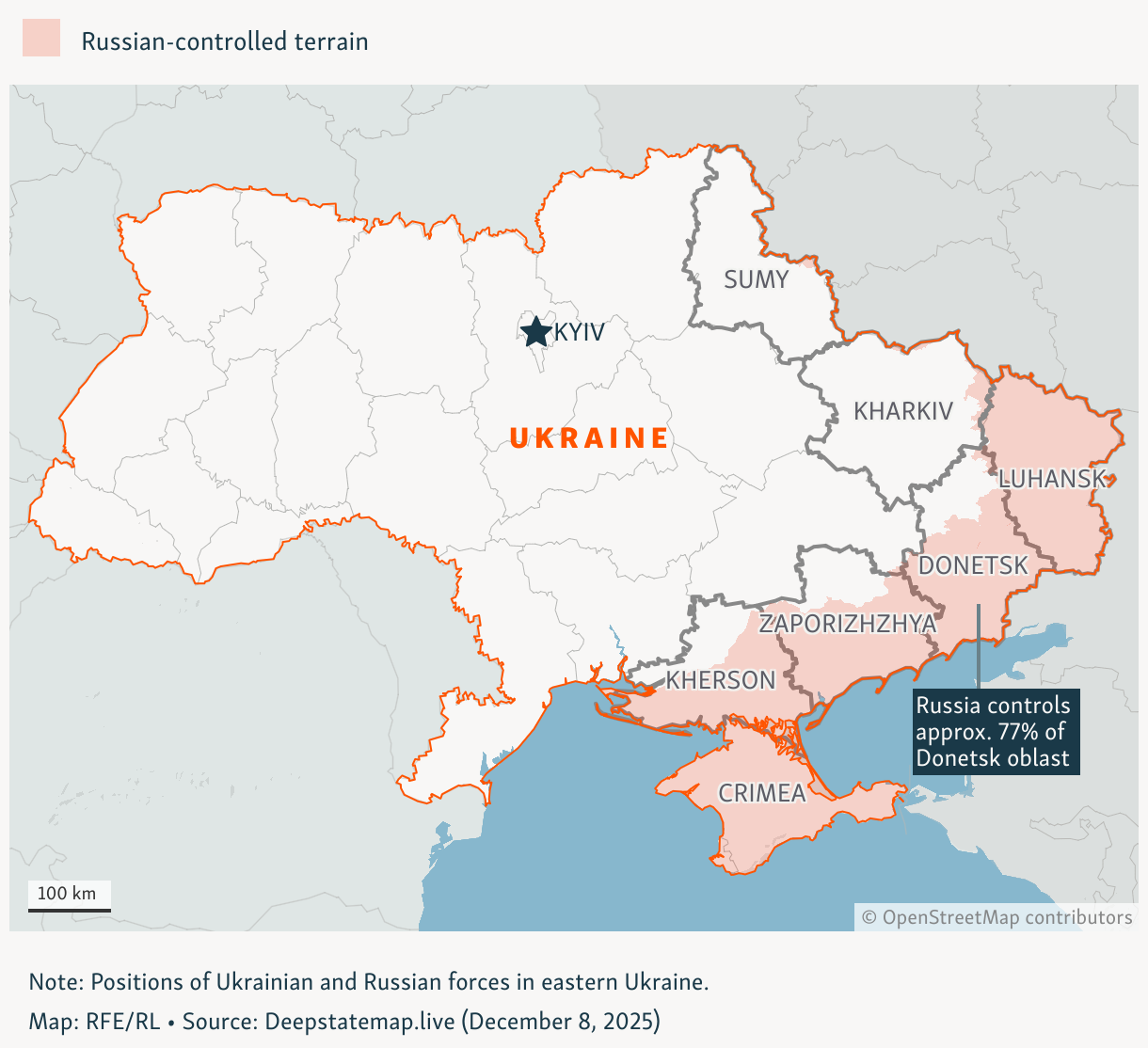
Key points that remain, he said, include the fate of the Zaporizhzhya Nuclear Power Plant, which is located in territory under Russian military control near the front line.
Under the draft peace plan, the plant would be jointly operated by Ukraine, the United States, and Russia.
Zelenskyy has also indicated that a referendum on the peace agreement and a presidential election could be held simultaneously and that any security guarantees would only take effect once the agreement is fully ratified or approved through a referendum.
“Ukraine will submit this agreement to parliament for ratification and/or hold a nationwide referendum for approval in a ‘yes’ or ‘no’ format,” Zelenskyy told journalists.
The draft agreement also includes a provision according to which all detained civilians and hostages, including children and political prisoners, will be returned.
With reporting by RFE/RL's Ukrainian Service, AFP, and Reuters

