




Ukrainian aid worker Yevhen Tkachov has had so many close calls he can no longer list them all.
“God helps me to forget but I think there have been about 20 cases,” he told RFE/RL from his base in the Donetsk region. The 57-year-old is one of the few still entering towns at the very edge of Russia’s advance to evacuate vulnerable locals.

Among the many harrowing close calls captured on video by Tkachov are FPV drones and shells shattering the windows of his moving car, as well as drones systematically destroying his vehicle as he and his passengers hide nearby. Others show Tkachov driving a severely wounded Ukrainian soldier to safety as the aid worker grasps at his own wounds from an artillery strike that had just targeted the pair.
Tkachov credits his faith as a Pentecostalist Christian with his willingness to drive into maximum danger on an almost daily basis. “For us, self-sacrifice, caring for others and saving lives is the highest priority,” he says.
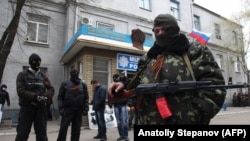
Tkachov grew up in Chasiv Yar in the Donetsk Region, just a short drive from where much of his evacuation missions take place today. He first began running aid missions in the spring of 2014 when Russia-backed separatists captured Slovyansk in the Donetsk Region. He openly sided with Ukraine at the time and was imprisoned by pro-Russian militia. Tkachov regained his freedom when Ukrainian forces recaptured the city but four other Pentecostal Christians imprisoned in the city under similar circumstances were murdered.
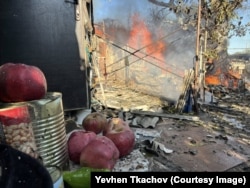
The Ukrainian says today the people remaining in towns in the final stages of falling to Russian forces can generally be split into categories. Some remain steadfastly pro-Kremlin and await the “Russian world,” others care little about geopolitics provided they are still able to scrounge alcohol and drugs, and some fear the abject poverty they believe awaits if they leave their homes and treasured domestic appliances inside, such as washing machines.
But Tkachov, who works for the Ukrainian-founded Proliska humanitarian mission, says the largest cohort are those who believe risking whatever carnage lies ahead is worth it for the potential of “an opportunity to reunite with their children, grandchildren and relatives in Russia.” The current path from eastern Ukraine to Russia is too arduous and expensive for many elderly people.
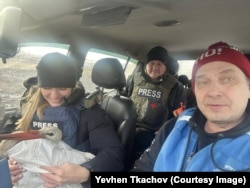
As well as the constant threat of drones and artillery, Tkachov and his team must carefully verify calls for “help” from specific addresses. In some cases, he says, suspicious requests for evacuation are likely to have been made by Russian forces in order to lay a trap. In the event he and his vehicle were to be captured, Tkachov explained to RFE/RL “theoretically in a humanitarian car, saboteurs will be able to drive far into the rear,” to launch surprise attacks on Ukrainian forces.
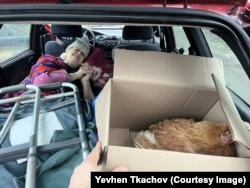
Other interactions with the invading army have ended humorously. In December 2025, Tkachov was eating lunch at a cafe in Ukraine’s Donetsk region when news of his death appeared on a Pro-Kremlin Telegram channel.
The aid worker snapped a picture of the meal he was enjoying and sent it to the chat where his alleged demise was being discussed. “I’m commemorating him now,” Tkachov captioned the image of his lunch, adding, “though I never liked the guy.”
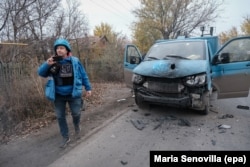
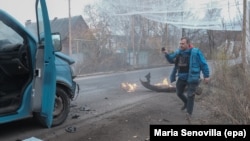
Maria Senovilla is one of several reporters to have ridden along with Tkachov in order to access frontline Ukrainian towns. The Spanish journalist credits the aid worker with providing a few critical seconds of warning before an FPV drone fitted with an armor-piercing warhead blasted a hole through the entire length of the vehicle (above) in which she and two others were traveling with Tkachov in November 2025.
“It was Yevhen who saved the lives of all of us in that van that day,” she told RFE/RL. “He was the one who saw the drone and reacted very quickly: He warned us that the drone was there and asked the driver to open the doors.”
She added that, "the mere fact that he continues to carry out evacuations in such dangerous conditions speaks volumes about the kind of person he is, and his humanity."

