




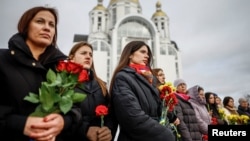
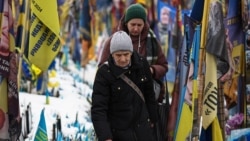
Ukrainians marked the fourth anniversary of Russia's full-scale invasion with emotional scenes as people laid flowers, lit candles, and remembered the fallen at ceremonies in towns and cities across the country.
In Kyiv, there was a moment of silence for war dead. In Lviv, children packed a church to join prayers for peace. In Bucha, there were bitter memories of brutal atrocities carried out by Russian soldiers who briefly occupied the town in 2022.

Ukrainian President Volodymyr Zelenskyy released a video in which, for the first time, he presented the bunker where he spent the first hours of the war. He said that Russian leader Vladimir Putin had not achieved his goals.
"He has not broken Ukrainians. He has not won this war. We have preserved Ukraine, and we will do everything to secure peace and justice," he said in a video address released on February 24.
Zelenskyy also said he would like to welcome US President Donald Trump to Ukraine.
"Only by visiting Ukraine and seeing our life and struggle with one's own eyes, feeling our people and this sea of pain, can one understand what this war is really about," he added.
Ukraine has entered the fifth year of Russia's all-out invasion, the largest armed conflict in Europe since World War II, with its troops holding the line against grinding attacks in frozen trenches while its civilians face nightly mass drone and missile strikes that have cut off energy supplies amid bitter winter weather.
Even on the day of the anniversary, Russian missiles and drones rained down on Zaporizhzhya in eastern Ukraine, injuring several people.

Estimates of overall casualty figures vary, but one recent report put the number of killed, wounded, and missing at 1.2 million Russians and 500,000-600,000 Ukrainians.
The conflict has displaced millions of Ukrainians from their homes. The World Bank said on the eve of the anniversary that reconstructing the economy would cost $588 billion over a decade.
But for this to begin, the war must end.
Peace Talks
US-led peace negotiations, launched by Trump after he took office in January 2025, have not made a clear breakthrough -- although further talks may take place in the coming days, according to the Ukrainian authorities.
During talks last week, US chief envoy Steve Witkoff said "meaningful progress" was made, without giving details, and added that "both parties agreed to…continue working toward a deal."

On February 24, the US Embassy in Kyiv posted a message on social media recognizing “four years of destruction and human suffering” and stating that Trump “remains committed to achieving a negotiated settlement and lasting peace that ensures Ukraine’s independent and prosperous future.”
A statement was also released on February 24 backing peace efforts by the G7 group of leading industrial nations, which brings together the United States, Japan, Canada, Britain, France, Germany, and Italy.
"We express our continued support for President Trump's efforts to achieve these objectives by initiating a peace process and bringing the parties to direct discussions. Europe has a leading role to play in this process, joined by other partners," it said.
After months of talks, territory remains one of the main sticking points. Russia is demanding Ukraine hand over what it still holds in the eastern Donbas region, despite proving unable to conquer it militarily.

On February 24, Kremlin spokesman Dmitry Peskov told reporters that Russia had not yet reached its war objectives and would continue fighting until it did.
"The goals haven't been fully achieved yet, which is why the military operation continues," he said.
Later, Putin struck a defiant tone in an address to the Federal Security Service, stating Ukraine "did not manage to inflict a strategic defeat on Russia" and was now seeking other means.
"There is an absolute need to defeat Russia. They are looking for any way, anything at all. They will push themselves to some extreme point, and then they will regret it," he said.
Separately, Kremlin officials alleged, without evidence, that Britain and France were trying to provide Ukraine with nuclear weapons.
Russia has repeatedly resorted to nuclear saber-rattling during the course of its four-year invasion in an attempt to dissuade Western countries from supporting Ukraine. Ukraine and France immediately dismissed the latest Russian claim.
Leaders Reaffirm Support For Ukraine
European leaders commemorated the anniversary by reiterating their support for Kyiv and denouncing Moscow's aggression.
UK Prime Minister Keir Starmer, announcing a new package of military, humanitarian, and reconstruction support, said: "Russia is not winning this war. They will not win this war."
"This war is a triple failure for Russia: military, economic, and strategic," French President Emmanuel Macron said on X on February 24.
"One day, Russians will grasp the enormity of the crime committed in their name, the hollowness of the pretexts invoked, and the long-term, devastating effects on their own country," he added.
NATO Secretary-General Mark Rutte emphasized that the Ukrainian people deserve a just and lasting peace. "Their security is our security," he stated during a ceremony in Brussels.
European nations have sought to pick up the slack since US President Donald Trump decided to substantially reduce military support for Ukraine. Under a NATO scheme, European countries now purchase US weapons and other military equipment for Ukraine while also maintaining their own supplies to Kyiv.
The past year also saw European nations plus Canada and other allies forming the Coalition of the Willing to coordinate Ukraine support and also plan for a potential post-war peace-keeping mission or "reassurance force."
Security Guarantees
The prospect of Western troops in Ukraine is part of Kyiv's key demands for peace: viable security guarantees so Moscow doesn't use a pause in fighting to simply rearm and attack again down the line.
This is also a sticking point, with Kremlin officials repeatedly stating that Western forces deploying to Ukraine would be unacceptable. Many analysts have said Russia does not really want peace.
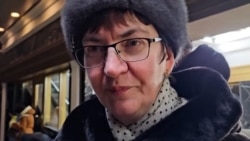
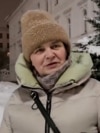
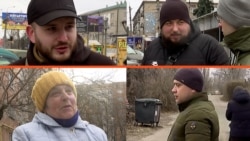
Speaking to an RFE/RL camera team in Kramatorsk, a town in eastern Ukraine that has come under repeated Russian bombardment, one local resident articulated the widely held desire for peace as the war enters its fifth year.
"I wish they'd agree on something good. We've been praying about that. People have suffered so much," she said. As she finished speaking, a loud explosion rang out.



