




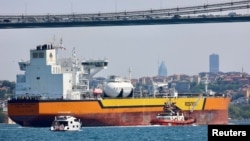
WASHINGTON -- A bipartisan group of US lawmakers have warned American banks, port authorities, and fuel-industry groups against facilitating imports of Russian diesel, raising the prospect of congressional investigations and legal action over President Donald Trump’s decision to ease restrictions on Russian fuel.
In letters sent to the chief executives of major US banks and the heads of several port authorities, the lawmakers warned that importing Russian diesel could violate federal law and expose companies to civil and criminal liability.
They also said the imports would raise national-security concerns by providing Moscow with revenue to help finance its war against Ukraine.

The intervention comes after Trump recently announced an arrangement with Russian President Vladimir Putin under which Moscow would supply hundreds of thousands of metric tons of diesel to the United States, with additional shipments planned in the coming months. The US Treasury Department subsequently issued General License 135, granting a six-month exemption from certain sanctions restrictions.
The letters signal a potential new front in the political and legal battle over the administration’s Russia policy. Democrats could gain significant investigative powers if they regain control of one or both chambers of Congress in the November midterm elections.
“Any importation of Russian diesel into the US raises significant legal questions and may be subject to legal action, as well as congressional investigations,” the lawmakers wrote.
The group includes Democratic Senators Jeanne Shaheen, Ron Wyden, Sheldon Whitehouse, Chris Coons and Elizabeth Warren, as well as outgoing Republican Senator Thom Tillis and Representative Gregory Meeks, the top Democrat on the House Foreign Affairs Committee.
They urged companies not to facilitate the purchase, transportation, importation, unloading, storage, financing, or distribution of Russian-origin diesel until the relevant legal requirements had been met.
The lawmakers also demanded that the companies preserve records of proposed or completed transactions, including contracts, shipping documents, payment records, port reservations and communications with suppliers and US government officials dating back to September 1.
Recipients were asked to confirm by October 28 that they had implemented the required preservation measures and to disclose whether they had knowledge of any proposed or actual Russian diesel imports.
The letters went to the chief executives of major US banks, including Goldman Sachs, as well as the port authorities of Houston, Corpus Christi and Beaumont in Texas and New York/New Jersey.

Public reporting and vessel-tracking data cited by the lawmakers indicate that ships carrying Russian diesel could arrive at Beaumont and New York/New Jersey as early as the end of October.
At the center of the dispute is whether the administration’s licensing action is consistent with restrictions established by Congress.
The lawmakers cited the Ending Importation of Russian Oil Act of 2022, which generally prohibits imports of Russian-origin energy products unless the president certifies to Congress, following a period of consultation, that Russia has ceased military hostilities in Ukraine, poses no immediate military threat to NATO members, and recognizes Ukrainians’ right to choose their government.
They also argued that Section 216 of the Countering America’s Adversaries Through Sanctions Act requires congressional review before certain licensing actions that significantly alter US foreign policy toward Russia. The lawmakers said the administration had not fulfilled that requirement.
The administration maintains that its action is lawful and consistent with previous decisions by the Treasury Department’s Office of Foreign Assets Control, which administers US sanctions.

The White House dismissed the lawmakers’ initiative as politically motivated.
“The Democrats are already telegraphing that, once again, they have no agenda to improve the lives of Americans and will instead continue their decade-long obsession with investigating President Trump,” spokesperson Taylor Rogers said.
The letters do not establish that any company has committed a crime. Instead, they warn that participating in the transactions could expose companies to legal challenges and investigations despite the administration’s assurances that the waiver is valid.
Representative Jamie Raskin, the top Democrat on the House Judiciary Committee, separately warned major fuel-industry associations that companies importing Russian diesel could face civil and criminal penalties, including up to 20 years in prison.
Raskin argued that Trump’s move could not override statutory prohibitions and warned that companies could be held accountable “whether in this administration -- or the next.”
Experts say the warnings could complicate the administration’s plans even if the waiver reduces the risk of sanctions violations under US executive-branch rules.
Michael Wain, a senior international trade policy adviser at the law firm Akin, told RFE/RL that the congressional pushback was noteworthy but that US imports represented only part of the picture.
“General License 135 covers a broad range of Russian diesel transactions and substantially reduces US sanctions risk for foreign firms that stay within its terms,” Wain said. However, he added, companies must still consider British, European Union and other jurisdictions’ sanctions rules.

A key question, he said, is whether foreign buyers previously reluctant to handle Russian fuel will now feel more comfortable doing so -- an outcome that may be part of the administration’s objective.
Glen Howard, president of the Saratoga Foundation and a longtime Russia strategist, said the letters could make major US banks reluctant to finance the transactions.
“It is very significant because it was sent to each of the major US banks and will likely cause them to freeze in place any efforts by the Trump administration to proceed with the sale,” Howard told RFE/RL.
He said the move suggested the administration had failed to adequately consider the deal’s legal obstacles and strategic implications. Howard speculated that the decision had been made by a small group of advisers without broader consultation across the administration.
The potential consequences extend beyond the immediate shipments. Banks and other intermediaries may be wary of congressional subpoenas, requests to testify or future legal challenges, even if they believe a transaction is permitted under the Treasury license.
Rachel Ziemba, a senior fellow at the Center for a New American Security, said the warnings reinforced her view that most Russian diesel cargoes would be sold outside the United States.
“These warnings reinforce my view that most of any Russian diesel cargos will go to countries outside the US and that it is mostly diplomatic theater,” Ziemba told RFE/RL.
She said a meaningful increase in diesel supplies would likely require an energy cease-fire, which she said Russia was wary of agreeing to. Ziemba also said the administration believes its waivers are sufficient to overcome the legal obstacles identified by lawmakers, but that uncertainty could still deter American buyers and financial institutions.

“The concerns from the senators may give some US banks and buyers pause about purchasing the diesel, which is en route to the US as we speak,” Ziemba said.
Some cargoes could consequently be resold to other countries in the Americas, where demand for fuel remains strong.
Russia confirmed the arrangement after Trump announced it on October 9. Trump said Moscow would initially deliver more than 300,000 metric tons of diesel, followed by another 500,000 tons in November and a further 1 million tons afterward. He said Russia could supply an additional 3 million tons, depending on the condition of its refineries.
Traders said the Russian government had begun granting exemptions to its diesel export ban on October 1 to allow shipments under the arrangement. Industry sources said Russian diesel production fell from about 175,000 tons a day in September to 160,000 tons a day in the first half of October, before recovering toward 180,000 tons a day after new export quotas were introduced.
The shipments could provide Russia with additional revenue, but legal uncertainty may deter some US buyers and redirect cargoes to other markets.

