


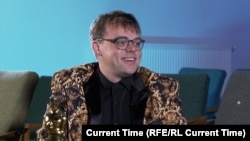
Even before a provincial Russian city court had banned his film about the indoctrination of Russian schoolchildren, and even before the government slapped the contemptuous "foreign agent" label on him, Pavel Talankin was exuberant.
The film Mr. Nobody Against Putin had won one of the industry’s highest honors just days earlier: an Oscar for best documentary film.
Now, condemned by the government as a “foreign agent,” and his film banned by a court: all the more reason to celebrate.
“Everything that’s banned gets even more attention. In fact, it’s a perfect promotional campaign,” he told Current Time. “They ban everything, and everyone watches it.”


“You couldn’t dream up a better advertising campaign,” he said in an interview on March 30.
Russians will have to work harder to see the 90-minute film, which is based on hours of footage that Talankin shot when he worked as a schoolteacher in Karabash, a city located in the Ural Mountains region, about 1,700 kilometers east of Moscow.
But in theaters, and on computer screens, around the world, the film, which was released in January 2025, has struck a chord, offering a window into Russia’s education system and its evolution since the all-out invasion of Ukraine in February 2022.
“It's nice on the one hand, and on the other hand, it’s unpleasant,” he said about the decision by the Chelyabinsk regional court. “It’s a nice thing, you know, but the question is: why a year later? I mean, they didn’t believe me, but so they banned it only after the Oscars?”
His former colleagues, the local authorities back in Russia: they can’t believe all this happened, he said.
Talankin, who moved to Prague in 2024, shot hours of video of students and teachers at School No. 1 in Karabash. The videos documented how teachers and administrators organized lectures and presentations for children amplifying Kremlin propaganda about the Ukraine war as well as President Vladimir Putin’s wider military and political views.
Lessons included topics like “denazification and demilitarization” -- rhetoric used by the Kremlin to justify its war on Ukraine -- and presentations by soldiers from the notorious private mercenary company Wagner Group.
Among Russians, not to mention Ukrainians, the film -- which was co-directed with American filmmaker David Borenstein -- has sparked both praise and criticism.
“Is it the work of a fearless anti-war activist who gathered footage undercover?” Anton Dolin, a film critic for the exiled Russian news outlet Meduza, wrote. Or is it an immoral stunt that could have harmed Talankin’s own colleagues and students?”
“Is it the unfiltered truth about today’s education system in a totalitarian state, or opportunistic garbage by a small-town narcissist chasing an Oscar? An act of love, or maybe a hit job commissioned by the hateful West?”
During his Oscar acceptance speech, Talankin broadly condemned all wars, but observers noted he specifically omitted mention of the actual war that is at the heart of the film and the Kremlin indoctrination being taught to Russian schoolchildren: Ukraine.
Asked why, Talankin explained that his acceptance speech had been written based on messages he had received from students in Russia.
“The children evidently wrote this,” he said, referring to the wider anti-war message, “and they thought it was important to say.”

