




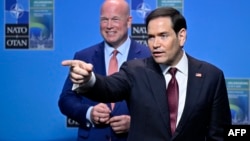
HELSINGBORG, Sweden -- US Secretary of State Marco Rubio defended how Washington shifted military forces around the world amid confusion over whether a brigade-size contingent of US troops would be rotated out of Poland.
Rubio's comments on May 22 came on the sidelines of a gathering of NATO foreign ministers in Sweden.
The meeting has been clouded by confusion over US military forces in Europe, as well as a major Russian nuclear exercise in Belarus and new Russian threats toward NATO's Baltic members. The US-Israeli war against Iran has also exposed deep disagreements as NATO has resisted being drawn into the nearly three-month-old conflict.
Earlier this month, Trump announced that 5,000 US troops would be withdrawn from Germany. Trump's public clashes with German Chancellor Friedrich Merz in recent weeks, in particular over the Iran war, raised questions whether the decision was made to punish Merz.
But the Pentagon later said it was postponing a planned deployment of roughly 4,000 troops to Poland and shelving plans to deploy a battalion of ground-launched Tomahawk cruise missiles to Germany.
Those moves rattled Warsaw -- where enmity toward Russia is deep -- and other NATO allies, who have long fretted about the Trump's administration's commitment to the alliance.
In a May 21 post to social media, however, Trump announced that Washington would be sending an additional 5,000 troops to Poland. He cited the "the successful election" of Polish President Karol Nawrocki, who took office last August, as the main reason.
That reportedly caught Pentagon officials off-guard.
Speaking to reporters in Sweden on May 22, Poland's foreign minister said US troop levels in Poland would remain at roughly the same level they are now.
Sikorski thanked Trump for "his announcement that the rotation, the presence of American troops in Poland, will be maintained more or less at previous levels."

Asked by reporters about the US troops, Rubio argued that Washington was constantly evaluating the deployment of forces around the world. He said those decisions were made only on technical grounds, not for political reasons.
Rubio also chided NATO members for not joining the Iran war effort.
"The president's view is, frankly, disappointment at some of our NATO allies and their response to our operations in the Middle East," he said.
He suggested that the issue would come up in July, when the heads of state for the alliance -- including likely Trump -- meet in Turkey.
"That will have to be addressed. That won't be solved or addressed today," he added. " "That's something for the leaders' level to discuss
The meeting in Helsingborg -- a port in Sweden just across the water from fellow NATO member Denmark -- is one of the final senior-level meetings before the Ankara summit.
'Kept In The Dark'
A senior European diplomat, speaking to RFE/RL on condition of anonymity, warned that the lack of communication from Washington was undermining the alliance's confidence.
"The worst thing is the fact that the continent is seemingly being kept in the dark about the scope of this drawdown," the diplomat said, noting that frontline states such as the Baltic countries are struggling to plan.

"NATO's effectiveness rested on the idea that it was unbreakable," the diplomat said. "Now, in a divorce, you start to see the cracks appearing."
Administration officials have insisted the moves are temporary adjustments rather than a strategic retreat.
US Vice President JD Vance recently said the administration's focus remains on "European independence and sovereignty."
NATO's Baltic members have been rattled over the past week over a series of escalating threats from Moscow regarding Ukrainian drone flight. Ukraine has stepped up its long-range drone campaign against Russian targets; some of its drones have crashed or been shot down in Estonia and Latvia.
This week, Russia's Foreign Intelligence Service accused Latvia of plans to allow Ukraine to launch its drones from Latvian territory.
The accusation prompted strong pushback from European allies. Lithuania accused Russia of jamming Ukrainian drones and deliberately trying to cause them to enter or crash in Baltic airspace. And a Romanian fighter jet on NATO patrol shot down a drone over Estonia this week.
Speaking to RFE/RL in Sweden, Rubio said the issue of Russian threats toward the Baltic states was "concerning," adding that Washington doesn't want the incidents to lead to a broader conflict.
"We're watching it, carefully. We're obviously engaged with our allies in NATO in that regard... We don't want it to lead to some broader conflict that could really lead to something far worse," he said.
Russia also kicked off a major nuclear training exercise in Belarus this week, an exercise that included thousands of troops, and hundreds of aircraft, ships, and missile launchers. The Russian Defense Ministry said tactical nuclear warheads were also in use, an unusual measure.
Rubio As The 'Steady' Messenger
For many European officials, Rubio's presence offers a measure of reassurance. He is widely viewed in Brussels and Eastern European capitals as a more traditional supporter of NATO and European security than others in the Trump administration.
US Representative Don Bacon, a Republican and staunch NATO supporter, told RFE/RL that Rubio plays a key role in stabilizing relations. Bacon said he hoped Rubio would reinforce Washington's commitment to collective defense while urging European allies to increase defense spending.
Bacon has repeatedly argued that alliances remain central to US security interests and warned against isolationism amid growing threats from Russia, China, and Iran.
Those concerns were echoed on May 20 during Senate confirmation hearings for Trump's ambassadorial nominees to several European countries.
Michael Kavoukjian, nominated to serve as ambassador to Norway, described Oslo as "the eyes and ears of the alliance in the Arctic" and pledged to strengthen military and intelligence cooperation against growing Russian and Chinese activity.
Meanwhile, Eric Wendt, nominated to be ambassador to Albania, emphasized the importance of NATO burden-sharing and said he would push Tirana to meet alliance targets to increase defense spending to 5 percent of gross domestic product by 2035.

