


Germany Says Navalny Poisoned By Novichok Nerve Agent
Russian opposition leader Alexei Aleksei Navalny (file photo)
The German government says tests on blood samples taken from Russian opposition leader Aleksei Navalny showed the presence of a chemical nerve agent from the Novichok group, a poison suspected of being used in other attempts to silence outspoken Kremlin opponents.
Steffen Seibert, Chancellor Angela Merkel’s spokesman, said in a statement on September 2 that tests at a special German military laboratory had shown proof of "a chemical nerve agent from the Novichok group."
Western nations and officials in unison expressed outrage over the use of a military-grade agent banned by an international treaty to poison Navalny and demanded that Russia investigate the case.
The German Foreign Office said it would be informing the Russian ambassador in Berlin of the result and demanded Moscow issue a response.
"It's a startling event that Aleksei Navalny was the victim of an attack with a chemical nerve agent in Russia. The German federal government condemns this action in the strongest possible terms. The Russian government is urged to explain itself over the incident," Seibert said in a statement.

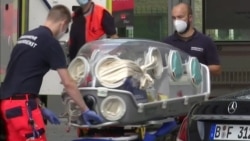
Navalny, 44, fell ill on a flight from Siberia to Moscow on August 20, forcing the plane he was traveling on to make an emergency landing in Omsk, where he spent two days in hospital before being evacuated to Germany. He is in a medically induced coma in an intensive care unit at Charite Hospital in Berlin and is on a respirator.
"A longer course of treatment for the illness is to be expected. Long-term consequences of severe poisoning cannot be ruled out," the hospital said in a statementon September 2.
Navalny is the latest Kremlin critic to take ill from a toxic substance. Activist Pyotr Verzilov was flown to Germany from Moscow in September 2018 for medical treatment after he was poisoned with an agent that affected his nerves.
Verzilov's poisoning came just months after former Russian double-agent Sergei Skripal and his daughter, Yulia, were found unconscious in a park in the English city of Salisbury.
A British investigation determined that the Skripals had been poisoned with the deadly nerve agent Novichok and alleged that the attack was carried out by Russian state agents.
In the most infamous Russia-related poisoning, Aleksandr Litvinenko, a former state security service agent who defected to Britain and became a sharp critic of the Kremlin, died in November 2006 after being poisoned with the rare radioactive isotope polonium-210.
Over Vladimir Putin's 20 years in power, there have been numerous cases where outspoken Kremlin opponents are suspected of having been poisoned -- sometimes fatally.
Navalny, who has been attacked several times in the past, was visiting the Siberian cities of Novosibirsk and Tomsk for his latest investigation into government corruption when he fell ill.
Navalny’s team published the results of their Siberian investigation on August 31, claiming that 18 out of 50 lawmakers in Novosibirsk are owners or represent owners of construction companies.
The activist has made many enemies over the years with his investigative videos, which have targeted Kremlin insiders, including former Prime Minister Dmitry Medvedev and former Prosecutor-General Yury Chaika.
German Chancellor Angela Merkel said the poisoning was aimed “to silence him” while the EU’s top diplomat Josep Borrell described it as an “assassination attempt.”
The U.S. National Security Council called the poisoning "completely reprehensible" and said Washington would work with allies "to hold those in Russia accountable, wherever the evidence leads, and restrict funds for their malign activities."
Novichok would only be available to the "richest and most powerful," said Mark Galeotti, an expert on Russia's security services at the Royal United Services Institute in London, in a September 2 blog post.
"No local FSB officer or city mayor would be likely to be able to access such a nerve agent. Instead, someone would presumably need to be able to access the modern successors to the old Soviet ‘Kamera’ poisons lab," Galeotti said, noting the SVR foreign intelligence service or FSB security service likely have access to Novichok.
Russian doctors in Omsk said last week that they did not find any evidence of poisoning in Navalny. The doctors updated their findings on September 2, saying the activist had carbohydrate metabolism complications and pancreatitis.
Kremlin spokesperson Dmitri Peskov reiterated that message, claiming there were no poisonous substances found in Navalny before his transfer to Germany on August 22.
Meanwhile, Navalny’s team said it had filed a lawsuitin Moscow against the Russian government for not opening an investigation into the poisoning. A hearing in that case will be held on September 4.
Run-Ins Endured By Aleksei Navalny, Russia's Leading Opposition Figure
1/15Aleksei Navalny in court in December 2011 after his arrest during an unauthorized anti-government march in Moscow. Navalny was sentenced to 15 days detention for “resisting law enforcement officers.” It was the first of what would later become a regular occurrence for the opposition figure.
Pictures from some of the dozens of encounters Russia’s leading opposition figure has had with police, the courts, and unknown assailants through his years of public activism. Navalny has been jailed more than 10 times and has spent hundreds of days in custody since 2011.
2/15A sign expressing support for Navalny scrawled on the back of a truck outside the detention center where Navalny was being held after his December 2011 arrest. In February 2011, Navalny described President Vladimir Putin’s political party, United Russia, as “the party of crooks and thieves” in a radio interview. The phrase was widely picked up by opposition groups.
Pictures from some of the dozens of encounters Russia’s leading opposition figure has had with police, the courts, and unknown assailants through his years of public activism. Navalny has been jailed more than 10 times and has spent hundreds of days in custody since 2011.
3/15Navalny is escorted to a court session in Moscow in May 2012. He was detained during an opposition rally a day after the May 7 inauguration of Putin. Navalny was sentenced to another 15 days of jail for "participating in an illegal public event."
Pictures from some of the dozens of encounters Russia’s leading opposition figure has had with police, the courts, and unknown assailants through his years of public activism. Navalny has been jailed more than 10 times and has spent hundreds of days in custody since 2011.
4/15A journalist films Navalny’s Moscow apartment after it was ransacked by police on June 11, 2012. Russian police raided several opposition leaders' homes amid widespread anti-government protests in the spring and summer of 2012.
Pictures from some of the dozens of encounters Russia’s leading opposition figure has had with police, the courts, and unknown assailants through his years of public activism. Navalny has been jailed more than 10 times and has spent hundreds of days in custody since 2011.
5/15Masked men drive away after searching Navalny’s Moscow office on June 12, 2012. Navalny was later summoned for questioning by police, which prevented his participation in a planned protest.
Pictures from some of the dozens of encounters Russia’s leading opposition figure has had with police, the courts, and unknown assailants through his years of public activism. Navalny has been jailed more than 10 times and has spent hundreds of days in custody since 2011.
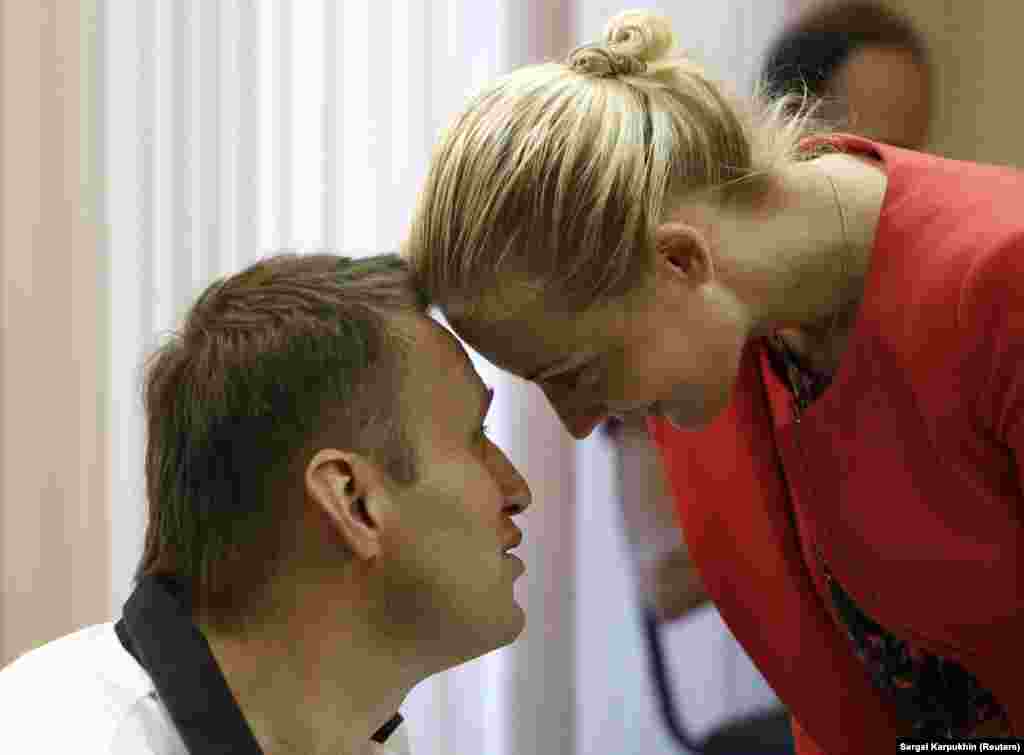
6/15Navalny and his wife, Yulia, during a break in court proceedings in Kirov in July 2013. Navalny was charged with stealing 16 million rubles ($500,000) from a state timber firm. He rejected the charges as trumped up. The court handed down a five-year prison term that was later reduced to a suspended sentence after widespread public protests.
Pictures from some of the dozens of encounters Russia’s leading opposition figure has had with police, the courts, and unknown assailants through his years of public activism. Navalny has been jailed more than 10 times and has spent hundreds of days in custody since 2011.
7/15Navalny and his brother Oleg (inside cage) during a court hearing in Moscow in December 2014. The pair were convicted of stealing around $500,000 from Russian firms during business dealings dating back several years. They rejected the charges. Aleksei Navalny’s sentence was suspended, but his brother served a full prison term of 3 1/2 years, being released in June 2018.
Pictures from some of the dozens of encounters Russia’s leading opposition figure has had with police, the courts, and unknown assailants through his years of public activism. Navalny has been jailed more than 10 times and has spent hundreds of days in custody since 2011.
8/15Navalny being detained after leaving a radio station in Moscow in January 2015. Shortly before, Navalny had snipped off an electronic bracelet he was required to wear while under house arrest for his 2014 suspended sentence.
Pictures from some of the dozens of encounters Russia’s leading opposition figure has had with police, the courts, and unknown assailants through his years of public activism. Navalny has been jailed more than 10 times and has spent hundreds of days in custody since 2011.
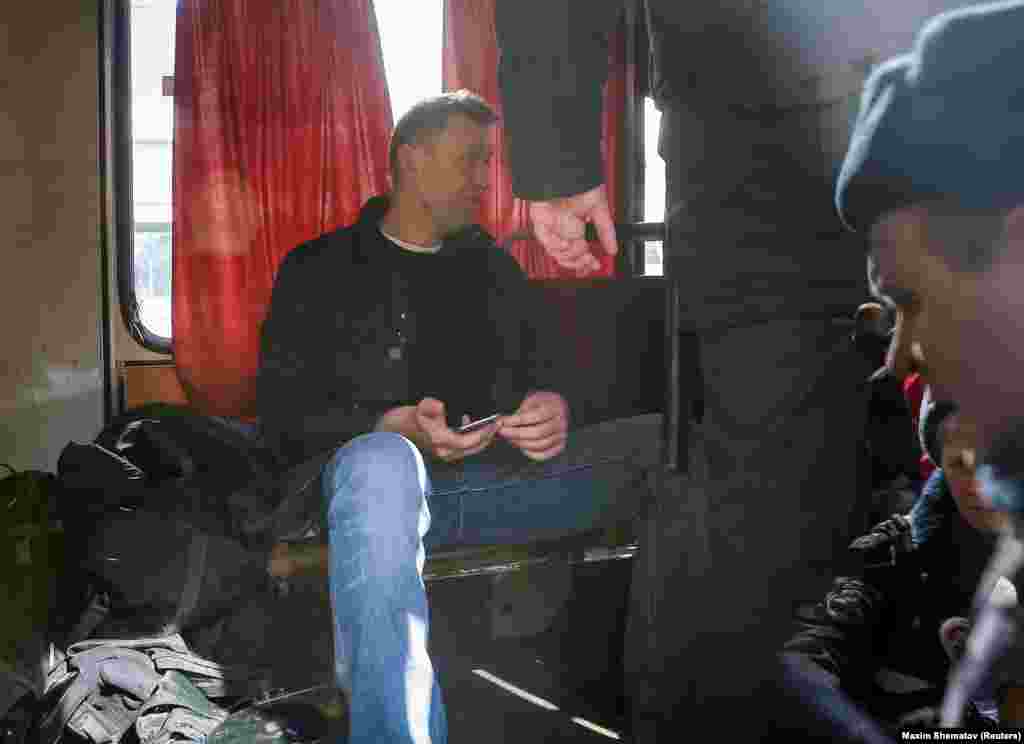
9/15Navalny sitting in a police van after being seized by police during a massive Moscow rally in March 2017. He was fined $350 for taking part in what the authorities called an illegal protest.
Pictures from some of the dozens of encounters Russia’s leading opposition figure has had with police, the courts, and unknown assailants through his years of public activism. Navalny has been jailed more than 10 times and has spent hundreds of days in custody since 2011.
10/15Navalny on his way to the hospital after being splashed with green dye by unknown assailants in Moscow in April 2017. He suffered burns to his eye in the attack.
Pictures from some of the dozens of encounters Russia’s leading opposition figure has had with police, the courts, and unknown assailants through his years of public activism. Navalny has been jailed more than 10 times and has spent hundreds of days in custody since 2011.
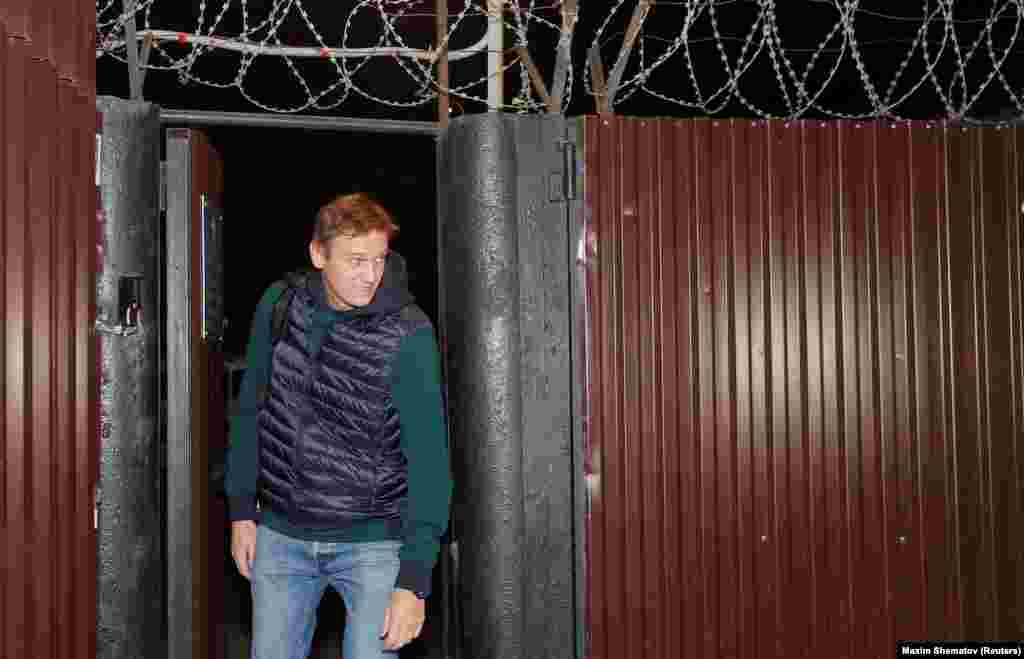
11/15Navalny leaves a Moscow jail in October 2018 after serving 20 days on charges of staging illegal protests.
Pictures from some of the dozens of encounters Russia’s leading opposition figure has had with police, the courts, and unknown assailants through his years of public activism. Navalny has been jailed more than 10 times and has spent hundreds of days in custody since 2011.
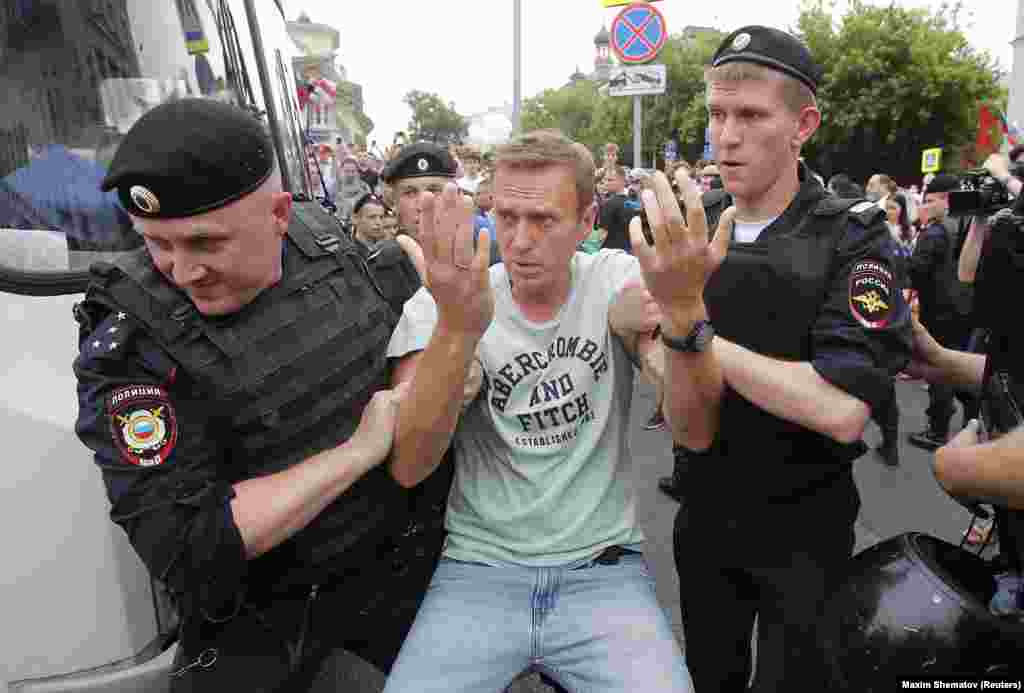
12/15Police detain Navalny during a rally in support of investigative journalist Ivan Golunov, who was detained by police and accused of drug possession on June 12, 2019.
Pictures from some of the dozens of encounters Russia’s leading opposition figure has had with police, the courts, and unknown assailants through his years of public activism. Navalny has been jailed more than 10 times and has spent hundreds of days in custody since 2011.
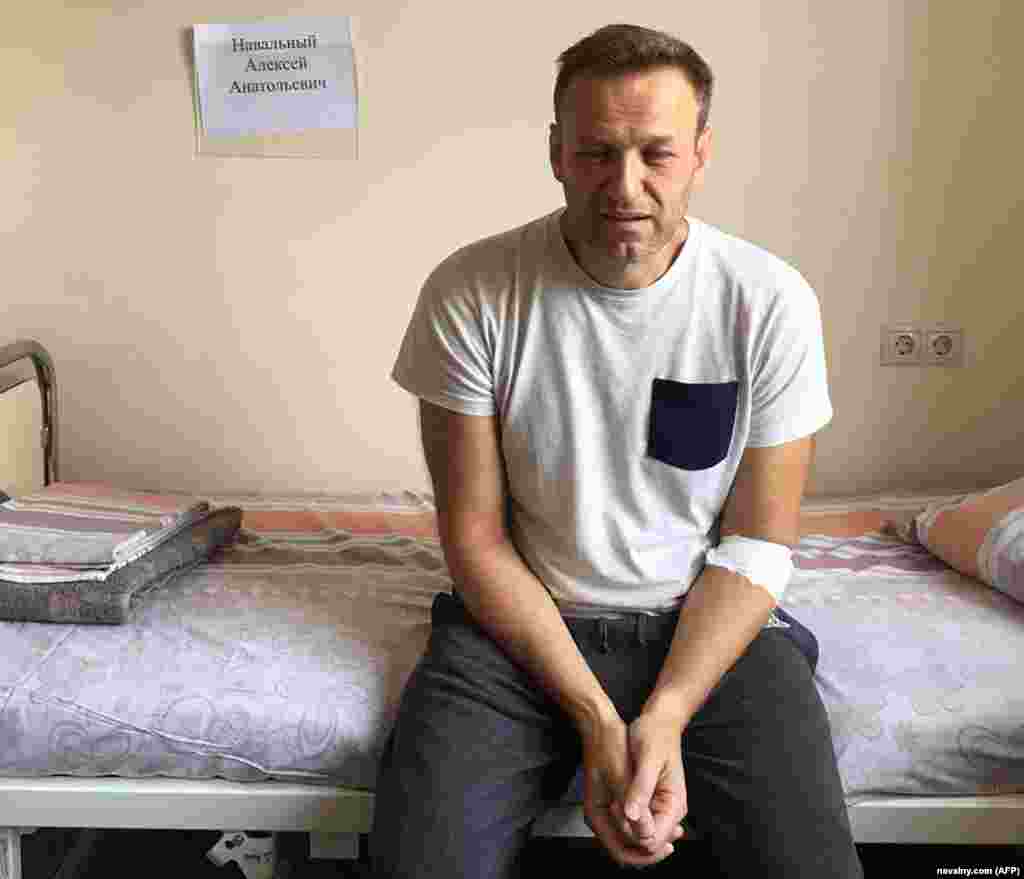
13/15Navalny, his eyes red and puffy, sits on a hospital bed in Moscow on July 29, 2019, after feeling unwell in his Moscow cell while serving a prison term on charges of calling an unauthorized rally. He said he believed he'd been poisoned. Doctors attributed it to an "acute allergic reaction."
Pictures from some of the dozens of encounters Russia’s leading opposition figure has had with police, the courts, and unknown assailants through his years of public activism. Navalny has been jailed more than 10 times and has spent hundreds of days in custody since 2011.
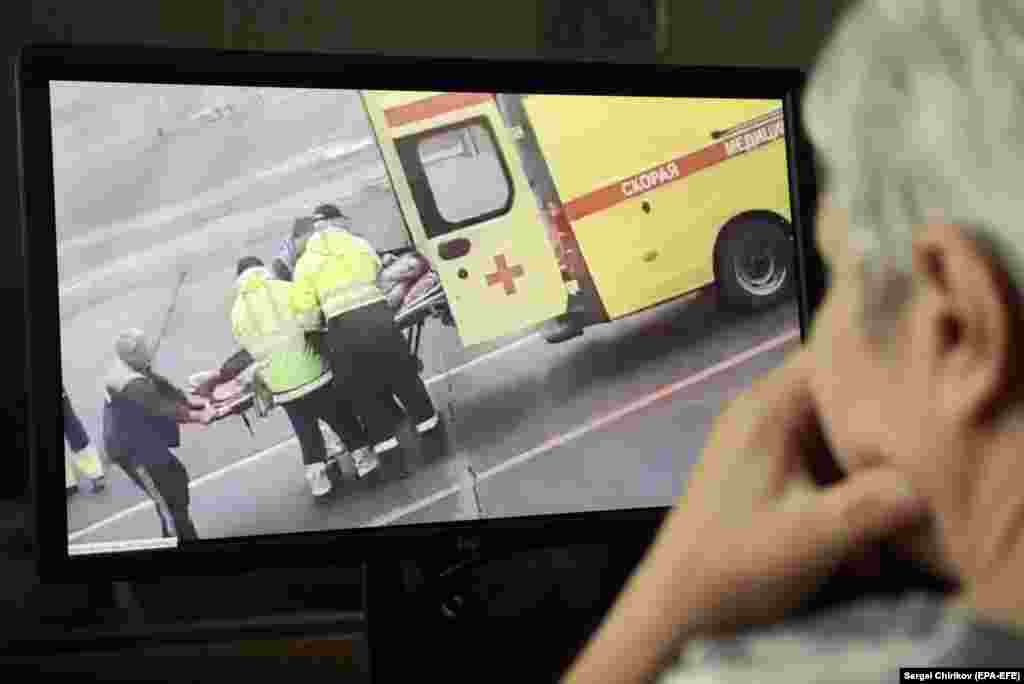
14/15A person watches a video on social media showing Navalny being carried on a stretcher by an ambulance team in Omsk after falling gravely ill from suspected poisoning while aboard a flight from Tomsk to Moscow on August 20.
Pictures from some of the dozens of encounters Russia’s leading opposition figure has had with police, the courts, and unknown assailants through his years of public activism. Navalny has been jailed more than 10 times and has spent hundreds of days in custody since 2011.
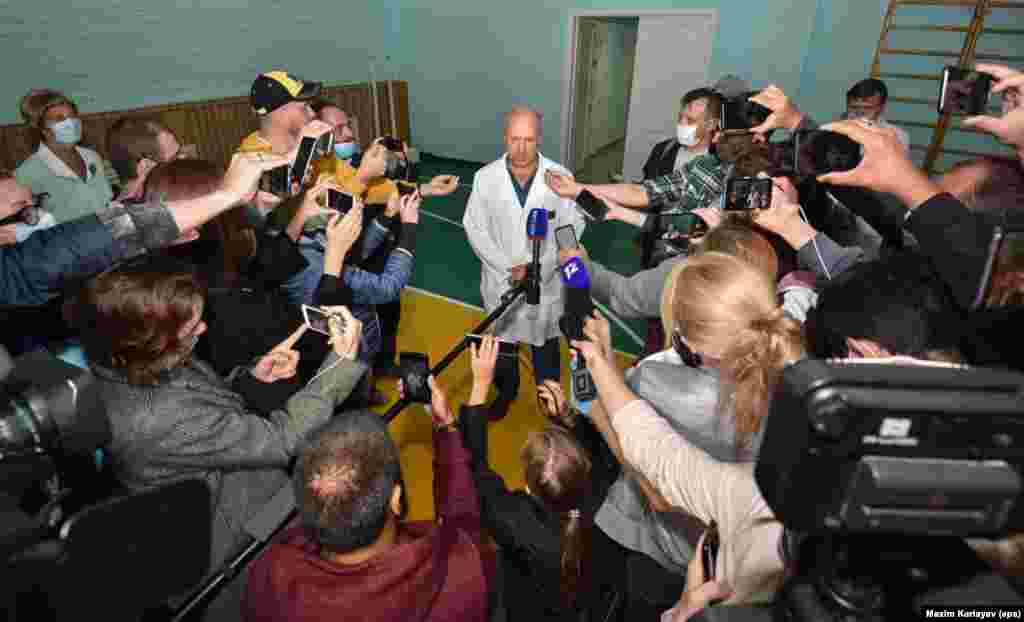
15/15A doctor at an Omsk hospital tells journalists that Navalny had been placed in an induced coma.
Pictures from some of the dozens of encounters Russia’s leading opposition figure has had with police, the courts, and unknown assailants through his years of public activism. Navalny has been jailed more than 10 times and has spent hundreds of days in custody since 2011.
Previous slide
Next slide
Novichok group chemicals were developed by the Soviet Union during the Cold War and are more toxic than other nerve agents.
They work by blocking messages from the nerves to the muscles, causing a collapse of many bodily functions. They can lead to vomiting, sweating, a loss of consciousness, coma, and death.
Parties to the Chemical Weapons Convention (CWC) treaty agreed in November to update the list of banned Schedule 1 chemicals to include the Novichok group following the Skripal poisoning.
CWC member states are not allowed to possess, develop, stockpile, use, or transfer Schedule 1 substances, said Julia Masterson, a researcher at the Washington-based Arms Control Association.
Russia initially objected to the proposal from Canada, the Netherlands, and the United States to add the Novichok group to the list.
They were officially included on June 7, meaning its existence and use in Russia violated the international treaty.
Germany said it would contact the Organization for the Prohibition of Chemical Weapons (OPCW), the treaty’s watchdog, and "discuss an appropriate joint reaction with the partners in the light of the Russian agreement."
The OPCW will carry out its own investigation into the incident.
Depending on its findings and Moscow's cooperation, the OPCW Exeuctive Council could recommend that CWC state parties vote to restrict or suspend Russia’s rights and privileges as a member of the CWC or refer the case to the UN, Masterson told RFE/RL.
The OPCW's Executive Council may discuss the investigation at its upcoming meeting in October, she said.
The British government expelled 23 Russian diplomats after Moscow refused to cooperate with an investigation into the Skripal poisoning.
"We will work with international partners to ensure justice is done," British Prime Minister Boris Johnson said in a statement, calling the use of the agent "outrageous."

RFE/RL journalists report the news in 24 languages in 18 countries where a free press is banned by the government or not fully established. We provide what many people cannot get locally: uncensored news, responsible discussion, and open debate.