




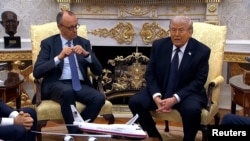
WASHINGTON -- The split screen in the Oval Office captured the real moment. On one side, escalating tensions in the Middle East. On the other, Europe's largest economy insisting Russia's war against Ukraine remains the defining test of transatlantic security.
With US President Donald Trump sharpening his focus on Iran, German Chancellor Friedrich Merz spent his time in Washington this week with a clear objective: Ensure Ukraine does not get pushed to the periphery.
"We all want to see this war come to an end as soon as possible," Merz said at the start of his third visit to the White House on March 3. "But Ukraine has to preserve its territory and its security interests."
Merz said that during their meeting, he showed Trump a map of the war-torn country and left with the "strong impression" that the US administration understands Kyiv "cannot make further territorial concessions beyond those areas already militarily occupied by Russia -- and no more."
The wording appeared deliberate.
A previous US cease-fire proposal had floated recognizing Russian control over additional Ukrainian territory -- including areas Moscow does not fully occupy -- which prompting sharp pushback from European capitals. Merz's formulation signaled Europe's red line: no formalizing gains beyond Russia's current battlefield footprint.
Trump: Ukraine War 'Very High' On Priority List
For his part, Trump insisted the war remains "very high" on his priority list, even as his administration devotes increasing attention to Iran.
"There's tremendous hatred" between Russian President Vladimir Putin and Ukrainian President Volodymyr Zelenskyy, Trump said, underscoring the difficulty of brokering a deal. "Sometimes I blame one, sometimes I blame the other."
During the 2024 campaign, Trump said he could end the war within 24 hours. Months later, mediation efforts appear stalled, and the diplomatic terrain is more complicated than campaign rhetoric suggested.
Still, Trump sought to reassure his visitor. He told Merz the United States has sufficient munitions to sustain its posture in the Middle East while continuing to supply Europe for Ukraine's defense -- an implicit acknowledgment of allied concerns about strategic overstretch.
'Russia Is Playing for Time'
Merz's message, delivered both publicly and in private meetings, was blunt: Moscow is not negotiating in good faith.
"This war has entered its fifth year. The number of dead and wounded has now exceeded 1 million," he said. "Russia is playing for time, and in doing so it is acting against the will of the American president."
The implication was clear: If Trump wants a deal, pressure must be directed at the Kremlin, not Kyiv.
"Only if Washington increases the pressure on Russia will President Putin be ready to make concessions," Merz said. "We are not prepared to accept an agreement negotiated over our heads."
That warning reflects deep European anxiety that a US-Russia understanding reached without Europe could trade Ukrainian territory for a fragile cease-fire.
"There will be no agreement without the participation of the Europeans," Merz said, staking out a firm position on the Continent's role in any settlement.
Iran: Distraction Or Strategic Blow To Moscow?
Some analysts said it remains an open question as to whether Washington can maintain focus on both crises.
Veteran US diplomat Daniel Fried, who has served in senior national-security roles for seven US administrations and is now a distinguished fellow at the Atlantic Council, described Merz's account of the talks as "more hopeful" than expected. Fried recently returned from Kyiv.
"I don't think he's making it up," Fried told of Merz's assertion that Washington understands Russia is buying time. "He must have had some good conversations."
Fried suggested that improved chemistry between Merz and Trump -- and a shift in how the White House views Berlin -- may matter.
Germany, once criticized by Trump for lagging behind in defense spending, is now positioning itself as a more serious security actor as it boosts NATO contributions and strengthens Europe's defense pillar.
Yet Iran complicates the strategic picture.
"If the US succeeds in Iran, it will be a significant blow against Russia," Fried said, noting Tehran's role in supporting Moscow's war effort. A weakened Iran would have fewer resources to assist Russia.

