




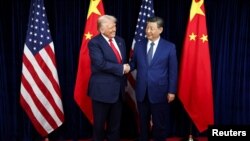
US President Donald Trump and Chinese leader Xi Jinping are set to open a closely watched summit in Beijing as Washington and Beijing seek a fragile economic truce while maneuvering over Iran, Taiwan, and control of critical supply chains.
Trump, who last visited China in 2017, will arrive on the evening of May 13 and engage in two days of talks and public appearances with Xi on May 14-15. The trip marks the two leaders' first face-to-face talks in more than six months as they try to stabilize ties strained by tariffs, mineral export controls, and other areas of disagreement.
While the highly anticipated meeting will cover a range of economic and geopolitical issues -- from US soybean exports to China's relationship with Russia -- the Iran war is also expected to feature on the summit's agenda, senior US officials told reporters during a May 10 briefing.
"The [US] president has spoken multiple times with General Secretary Xi Jinping about the topic of Iran," an official said, adding they expect Trump to "apply pressure" on Beijing, which relies on Iran for low-cost oil in their transactional relationship, to help broker an agreement to end the war that's now in its third month.
While the implications of the war in Iran, including the blockade of the Strait of Hormuz, will loom over the meeting, US officials and analysts say trade tensions are set to be the focus of talks when Trump and Xi sit down together in the Great Hall.
"President Xi wants to reduce US support for Taiwan, particularly by pressing for delays or limitations on US arms sales," Alicia Garcia-Herrero, chief economist for Asia-Pacific at Natixis, a French financial firm, told RFE/RL. "Beijing is also keen to secure some relief on US export controls for advanced technology and to protect its position in global supply chains."
In Search Of A Trade Truce?
The two sides are also expected to sign a flurry of deals ranging from purchases of agricultural products like soybeans to Boeing planes and also hold talks over establishing new forums to facilitate mutual trade and investment.
The Trump administration hit China hard with high tariffs in early 2024 as his second term began, but trade frictions have since been ratcheted down after the US Supreme Court restricted some of the levies and found others illegal in recent months. Xi and Trump also reached a deal in October 2025 during a meeting in South Korea that dialed down tensions by rolling back export controls, including shipments of some rare earth minerals to the United States.
Beijing will look to use its control over the supply of critical minerals and rare earths, a set of 17 elements that are vital for the manufacturing of everything from smartphones to fighter jets, to improve its negotiating position, analysts say.
"[The United States has] become aware of this problem that China holds these cards that it can play whenever it wants, because it dominates the production and processing of these rare earths and critical minerals that are so key to pretty much everything," Michael Clark, research associate for China policy at the Center for American Progress, a Washington think tank, told RFE/RL.
China accounts for more than 70 percent of global rare-earth mining, 90 percent of their separation and processing, and 93 percent of magnet manufacturing.
In October 2025, China unveiled a legal framework that would allow it to deny rare earth minerals and other dual-use components to any country, which added to export curbs unveiled months earlier on seven rare earths crucial to defense manufacturing.
The Trump-Xi meeting in South Korea that same month suspended some of those rare earth restrictions in exchange for Washington easing certain tariffs and China resuming soybean imports.
"Both sides know that they have one particular element that could seriously damage the other," Rana Mitter, ST Lee chair in US-Asia relations at the Harvard Kennedy School, told RFE/RL. "That's one of the reasons why they have a truce, which, at least for the moment, is operating until October [and] may be extended on the side of the United States."
The War In Iran Looms Large
While trade talks and the pomp and pageantry of the state visit will take center stage, the war in Iran is expected to cast a shadow over the summit.
A week before Trump was scheduled to land in Beijing, China flaunted its close ties and coordination with Tehran by hosting Iran's foreign minister.
The US Treasury also recently sanctioned five Chinese private oil refiners, including one of the country's largest, for processing Iranian crude. Beijing responded publicly with unprecedented defiance, ordering companies to ignore US sanctions, though its financial regulator privately advised large state-owned banks to suspend new loans to the blacklisted refiners.

The State Department also sanctioned four Chinese entities on May 8 for "providing satellite imagery that enables Iran's military strikes against US forces in the Middle East," a move that China's Foreign Ministry strongly rebuked.
China and the United States have economic and strategic interest in seeing the reopening of the Strait of Hormuz, through which a fifth of global oil and gas flows passed before the war, but analysts say the key question for Beijing is whether it's prepared to put pressure on Tehran and what it would want in return from Washington.
"China will not help Trump open the Strait of Hormuz unless Trump gives China something that is extremely valuable," Clark said. "In this case, they could include loosening restrictions on export controls of advanced US technology like AI chips, advanced chip making equipment, and jet turbine technology."
What Will Be Said About Taiwan?
One area where Beijing is expected to hunt for concessions is Taiwan.
China views Taiwan as its territory and has vowed to bring it under its control eventually, by force if necessary, and Beijing is concerned about US arms sales to the self-ruling island and may seek to push the Trump administration to express opposition to Taiwan independence.
Washington approved a record $11.1 billion arms sale package for Taiwan in December. It has been working on another package that could exceed $14 billion but reportedly delayed the notification to Congress to avoid disrupting the summit.

Trump told reporters on May 11 that US arms sales to Taiwan will be discussed when he meets with Xi.
Beijing's gray-zone harassment of Taiwan has escalated in recent years, with frequent simulations of a blockade accompanied by pervasive cyberattacks and mounting information warfare.
"[China] wants to make it clear in the summit that they regard American support for Taiwan as being a fundamental problem from their point of view," said Harvard's Mitter. "Trying to get a change in the American position on this issue will be a key aim that may be stated much more explicitly than anything about Iran."
Nuclear Weapons, AI, Russia, And More
The agenda also includes artificial intelligence (AI), nuclear weapons, and China's support for Russia during the war in Ukraine.
But it's unclear how substantive the dialogue will be on these issues during the summit.
Beijing has been reluctant to open up talks about nuclear weapons and may look to avoid substantive talks on the issue. Trump administration officials have said they also plan to raise Beijing's financial support for Russia and to open "a channel of communication" to avoid conflicts arising from the use of advanced AI models.
"The summit may deliver a short-term truce that stabilizes markets temporarily," said Garcia-Herrero. "But it is unlikely to resolve the deeper structural competition between the two powers in technology, supply chains, and security matters."