




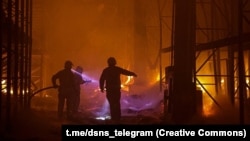
Ukrainian authorities battled to restore power to hundreds of thousands of people in the east of the country following Russian air strikes, while US President Donald Trump suggested in a TV interview that Kyiv may have to cede territory in any US-brokered peace deal.
"I think we're gonna have it [a peace deal] done, and I think it's gonna happen, and they're gonna end up with a little bit different shape Ukraine," Trump said without elaborating in an interview broadcast by CBS TV's "60 Minutes" news program on November 8.
Ukraine has insisted it will not permanently cede territory to Russia as part of a peace deal, although it has indicated a willingness to reach a cease-fire with the Kremlin while Moscow's troops are temporarily in occupied Ukrainian lands.
"Of course, Russia insists that we give up territory. We certainly do not want to give anything up. That is what we are fighting for," Ukrainian President Volodymyr Zelenskyy has said.
Meanwhile, on the ground in Ukraine, power has been restored to the Russian-occupied Zaporizhzhya nuclear facility. Energoatom, Ukraine's nuclear power company, said late on November 8 that the site "is again receiving external power supply from the Ukrainian power system."
However, it added that the situation at the plant remains “extremely dangerous” and that the risks of power outages and threats to nuclear and radiation safety persist "as long as the plant is under Russian occupation."
It was not immediately clear what caused the power outage at the site, although Ukraine reported Russian attacks on energy infrastructure in the nearby Zaporizhzhya region, which still is under Kyiv's control.
The Zaporizhzhya plant is Europe's largest nuclear power station, with six reactors. Russian forces seized it shortly after Moscow launched its full-scale invasion in February 2022, and Ukraine and Russia have traded accusations of shelling and other actions threatening the safety of the plant, which lies across the Dnieper River from Ukrainian-held territory.
The plant has often seen interruptions that have endangered critical plant infrastructure, like pumps that supply cooling water.
"This is the 16th case of complete loss of external power supply to the [plant] since the beginning of 2026," Energoatom said. "The systematic loss of external power is a consequence of the [Russian] occupation."
International Atomic Energy Agency (IAEA) chief Rafael Grossi has called on " military commanders responsible for these actions as well as all others aiming on nuclear power plants and/or their staff to put an immediate stop to these unacceptable actions which...constitute great risks to nuclear safety and security during the conflict."
Hundreds Of Thousands Of People Lose Power
Russian attacks on the power system in Ukraine's eastern Dnipropetrovsk region left emergency crews working early on November 9 to restore electricity to some 600,000 people as the Kremlin's campaign against energy targets continued.
Dnipropetrovsk military chief Oleksandr Hanzha said hospitals had been forced to switch to diesel generators and that electric-powered public transport had ground to a halt in Dnipro.
"Power company workers are already working to restore power. Their efforts are being hampered by constant Russian shelling," he wrote in a statement on social media.
Zelenskyy said there were "widespread power outages across the country. In the Zhytomyr region alone, 140 apartment buildings were left without heating following a Russian strike."
Poltava, Odesa Regions Hit
Russia's attacks continued late on November 8 and into the morning of November 9, Ukrainian authorities said.
At least four people were injured in Kremenchuk in the Poltava region during Russian drone attacks, said Vitali Dyakivnych, the regional military administrator.

He said a residential building and a hotel were hit in the attack and that 15 people had been rescued from damaged structures.
In the Ukrainian port city of Odesa, authorities said Russia used drones to strike electricity distribution centers and other infrastructure, causing additional power cuts.
"The Odesa region has suffered a massive hostile attack on the energy sector. Power outages are being recorded in the north of the region," military administrator Oleh Kiper wrote on Telegram.
"Despite constant air alerts, energy workers are doing everything possible to restore power to people as soon as possible."
Abu Dhabi Next
The latest attacks came a day after Zelenskyy accused Russia of seeking to apply maximum pressure ahead of US-Ukraine-Russia talks in Abu Dhabi in the coming days by plunging "the entire country into a blackout."
Trump, whose administration has been trying to settle the conflict since the start of his second term in January 2025, has said he believed a "big, beautiful agreement" could be close and suggested it might involve not only Ukraine but "all of Europe."

European officials have pushed back on the suggestion that it could be excluded from talks deciding the Continent's security future.
"The Europeans will be represented, and France will be in Abu Dhabi to participate in these talks," French Foreign Minister Jean-Noel Barrot told RTL television on November 8, referring to the gathering set for the UAE city on November 10-11.
Zelenskyy has also expressed doubts about the Trump proposals for a new European security order to end Russia's full-scale war on his country.
"It's not simple, and it can be dangerous, for us," Zelenskyy told CNN on November 6.
US Secretary of State Marco Rubio, who is set to travel to Abu Dhabi, said some progress has been made on establishment of the "security infrastructure" that Ukraine and Europe could see after the war with Russia ends.
"I think that's what the president's alluding to -- is that there's been some advances made in what that architecture could look like post-conflict," he said.'
He added that "nothing's been finalized yet, and maybe some progress can be made in Abu Dhabi."