




Ukrainian and Russian negotiators met with US officials for critical talks on Moscow's all-out war against Ukraine as the Kremlin signaled no softening of hard-line territorial demands following a late-night meeting between Russian President Vladimir Putin and a White House delegation.
The January 23 talks held in Abu Dhabi were the first time that Ukrainian and Russian officials have met face-to-face, along with American negotiators, since just after the start of the invasion nearly four year ago.
The meetings come as Ukraine reels in the dark and cold from Russia's pummeling of Ukraine's energy infrastructure -- power plants, substations, municipal heating plants -- that has left millions of people struggling to cope with conditions in the dead of winter.

Ukraine's largest private energy company warned the country's situation had "significantly" worsened after recent Russian attacks; a day earlier, Energy Minister Denys Shmyhal said the country's energy system had suffered its worst day since a widespread blackout in November 2022.
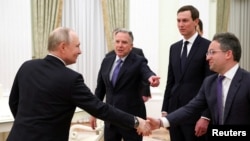
Ahead of the Abu Dhabi meetings, Kremlin aides said Putin was satisfied with nearly four hours of talks held overnight with White House envoy Steve Witkoff, Trump son-in-law Jared Kushner, and other US officials. It was Witkoff's seventh meeting with Putin since last January.
Kremlin spokesman Dmitry Peskov reiterated Russia's longstanding demand that Ukrainian forces leave the portion of the Donbas they still hold. The Donbas is wide swathe of territory in eastern Ukraine; Russia controls almost 90 percent of it.
"Russia's well-known position is that [Ukraine's armed forces] must leave the territory of the Donbas territory, they must be withdrawn from there," Peskov told journalists. "This is a very important precondition. There are also other nuances that remain on the negotiation agenda."
Ukrainian President Volodymyr Zelenskyy, who met with US President Donald Trump in Switzerland a day earlier, told reporters the talks would include the issue of territory in the Donbas.

Russia has been capturing additional land in the Donbas slowly and at a massive cost in casualties, but Putin and other officials have repeatedly said its forces will seize further territory by force if Moscow does not obtain it through diplomacy.
In his nightly video address on January 23, Zelenskyy said the first round of talks in Abu Dhabi had already taken place and had focused on the "parameters of ending the war."
"It is imperative that it is not only Ukraine which strives to end this war and to achieve true security, but that a similar desire also somehow materializes in Russia," Zelenskyy added.

Russian Demands
Ukraine has said that relinquishing the part of the Donbas that its forces hold, which includes a "fortress belt" of well-defended towns and cities, would reward Russia for its aggression and leave Ukraine vulnerable to new attacks.
According to Zelenskyy, Ukraine and the United States have discussed a potential compromise where part of the Donbas would become a demilitarized zone or a free economic zone, with Ukrainian forces withdrawing and Russian troops barred from entering.
Zelenskyy said he was open to such a plan if Ukrainians support it, but that if Ukraine withdraws its troops Russia should do the same, pulling its forces back a comparable distance.
The Kremlin has indicated it would not agree to withdraw its forces under any scenario that does not recognize the entirety of the Donbas as Russian. It has also insisted that Russian police and national guard units, which in some cases are heavily militarized, be allowed to patrol the area.
Zelenskyy, on the contrary, has suggested demilitarized areas could be policed by Ukraine, with international forces.
Russian officials indicated that the trilateral talks in Abu Dhabi would focus on security, while the United States and Russia would hold separate economic talks.
One of negotiators was expected to be head of the Russian military intelligence agency known as the GRU.
One of Kyiv's lead negotiators, meanwhile, is Kyrylo Budanov, a former director of Ukraine's military intelligence agency who is now Zelenskyy's chief of staff. The military agency's current director, Lieutenant General Oleh Ivashchenko, and a deputy were also part of the Ukrainian delegation.
Zelenskyy, who has had a sometimes frosty relationship with the White House, praised his Davos meeting with Trump, though it was unclear exactly what, if anything, was agreed.

US and Ukrainian officials have been trying to finalize a plan that would give US companies preferential access to Ukrainian minerals and some industries.
Another crucial issue and matter of dispute has been Western security guarantees for Ukraine in the event of a peace deal, with Russia opposing the deployment of troops from NATO nations in Ukraine.
Security guarantees for Ukraine "are really ready, and the contract is ready for signing.... Now I am waiting for President Trump to give me a date and place. It's up to him," Zelenskyy told reporters.
Trump has been seeking to broker an end to Russia's war on Ukraine since he took office for his second term a year ago.
"The meeting was good with President Zelenskyy. We'll see how it turns out," Trump told reporters on January 22, adding that his message to Putin was, "The war has to end."

