




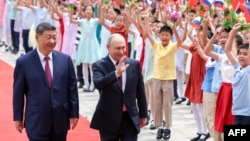
Russian President Vladimir Putin and Chinese leader Xi Jinping signed a series of agreements in Beijing aimed at deepening strategic and economic ties, as Moscow sought to turn the optics of the summit into tangible gains on energy cooperation amid turmoil in global oil and gas markets caused by the war in Iran.
But despite repeated pledges of friendship and strategic coordination, the May 20 state visit ended without any public breakthrough on the long-delayed Power of Siberia-2 gas pipeline, the multibillion-dollar project Moscow sees as critical to redirecting gas exports from Europe to China after Russia’s full-scale invasion of Ukraine. Negotiations have repeatedly stalled over pricing, construction costs, supply volumes, and concerns in Beijing about becoming too dependent on Russian energy.

Kremlin spokesman Dmitry Peskov told reporters that “the basic parameters of understanding” for the pipeline are in place, including its route and construction method. He did not offer further details and said there is no clear timeline for the megaproject as “some nuances remain to be ironed out.”
A joint statement issued after the meeting said only that Putin and Xi "have agreed to continue deepening comprehensive relations of partnership in the field of energy" and "deepen mutually beneficial collaboration in areas of oil and gas, and coal."
“Russia needs the revenue from trade much more than China needs Russian energy,” Henrik Wachtmeister, a researcher at the Swedish Institute of International Affairs’ China center, told RFE/RL.
The two leaders signed a joint statement on further strengthening “comprehensive partnership and strategic interaction” and another declaration promoting a “multipolar world order,” while also overseeing the signing of at least 20 additional agreements covering trade, technology, and broader cooperation.
The meeting came just four days after US President Donald Trump departed Beijing following his own summit with Xi, and the rhetoric from China and Russia adds to Xi’s efforts to position his country as a global diplomatic power.
“The timing of this visit really played out well for Beijing,” Temur Umarov, a fellow at the Carnegie Russia Eurasia Center in Berlin, told RFE/RL. “China looks like the center of the world where the most important geopolitical meetings are taking place.”
‘Strategic Strongholds’
The absence of concrete progress on the pipeline underscored the central imbalance hanging over the relationship.
“Russia has few alternative [energy] buyers and sells its oil at discounts due to sanctions,” Wachtmeister said. “China has multiple suppliers and is overall a much larger economy.”
Speaking during a signing ceremony at the Great Hall of the People, Xi said China and Russia must remain “strategic strongholds for each other” and pledged deeper coordination in areas including artificial intelligence and technological innovation.
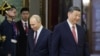
China and Russia should also act as “responsible great powers” and oppose “all unilateral bullying and actions that reverse history,” Xi said.
Putin, speaking after Xi, said Russia was prepared to continue uninterrupted oil and gas supplies to China and described bilateral trade as insulated from “external influence” and instability in global markets.
The summit projected an image of a deepening political alignment between Beijing and Moscow at a moment when both governments are increasingly at odds with the West.
But the relationship has become markedly less balanced since Russia launched its full-scale invasion of Ukraine in 2022.
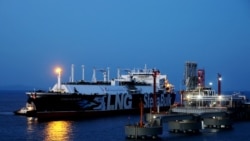
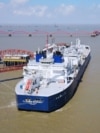

China is now Russia’s largest trading partner and purchases nearly half of Russian oil exports. Chinese firms have also become increasingly important suppliers of consumer goods, industrial equipment, and dual-use technologies that Western officials say help sustain Russia’s military-industrial base.
Beijing has denied providing lethal military assistance to Moscow and says it strictly controls exports of dual-use items.
Even so, analysts say Russia’s growing dependence on Chinese trade, technology, and financing has transformed what the Kremlin once described as a partnership of equals into a far more asymmetric relationship.
“There are growing dependencies on the Russian side and China is leaning more towards Russia for energy because of the war in Iran,” said Umarov. “But structurally, their relationship is durable and that doesn’t look to be changing.”
Iran War Revives Debate Over Russian Gas Supplies
The war in Iran and disruptions to shipping through the Strait of Hormuz have heightened concerns in Beijing about energy security and renewed volatility in global oil and gas markets.
Moscow has sought to use the crisis to argue that additional overland energy supplies from Russia would reduce China’s dependence on vulnerable maritime shipping routes.
Russia has pushed for years to finalize the proposed Power of Siberia-2 pipeline, which would transport 50 billion cubic meters of natural gas annually from western Siberia to China through Mongolia.
A memorandum signed in September 2025 between Gazprom and Chinese counterparts was portrayed by Russian officials as a major breakthrough, but it did not constitute a binding final agreement. Key details remain unresolved, and no announcement on the project’s emerged from the summit.
Russia is already China’s largest supplier of pipeline gas thanks to the Power of Siberia-1 pipeline, which began operations in 2019 under a 30-year, $400 billion agreement. The country is also China’s third-largest supplier of liquefied natural gas after Australia and Qatar.
The next major increase in Russian gas export capacity to China is expected to come through the Far East pipeline project, which is scheduled to begin operations in 2027 and gradually ramp up deliveries.
At the same time, China has expanded purchases of discounted Russian crude oil since Western sanctions were imposed on Moscow following the 2022 invasion of Ukraine. The conflict in Iran and disruptions around the Strait of Hormuz have also prompted additional Chinese purchases of Russian oil and liquefied natural gas.
Still, analysts say Beijing is unlikely to rush into a major new pipeline commitment.
China has spent years diversifying energy imports while increasing domestic oil and gas production and rapidly expanding renewable energy sectors such as solar power, wind power, and electric vehicles.
“In a way, Russia is the answer, but Russia is a very slow answer for China, and quite possibly too slow, especially if the war in Iran does get resolved in the next couple of months,” Michael Kimmage, director of the Kennan Institute, a Washington-based think tank, told RFE/RL.